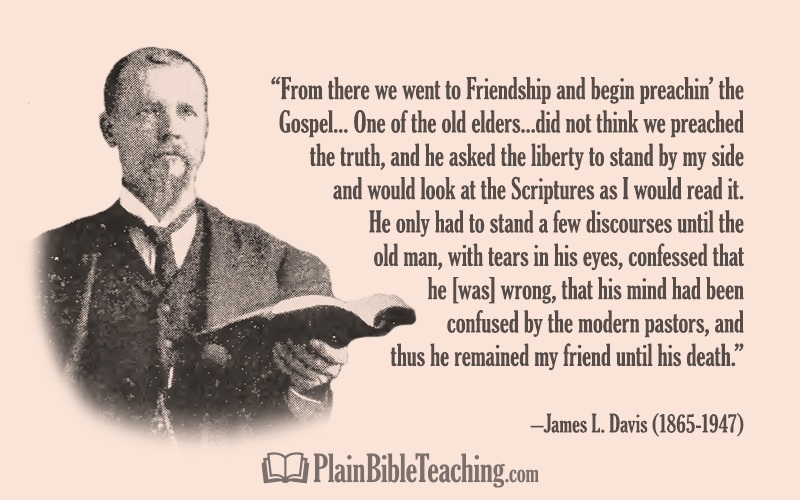
James L. Davis (1865-1947) spent several years laboring to preach the gospel in Kentucky around the turn of the twentieth century. He enjoyed great success in many places he preached despite fierce opposition to his teaching. In his short autobiography, Davis described an older man who had been warned about his preaching and wanted to make sure he caught him when he said something in error.
“From there we went to Bethel where we had been badly misrepresented, and begun to preach the Gospel with very few to hear, but we succeeded in establishin’ the truth there with fifty-one additions.
“From there we went to Friendship and begin preachin’ the Gospel where this same pastor as above had labored hard to keep us out. We went there and he fled—Proverbs, 28:1. We begin preachin’ with very few to hear us. One of the old elders was so poisoned agin us that he did not think we preached the truth, and he asked the liberty to stand by my side and would look at the Scriptures as I would read it. He only had to stand a few discourses until the old man, with tears in his eyes, confessed that he wa’ wrong, that his mind had been confused by the modern pastors, and thus he remained my friend till his death.” (The Mountain Preacher, p. 14)
Because Davis had been misrepresented, this older man did not believe he would be teaching the truth. However, what he did was commendable. Rather than refusing to listen to Davis’ preaching, he listened carefully to see where he was wrong. When he realized that Davis was preaching the truth and that others had wrongly accused him of false teaching, he accepted his message and became friends with him.
This was the same attitude of the Bereans who were commended to us in the book of Acts. When Paul arrived in their city, he began preaching in the synagogue (Acts 17:10). Notice what Luke recorded about the response of those who were listening to him:
“Now these were more noble-minded than those in Thessalonica, for they received the word with great eagerness, examining the Scriptures daily to see whether these things were so” (Acts 17:11).
The Bereans were eager to listen, which is certainly good. However, more than that, they wanted to make sure Paul was teaching them the truth. Their eagerness to listen did not mean they would blindly accept anything he said. Instead, they wanted to verify that his teaching was in harmony with the truth contained in the word of God.
When Paul wrote to the brethren in Thessalonica, he told them how they were to respond to those who taught them:
“But examine everything carefully; hold fast to that which is good; abstain from every form of evil” (1 Thessalonians 5:21-22).
They were to hold to the truth and reject anything contrary to that. The only way they could do this was by carefully examining what they were taught – not by their own opinions or traditions, but by what God had revealed.
With copies of the Bible readily available today (in print and digital format), it is unlikely that we will need to stand beside a preacher and look over his shoulder to make sure he is correctly quoting the Bible and representing it accurately. Yet we still need to show the same diligence as the Bereans who listened to Paul and the old man who listened to J. L. Davis.
The word of God is truth (Psalm 119:160; John 17:17). Anyone who teaches something that does not agree with the Scriptures is teaching “a different gospel” that will lead us astray (Galatians 1:6). Our spiritual well-being is too important to blindly trust anyone who claims to preach the truth. At the same time, our salvation is too important to close our ears to one who is preaching the truth because others told us not to listen.
So let us examine what we are taught. Then, when we understand the truth, let us hold onto it no matter who tried to poison our minds against it.