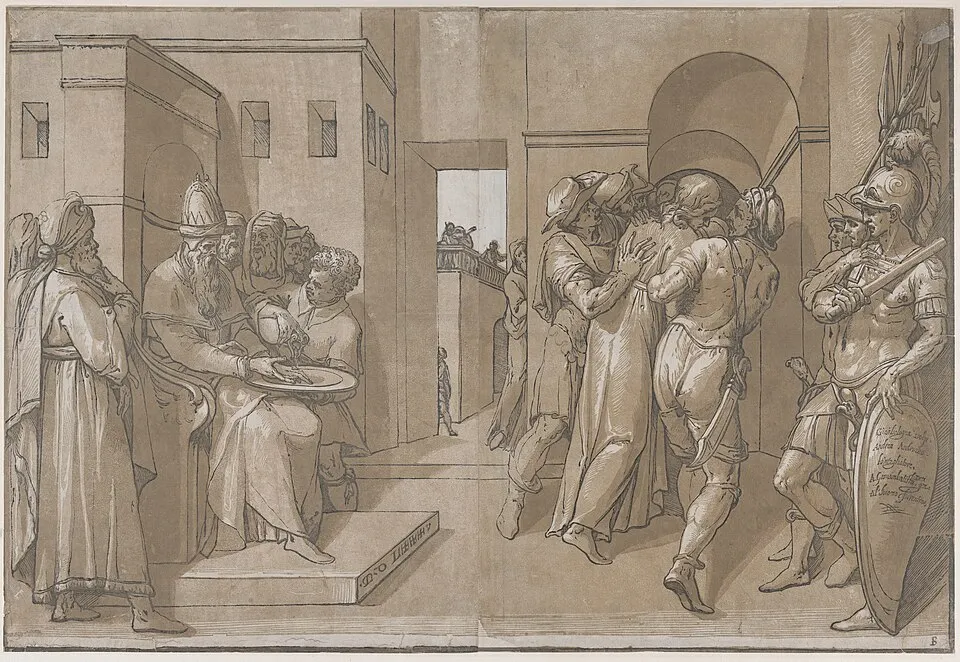
In a plot to have Jesus put to death, the chief priests and elders brought Him before the Roman governor Pilate. After examining Him, Pilate found “no guilt in Him” (John 18:38) and knew that it was “because of envy they had handed Him over” (Matthew 27:18). Once he found out that Jesus had claimed to be the Son of God (John 19:7), he “made efforts to release Him” (John 19:12), but the mob demanded His death, such that Pilate was afraid they would turn violent.
“When Pilate saw that he was accomplishing nothing, but rather a riot was starting he took water and washed his hands in front of the crowd, saying, ‘I am innocent of this Man’s blood; see to that yourselves’” (Matthew 27:24).
Pilate knew Jesus was innocent, but refused to stand up to the mob that demanded His death. He washed his hands to signify that he was absolving himself of responsibility. If they wanted to kill Jesus, he would not participate, but neither would he intervene to deliver Him from them.
However, somebody cannot pass off responsibility so easily. Pilate still had an obligation to properly dispense justice. Though written later, Paul’s words about the responsibility of civil authorities applied to Pilate as well:
“For rulers are not a cause of fear for good behavior, but for evil. Do you want to have no fear of authority? Do what is good and you will have praise from the same; for it is a minister of God to you for good. But if you do what is evil, be afraid; for it does not bear the sword for nothing; for it is a minister of God, an avenger who brings wrath on the one who practices evil” (Romans 13:3-4).
Of course, God knew that Pilate would make this choice and used it to carry out His “predetermined plan” (Acts 2:23) for Jesus to go to the cross. But Pilate was wrong. He had a responsibility to protect the one who was being delivered to death, and he refused to step in (or step up) and help.
Today, Christians may see the state of the world and be tempted to throw up their hands and say there is nothing we can do. The world is headed for destruction, for years our society has been speeding down the path of godless secularism, and our neighbors are blissfully ignorant of the fact that they are on the broad way that leads to destruction.
We cannot wash our hands like Pilate and refuse to do something when the world is moving in the direction it is. So what should we do? Notice the words of the wise man:
“Deliver those who are being taken away to death, and those who are staggering to slaughter, Oh hold them back” (Proverbs 24:11).
Whether we are talking about individuals we know personally or society in general, how do we hold them back from destruction?
- Recognize that evil exists – The apostle John wrote that “the whole world lies in the power of the evil one” (1 John 5:19). Satan has deceived the world, and wickedness abounds. However, more than just recognizing the reality of evil, we need to identify it if we hope to turn anyone away from it. Whether that evil manifests itself in the form of alcoholism, gambling, pornography, homosexuality, transgenderism, or Islam, we need to specifically identify it in order to help those who are tempted to follow after those sins. Remember that David could identify the sin of the man in Nathan’s parable, but was completely blind to his own sin until the prophet pointedly said, “You are the man!” (2 Samuel 12:7).
- Point the way to life – Sin leads to death, but Christ offers eternal life (Romans 6:23). Paul described how “the god of this world has blinded the minds of the unbelieving so that they might not see the light of the gospel of the glory of Christ, who is the image of God” (2 Corinthians 4:4). Once people recognize their sin [previous point], the only way to get them out of sin is to point them to Christ. So Paul said in the next statement, “For we do not preach ourselves but Christ Jesus as Lord” (2 Corinthians 4:5). Jesus is “the way, and the truth, and the life; no one comes to the Father but through [Him]” (John 14:6).
- Warn about destruction – Jesus offered the way to eternal life, but He also warned of the alternative: “Enter through the narrow gate; for the gate is wide and the way is broad that leads to destruction, and there are many who enter through it. For the gate is small and the way is narrow that leads to life, and there are few who find it” (Matthew 7:13-14). We need to point the way to life [previous point] while also warning of “eternal punishment” (Matthew 25:46). Paul described the judgment of the wicked in which the Lord would “[deal] out retribution to those who do not know God and to those who do not obey the gospel of our Lord Jesus. These will pay the penalty of eternal destruction, away from the presence of the Lord and from the glory of His power” (2 Thessalonians 1:8-9). God has provided the way to avoid this fate, but many will not appreciate the seriousness of our choice to follow the Lord unless they understand the terrible consequences of rejecting God’s offer of salvation.
- Stand between the innocent and destruction – On one hand, we could apply this to the importance of turning someone from their sin. James wrote about this at the end of his letter: “My brethren, if any among you strays from the truth and one turns him back, let him know that he who turns a sinner from the error of his way will save his soul from death and will cover a multitude of sins” (James 5:19-20). On the other hand, standing between the innocent and destruction is not limited to turning someone from sin. It can also include standing up for someone being bullied, protecting a child from groomers and transgender cultists, defending an innocent victim from a violent attack, and more.
- Fight back against wickedness – In his second letter to the Corinthians, Paul described our part in the spiritual battle that is raging around us: “For though we walk in the flesh, we do not war according to the flesh, for the weapons of our warfare are not of the flesh, but divinely powerful for the destruction of fortresses. We are destroying speculations and every lofty thing raised up against the knowledge of God, and we are taking every thought captive to the obedience of Christ” (2 Corinthians 10:3-5). The New Testament repeatedly uses military language to describe our struggle against evil (1 Timothy 6:12; Jude 3; et al.). We cannot passively hope for the best as the forces of evil destroy lives, homes, churches, and society as a whole. We must defend ourselves by putting on the whole armor of God (Ephesians 6:13-17) and defend others against the evil that threatens them (physically and spiritually). However, there are also times to be on the offensive – “taking every thought captive to the obedience of Christ” (2 Corinthians 10:5) – gaining ground against Satan and his forces.
When Pilate thought that the mob was too much for him to stand against, he tried to wash his hands and absolve himself of responsibility. But that did not clear him of his obligation to do what was right. In the same way, we cannot passively sit back and hope for the best while expecting the worst. No matter how strong the forces of evil might seem, we must take up “the sword of the Spirit, which is the word of God” (Ephesians 6:17) and “fight the good fight of faith” (1 Timothy 6:12), not only to protect ourselves but also to help save those around us.
———
This article first appeared on Plain Bible Teaching for Today on Substack.