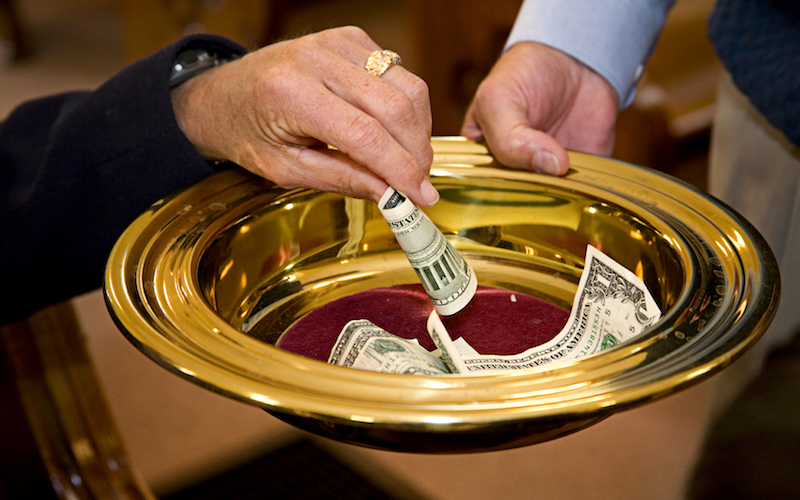
Finally, after discussing the instructions given about the act of giving, the attitude we are to have in giving, and factors that should motivate us to give, we will look at some examples to make some final points and to reinforce the points we have already made.
The Jerusalem church (Acts 4:32-35)
As we discussed earlier, this example shows us one of the things for which the church may use its treasury – the support of needy saints. The first thing we notice in this passage is that those who made up this congregation were united – they were “of one heart and soul” (Acts 4:32). A natural consequence of their unity was their willingness to share with those among them who were in need. This attitude existed to the extent that “not one of them claimed that anything belonging to him was his own, but all things were common property to them” (Acts 4:32).
Does this mean that the Christians in Jerusalem formed a sort of commune and that Christianity is the root of communism? No. Those who owned property had the right to keep and control that property (Acts 5:4). But these Christians were willing to share whatever they had with their brethren who were in need. This was necessary because of the extraordinary circumstances that existed in the first part of Acts after the church was established. Jews had come from all over to Jerusalem for the day of Pentecost (Acts 2:5, 9-11). The church grew in number from 3,000 at its establishment (Acts 2:41) to 5,000 (just counting the men) in a short period of time (Acts 4:4).
At this point there were thousands of new Christians staying in Jerusalem. Those who had come from other regions came for the day of Pentecost. Most likely, the majority of them had no plans to stay much longer than that. Yet they were still there. They would need food and other necessities while in Jerusalem but, being far from home, would have no income. Because of this, many were in need. This was a once in a lifetime occurrence. This unprecedented need was met with unprecedented giving.
Today, we should remember that there will be times when the need for funds in the work of the church will be greater than at other times. The lesson from the Jerusalem brethren is not that we should sell our house so we can pay the preacher more money. The routine work of the church should be funded by our normal weekly contribution. But when an exceptional circumstance arises, such as a natural disaster that brings hardship to a number of brethren, we should try to do what we can to go above and beyond what we normally give to help in these times, just as the church in Jerusalem did.
Ananias & Sapphira (Acts 5:1-11)
While the church in Jerusalem was doing an exceptional work, not all among them were completely sincere. Ananias and Sapphira, a husband and wife, basically did what the others were doing. They sold a piece of property and brought money from the sale to the apostles (Acts 5:1-2). What was different about what they did compared with what the others did in the previous chapter was that they “kept back some of the price” (Acts 5:2).
While it is not directly stated, we know the couple gave part of the proceeds of the sale, while portraying it as being the whole amount. We know this because Peter condemned them for lying to the Holy Spirit (Acts 5:3). We also see that their property, before and after the sale, was in their control (Acts 5:4). They could choose to give some or all of it. There was no sin in keeping some of the profit from the sale. The sin was their deception as they tried to make it look like they gave the entire amount they had received.
In reality, the only reason for them to do this would be for the appearance it gave to others. As we conclude from Peter’s statement, the money was in their control; therefore, they could keep back as much as they wanted. But they tried to make themselves appear to be as generous and caring as the other Christians like Barnabas (Acts 4:36-37).
We need to remember that what we give is personal. It is our decision and does not concern anyone else. Jesus spoke of the hypocrites who would give publicly “so that they may be honored by men” (Matthew 6:2). He then added, “Truly I say to you, they have their reward in full.” They wanted the praise of men. They got it, but that was all the reward they would receive. In contrast, our giving should be done in such a way that we could nearly say our left hand does not know what our right hand is doing (Matthew 6:3). When we give “in secret,” that is, give without seeking the praise of men, our “Father who sees what is done in secret will reward” us (Matthew 6:4). Our giving reflects a personal decision we have made. We ought not desire to make it public.
The Antioch church (Acts 11:27-30)
Antioch represents a couple of “firsts” in the New Testament. It was the first place the disciples were called Christians (Acts 11:26). It was also the first place we see a congregation made up of both Jews and Gentiles (Acts 11:19-21). At this time, prophets from Jerusalem came to Antioch (Acts 11:27). One of these prophets was a man named Agabus. He prophesied of a coming famine (Acts 11:28) that would produce a need among members of the church. So the Christians in Antioch “determined to send a contribution for the relief of the brethren living in Judea” (Acts 11:29). This was done by “each of them…in the proportion that any of the disciples had means.”
This example is interesting in light of the history between the Jews and Gentiles. Typically, Jews had no dealings with Gentiles. This is alluded to in Acts 11 after Peter returned to Jerusalem from Caesarea. He had gone there and preached the gospel to Cornelius (a Gentile) and his household (Acts 10:22, 34-48). They obeyed the gospel and asked Peter to stay a few days (Acts 10:48). When he came back to Jerusalem, the Jews confronted him: “You went to uncircumcised men and ate with them” (Acts 11:2-3). Peter then explained to them all that had happened and how God demonstrated that salvation was open to the Gentiles (Acts 11:4-17). These were Christians Peter was talking to, but even they had to be convinced to accept the Gentiles. It was not common for the Jews of this time to do this.
So we find in Antioch a church made up of both Jews and Gentiles (Acts 11:20-21). These Gentiles, despite the tension that generally existed between the two groups, sent relief to Jewish Christians in Judea. Not only were these Gentiles sending aid to Jews, but they were sending aid to Jews they did not even know. Often a need will arise in another location. How willing are we to help the affected brethren? With proper, verifiable reports of the condition of the brethren and of their needs, we should be willing to give like the Christians in Antioch did.
The Macedonians (2 Corinthians 8:1-5)
We have already discussed this example in some detail, so let us just summarize what we noticed earlier. Paul used the example of the Macedonians to motivate the Corinthians to give. They provided a good example of giving because they “overflowed in the wealth of their liberality” in spite of their “deep poverty” (2 Corinthians 8:2). They gave “beyond their ability” (2 Corinthians 8:3) and were eager to help, even “begging…for the favor of participation in the support of the saints” (2 Corinthians 8:4). The reason why they gave as they did was because “they first gave themselves to the Lord” (2 Corinthians 8:5). We need to first give ourselves to the Lord and give of our means accordingly.
The Poor Widow (Mark 12:41-44)
While in Jerusalem before His crucifixion, Jesus took time to observe people as they put money into the treasury (Mark 12:41). The treasury here was not the church treasury, but the treasury for the Jewish temple. The church had not yet been established. Even still, this example provides principles from which we can learn to improve our giving.
As Jesus watched the people giving into the treasury, the text says: “Many rich people were putting in large sums” (Mark 12:41). This would seem to us to be commendable. Here we have the rich putting great amounts of money into the treasury instead of keeping it all for themselves. Actually, it was commendable that these people were doing this. These would also be the ones we would likely notice for their generous giving. But the one Jesus noticed especially was “a poor widow [who] came and put in two small copper coins, which amount to a cent.” He then called His disciples and said to them, “Truly I say to you, this poor widow put in more than all the contributors of the treasury” (Mark 12:42-43).
Why did Jesus notice this woman? Why did He point her out to His disciples? And how could He say she gave more than the others who were contributing “large sums“? He went on to explain: “For they all put in out of their surplus, but she, out of her poverty, put in all she owned, all she had to live on” (Mark 12:44). The more money we have, the more we have to give. It is also true then that we have a greater responsibility to give. We are to give according to our ability (2 Corinthians 8:12). These rich people had plenty to live on. They gave some of their abundance back to the Lord.
But we look at this widow and see one who did not have extra money. She was not even able to provide for herself. And yet she gave what she could. It seems that a lot of Christians have the mindset that we only ever give out of our surplus, as the rich did. They see to it that all their needs and wants are met, then designate money for the Lord. But what happens if/when we do not have a surplus? Do we quit giving? I think some might do this. Often people will think they have nothing to give when they really could give something. It may take us giving up a luxury or cutting back on something, but we can find a way to give on the first day of the week. Rare is the exception to this. Even the poor widow could give something. How many of us have the faith in God, if we were in her situation, to give our last little bit of money back to the Lord? When we are blessed like the rich, it is good to give of our surplus. But when we are poor like the widow, we still have an obligation to give what we can.
Now Concerning the Collection | 1 | 2 | 3 | 4 | 5 | 6 | 7 | 8 | 9 | 10










