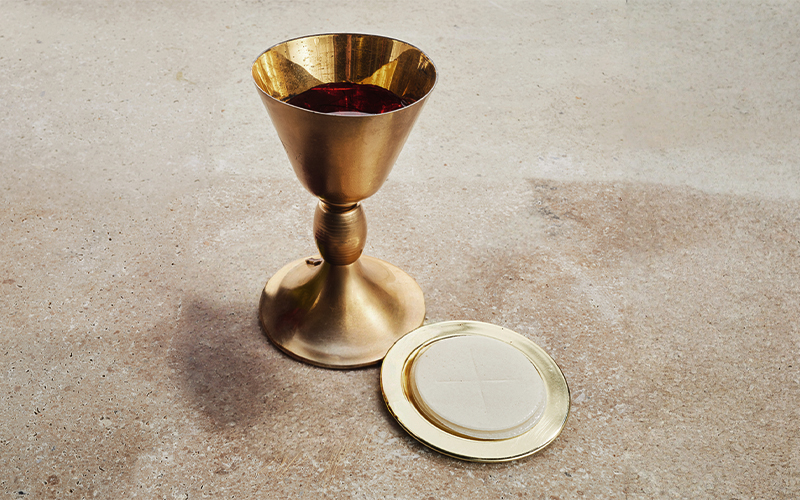
 When Jesus gathered with His disciples shortly before His death, He instituted the Lord’s Supper. This would be a memorial to remember His death, and would be observed by His people in the church until His return at the end of time. Because of this, we continue to observe the Lord’s Supper “on the first day of the week” (Acts 20:7), and by doing so, we “proclaim the Lord’s death until He comes” (1 Corinthians 11:26).
The Lord’s Supper is a simple memorial that reminds us of the body and blood of Jesus, which was offered on the cross for our sins. Jesus explained its purpose and significance to His disciples when He instituted it:
“While they were eating, Jesus took some bread, and after a blessing, He broke it and gave it to the disciples, and said, ‘Take, eat; this is My body.’ And when He had taken a cup and given thanks, He gave it to them, saying, ‘Drink from it, all of you; for this is My blood of the covenant, which is poured out for many for forgiveness of sins. But I say to you, I will not drink of this fruit of the vine from now on until that day when I drink it new with you in My Father’s kingdom’” (Matthew 26:26-29).
When Paul wrote to the church in Corinth, he reminded them of these same instructions:
“For I received from the Lord that which I also delivered to you, that the Lord Jesus in the night in which He was betrayed took bread; and when He had given thanks, He broke it and said, ‘This is My body, which is for you; do this in remembrance of Me.’ In the same way He took the cup also after supper, saying, ‘This cup is the new covenant in My blood; do this, as often as you drink it, in remembrance of Me. For as often as you eat this bread and drink the cup, you proclaim the Lord’s death until He comes’” (1 Corinthians 11:23-26).
These instructions are fairly straightforward. However, that does not eliminate the possibility of controversy regarding the observance of the Lord’s Supper. One point of controversy that has arisen among brethren over the years has to do with whether or not the Lord’s instructions require us to partake of one singular loaf and drink from the same singular cup. We will consider this question here.
The Argument for a Single Loaf and Cup
Those who argue that Christians must share a single loaf while partaking of the Lord’s Supper and drink from the same literal container claim that this is what Jesus demanded in His instructions. They assert that when Jesus “took some bread” and “broke it and gave it to the disciples” (Matthew 26:26), it must have been a single loaf. Yet this is not stated in the text. And regarding the cup, even if Jesus used a single container (Matthew 26:27), that in itself does not require us to drink from the same container while partaking of the Lord’s Supper. We will notice why later.
Brethren who argue for a single loaf and container will also appeal to Paul’s instructions about the Lord’s Supper and how it signifies the unity of Christians and the fellowship we have with one another. On this point, Paul’s statement is often cited:
“Is not the cup of blessing which we bless a sharing in the blood of Christ? Is not the bread which we break a sharing in the body of Christ? Since there is one bread, we who are many are one body; for we all partake of the one bread” (1 Corinthians 10:16-17).
Because we are united in “one body,” we partake of “one bread.” I know of no one who disagrees with that statement. However, those who insist that we must partake of a single loaf must argue that the “one bread” has to be a single loaf of bread. This reasoning is faulty, and we will notice how in a moment.
A Divine Requirement or a Matter of Expediency?
There is nothing wrong with using one literal loaf and one literal cup when partaking of the Lord’s Supper. However, the question we must ask is whether this is a matter of expediency or a divine requirement (as some brethren insist).
- If it is a matter of expediency, the course of action we take must be agreed upon within the local church and in harmony with what has been authorized in the New Testament. As a matter of expediency, we are not at liberty to bind our decision upon others.
- If it is a divine requirement, we have no choice but to practice it that way if we want to remain faithful to God.
So which is it? Some brethren insist that using one literal loaf and one literal cup is required by the Lord. If this is the case, we should be able to examine the Scriptures and find such a requirement. Let us consider what we find in the passages that discuss this.
The Practice of the Lord’s Supper
Remember what we noticed about the institution of the Lord’s Supper:
“While they were eating, Jesus took some bread, and after a blessing, He broke it and gave it to the disciples, and said, ‘Take, eat; this is My body.’ And when He had taken a cup and given thanks, He gave it to them, saying, ‘Drink from it, all of you; for this is My blood of the covenant, which is poured out for many for forgiveness of sins. But I say to you, I will not drink of this fruit of the vine from now on until that day when I drink it new with you in My Father’s kingdom’” (Matthew 26:26-29).
Today, we partake of the Lord’s Supper by following the pattern given by the Lord when He instituted this memorial (cf. 1 Corinthians 11:23-26). However, while using a single loaf and a single container is an authorized way to partake of the Lord’s Supper, this was never made a requirement. Consider each of the emblems:
- There is no way to prove that Jesus used just one loaf when He instituted the Lord’s Supper. Those who claim that He did will argue that He took “bread” (the Greek word artos), not “breads.” However, the singular form of the word can include the plural. Notice another passage that uses the same Greek word: “And the tempter came and said to Him, ‘If You are the Son of God, command that these stones become bread’” (Matthew 4:3). In this instance, the devil tempted Jesus to turn stones (plural) into bread. Does this mean turning multiple stones into a single loaf of bread? Surely, that was not the intention. However, if the devil’s temptation was successful and he convinced Jesus to turn multiple stones into multiple loaves, it would still be accurate to say that the stones were turned into bread. In the same way, we might use more than one loaf when observing the Lord’s Supper, yet we are still partaking of “one bread.”
- There is no way to prove that the cup was just a single container when Jesus instituted the Lord’s Supper. On the surface, it may appear that this was the case. However, notice what Luke recorded about how they prepared to observe the Lord’s Supper: “And when He had taken a cup and given thanks, He said, ‘Take this and share it among yourselves; for I say to you, I will not drink of the fruit of the vine from now on until the kingdom of God comes’” (Luke 22:17-18). When Jesus said to “share [the cup] among yourselves,” He was telling them to distribute it among themselves. The Greek word for share (diamerizo) means to be divided into parts. It does not suggest the idea of passing around a single container and all drinking from it. Instead, it describes a practice in which something is poured into smaller containers and distributed to those who are partaking. Also, notice that this was done before the institution of the Lord’s Supper (Luke 22:19-20). In other words, when they observed this memorial, the fruit of the vine had already been distributed to each one so that all could partake of it.
In order to practice the Lord’s Supper in the way that Jesus instituted it, we must partake of the bread and the cup. We can do this with a single loaf and a single cup, but those who insist that this must be done are adding to the text and making a requirement that the Lord never made.
A Symbol of Unity
Proponents of using a single loaf and a single container for the Lord’s Supper often argue that doing so is necessary because it signifies unity among God’s people. They may cite the following statement by Paul to the church in Corinth:
“Is not the cup of blessing which we bless a sharing in the blood of Christ? Is not the bread which we break a sharing in the body of Christ? Since there is one bread, we who are many are one body; for we all partake of the one bread” (1 Corinthians 10:16-17).
Two chapters later, Paul further emphasized the fact that Christians are “many members” who make up the “one body” in Christ (1 Corinthians 12:12ff). The importance of unity is stressed throughout the pages of the New Testament. However, does that require us to use a single loaf and container when we partake of the Lord’s Supper?
Those who argue in favor of this will say that since the many make up the one body, and since the church is the one body, and we partake of one bread, then we should use one single loaf, just as Jesus has just one church. On the surface, this may seem compelling, yet those who argue this are making too much of Paul’s statement regarding the “one bread” and are missing an important point.
Paul said that “we” are part of “one body” and “partake of the one bread.” He could not have been referring to a single, literal loaf used by a local congregation as they partook of the Lord’s Supper. How do we know? By using the term “we,” he included himself with the brethren in Corinth. Did he partake of a single, literal loaf with them? No. He already stated that he was “absent” from them (1 Corinthians 5:3). Despite not being physically present, he still partook of the “one bread” just as they did. Therefore, the “one bread” is simply bread used in the Lord’s Supper to represent the body of Christ; it does not refer to a single, literal loaf of bread. Even IF the church in Corinth used just one loaf in partaking of the Lord’s Supper (though it cannot be proven that they did), and even IF Paul, while he was in Ephesus when he wrote this letter (1 Corinthians 16:8), partook of a single, literal loaf of bread while with the church in that city (which also cannot be proven), there would then be two loaves between these two churches. Yet Paul still referred to this as “one bread.” Therefore, the number of loaves used to partake of the Lord’s Supper is immaterial. The important thing is that they are partaking in a worthy manner, remembering the death of Christ on the cross (1 Corinthians 11:26-27).
Unintentionally Undermining Unity
As we noticed in the last point, those who advocate for a single loaf and one container for the Lord’s Supper often appeal to unity as one of the primary reasons for promoting this position. However, by insisting that “one bread” must mean one literal loaf, and that “one cup” must mean one literal container, they are stirring up division in the body of Christ.
However, there is another way in which they unintentionally undermine our unity in Christ. Not only are they limiting their fellowship to those who agree with their contention that we must partake of a single, literal loaf and container as we observe the Lord’s Supper, but they have also placed another limit on the number of people with whom they can be in fellowship. If we must share one literal container when partaking of the Lord’s Supper, then the local church must necessarily be limited to the size of the container that the members can reasonably pass around while still holding enough fruit of the vine for every member in attendance. This may not be difficult for small congregations, but it quickly becomes impractical (and sometimes impossible) as the local church gets larger.
When the church was established on the day of Pentecost, “three thousand souls” obeyed the gospel and were added by God to the church (Acts 2:41, 47). These brethren continued worshipping together, which included “the breaking of bread” (Acts 2:42), a phrase which synecdochically referred to the Lord’s Supper. If these brethren had to use a single, literal container when they partook of the Lord’s Supper, they would not have been able to do so together. A container large enough to hold the amount of juice for three thousand people – and which quickly grew to thousands more (Acts 4:4) – would be impossible to pass around. Those who insist on a single container for the Lord’s Supper must be prepared to send brethren away and refuse to welcome them into fellowship lest they reach a point at which they can no longer share a single loaf and cup as they insist must be done.
Conclusion
The Lord’s Supper was given as a memorial to help Christians remember the death of Christ each first day of the week. Because Jesus has “all authority” (Matthew 28:18), we must observe the Lord’s Supper in the way that He instructed.
At the same time, we need to be careful not to make rules which the Lord did not make. He is the one with “all authority,” not us. Therefore, we must not disrupt the unity of the church by insisting upon something that cannot be proven in the Scriptures.
As we observe the Lord’s Supper, we must partake of the “one bread” which represents the body of Christ and the “one cup” which represents the blood He shed on the cross for our sins. However, the New Testament does not mandate the use of one literal loaf and one physical container. Each congregation must decide what is most expedient in their case, while still doing what the Lord commanded. Each member of a congregation must strive for unity as they work and worship together, not cause division by insisting that everyone conform to his unprovable assertion about the Lord’s Supper (or anything else).










