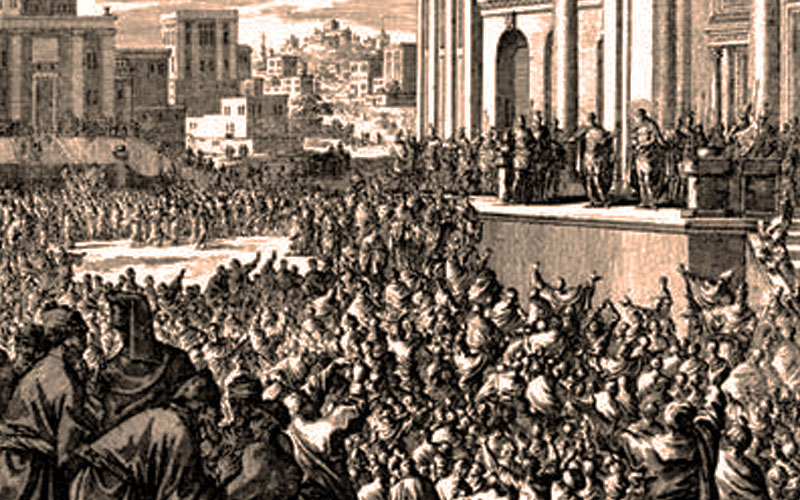
Pilate knew that the trial of Jesus was unique. Jesus explained to him that His kingdom was “not of this world” (John 18:36). Pilate then recognized that Jesus claimed to be a king (John 18:37), even though the Jews rejected Him as their king (John 18:33, 35). But the Jews’ rejection of Jesus was more than just a refusal to support Him as a king; they wanted to kill Him (John 18:31) even though Pilate was able to find “no guilt in Him” (John 18:38; 19:4, 6).
Then Pilate became “even more afraid” when the Jews told him that Jesus “made Himself out to be the Son of God” (John 19:7-8). How much of this Pilate believed is immaterial. The fact is that the events transpiring with the claims and charges being made were producing a volatile situation. So Pilate “made efforts to release Him” (John 19:12), but the Jews would not let him do it. Pilate then made one final effort to defuse the situation and allow the innocent Jesus to be released.
“Now it was the day of preparation for the Passover; it was about the sixth house. And he said to the Jews, ‘Behold, your King!’ So they cried out, ‘Away with Him, away with Him, crucify Him!’ Pilate said to them, ‘Shall I crucify your King?’ The chief priests answered, ‘We have no king but Caesar.’ So he then handed Him over to them to be crucified” (John 19:14-16).
This case was not about some random insurrectionist. There was much more to this than Pilate could have imagined at the start. But in the end, the Jews – influenced by their leaders (Matthew 27:20) – very clearly and boldly repudiated Jesus and demanded His crucifixion. Why was this so significant? It has to do with what they rejected, and what they chose to focus on instead.
What Did They Reject?
First and foremost, the Jews rejected Jesus. This point may seem too obvious to be worth mentioning, but it is important. They rejected Jesus even though Pilate found Him to be innocent (John 18:38; 19:4, 6). Peter wrote that Jesus “committed no sin, nor was any deceit found in His mouth” (1 Peter 2:22). They accused Him of blasphemy because “He made Himself out to be the Son of God” (John 19:7). This was in spite of the fact that Jesus performed undeniable miracles. A blind man who was healed by Jesus even pointed out this fact: “We know that God does not hear sinners; but if anyone is God-fearing and does His will, He hears him” (John 9:31). He then correctly said, “If this man were not of God, He could do nothing” (John 9:33). Jesus was unquestionably the sinless Son of God. Yet the Jews rejected Him and called for His crucifixion.
In addition to rejecting the Son, the Jews also rejected God the Father. If Jesus were a blasphemer and a wicked man, they could have rejected Him and called on Pilate to punish Him. But they did not just do this. They went a step further. They said, “We have no king but Caesar” (John 19:15). Their forefathers were guilty of rejecting God when they called for a human king to rule over them (1 Samuel 8:6-7). “God was [their] king” (1 Samuel 12:12), but they wanted to be “like all the nations” (1 Samuel 8:20) instead of being God’s chosen people (Deuteronomy 7:6). However, by this time, the Jews were to recognize the authority of the Roman rulers. Jesus said, “Render to Caesar the things that are Caesar’s”; but they were to also render “to God the things that are God’s” (Matthew 22:21). Allegiance to human rulers was fine to a point (Acts 5:29). But Jesus said, “Seek first His kingdom and His righteousness” (Matthew 6:33). By saying they had no king but Caesar, they were rejecting God who was over the civil authorities (John 19:11).
Finally, the Jews rejected the word of God. They claimed to be “disciples of Moses” (John 9:28). Yet Jesus said, “If you believed Moses, you would believe Me, for he wrote about Me” (John 5:46). Paul would later describe the Law of Moses as a “tutor to lead us to Christ” (Galatians 3:24). Yet they rejected this testimony, choosing rather to hold onto their own false beliefs.
On What Did They Choose to Focus?
Part of the reason why the Jews rejected Jesus, the Father, and the word of God was because they focused on a couple of things which they should not have been. First of all, they were focused on selfish interests. When Jesus raised Lazarus from the dead, the chief priests recognized that Jesus was “performing many signs” (John 11:47). These signs were so convincing that they believed if He continued, then “all men [would] believe in Him” (John 11:48). Their concern was rooted in selfishness. The reason why they did not want people turning to Jesus was because they feared it would cause the Romans to “come and take away both [their] place and [their] nation” (John 11:48). They were not concerned with truth. They were concerned with what would be advantageous for them.
Second, they placed their focus on this world. They rejected Jesus’ spiritual kingdom (John 18:36) for Caesar’s physical kingdom. They were not interested in storing up “treasures in heaven,” they were worried about their “treasures on earth” (Matthew 6:19-21). Jesus preached a message of self-denial (Luke 9:23), but these men placed the comforts of life above divine truth in their list of priorities.
Conclusion
Let us not make the same mistake as the Jews who rejected Jesus. We must recognize Jesus as our King. Because He is our King and possesses “all authority” (Matthew 28:18), we must obey Him (Matthew 28:19-20; Hebrews 5:9; Colossians 3:17).
Do not reject Jesus as King. Do not allow the things of life to distract you from Him. Instead, serve Him faithfully from this point forward.