Three Indictments

Gavel

For if we go on sinning willfully after receiving the knowledge of the truth, there no longer remains a sacrifice for sins, but a terrifying expectation of judgment and the fury of a fire which will consume the adversaries. Anyone who has set aside the Law of Moses dies without mercy on the testimony of two or three witnesses. How much severer punishment do you think he will deserve who has trampled under foot the Son of God, and has regarded as unclean the blood of the covenant by which he was sanctified, and has insulted the Spirit of grace?” (Hebrews 10:26-29).

In this passage, the Hebrew writer addressed the problem of those who would “go on sinning willfully” (Hebrews 10:26). These individuals previously had their “hearts sprinkled clean” and their “bodies washed with pure water” (Hebrews 10:22). In other words, they were Christians – forgiven of their sins after obeying the gospel. However, in the verses above, the Hebrew writer made three indictments against the ones who were “sinning willfully.”

What do we mean by using the term indictment? An indictment is a formal charge or accusation of a serious crime. In the passage above, the Hebrew writer was not just indicting these brethren of sin. It was more than that. There were three things they were doing because they continued in sin.

The warning in this passage is helpful for us to consider. Understanding this passage will help us recognize the severity of sin and how we should behave instead.Continue Reading

Christ Is Better Than the World

Jesus Saves

Therefore as you have received Christ Jesus the Lord, so walk in Him, having been firmly rooted and now being built up in Him and established in your faith, just as you were instructed, and overflowing with gratitude. See to it that no one takes you captive through philosophy and empty deception, according to the tradition of men, according to the elementary principles of the world, rather than according to Christ” (Colossians 2:6-8).

In the verses above, Paul encouraged the brethren in Colossae to remain faithful to Christ, while also warning them of the danger of being taken captive. In essence, there were two paths before them – the way of Christ and the way of the world.

It is just as true today as it was then that the world uses various tactics to make its way seem appealing (philosophy, deception, traditions of men, and the elementary principles of the world). In the verses that follow, Paul explained why Christ is better than the world, so that they would remain faithful to Him.

Let us consider the five reasons Paul gave to explain why Christ is better than the world.Continue Reading

“Jesus Wept”

Jesus Wept

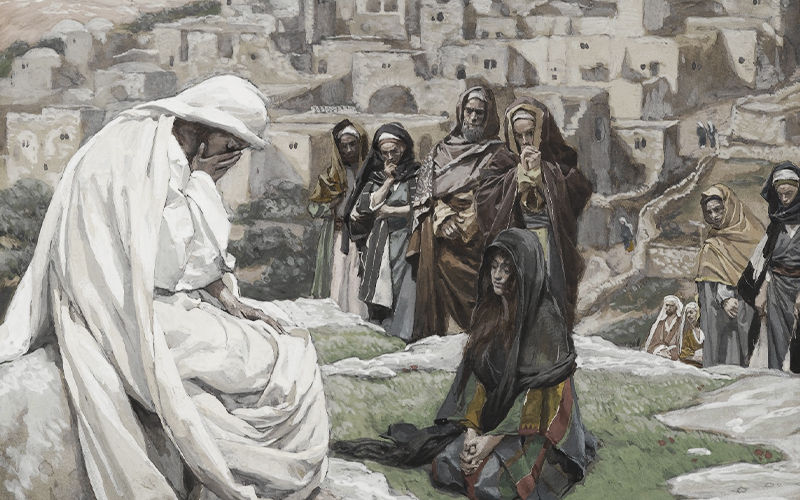
The shortest verse in the English Bible contains just two words: “Jesus wept” (John 10:35). Yet there is much to be learned from this brief statement. The context describes Jesus’ response to the death of Lazarus, who was a personal friend of His. Jesus would raise Lazarus from the dead, but an emotional scene preceded this event.

Therefore, when Mary came where Jesus was, she saw Him, and fell at His feet, saying to Him, ‘Lord, if You had been here, my brother would not have died.’ When Jesus therefore saw her weeping, and the Jews who came with her also weeping, He was deeply moved in spirit and was troubled, and said, ‘Where have you laid him?’ They said to Him, ‘Lord, come and see.’ Jesus wept” (John 11:32-35).

What can we learn from this passage? Let us consider a few points.Continue Reading

Why Did Jesus Die on the Cross?

Crucifixion

Many people talk about our purpose as Christians in terms that seem to have reduced it to things that pertain to this world – loving others, being a good neighbor, being part of a close-knit community of Christians, and so on. All those are good and important, but is that all there is to being a Christian?

If the Lord’s purpose for us is that we would essentially be part of one big social club that makes a positive impact on those around us, we might ask the question: Why did Jesus have to die on the cross?

After all, even atheists and religious people who do not believe in Christ (Muslims, Hindus, Jews, etc.) can form close relationships with others and help the people around them. Yet none of them acknowledge the Lordship of Christ, and they believe the crucifixion of Jesus of Nazareth was nothing more than a historical fact (if that).

If we reduce Christianity to being nothing more than eating together, helping one another, and showing concern for those around us, how are we different from atheists and unbelievers who simply try to get along with others and help those in need?Continue Reading

“The Spirit Is Willing, but the Flesh Is Weak”

Jesus in the Garden with His Disciples Sleeping

Then Jesus came with them to a place called Gethsemane, and said to His disciples, ‘Sit here while I go over there and pray.’ And He took with Him Peter and the two sons of Zebedee, and began to be grieved and distressed. Then He said to them, ‘My soul is deeply grieved, to the point of death; remain here and keep watch with Me.’ And He went a little beyond them, and fell on His face and prayed, saying, ‘My Father, if it is possible, let this cup pass from Me; yet not as I will, but as You will.’ And He came to the disciples and found them sleeping, and said to Peter, ‘So, you men could not keep watch with Me for one hour? Keep watching and praying that you may not enter into temptation; the spirit is willing, but the flesh is weak’” (Matthew 26:36-41).

Jesus prayed to His Father in the Garden of Gethsemane shortly before His arrest. As was recorded in the passage above, three of His disciples (Peter, James, and John) accompanied Him. They were told to pray and to keep watch, but they fell asleep.

It was at this point when Jesus said, “The spirit is willing, but the flesh is weak” (Matthew 26:41). This statement applied directly to those three disciples. However, it also has applications for us today. Furthermore, the principle was illustrated in Jesus and the events that followed.

Let us see what we can learn from this statement.Continue Reading

Monthly News Roundup (08.24.23)

Subscribe: Apple Podcasts | Google PodcastsSpotify | RSS

Plain Bible Teaching Podcast

This episode is our monthly news roundup for August. In this episode, we’re talking about Richard Dawkins’ recent comments about transgenderism, a new app that lets people “text with Jesus,” and the number of Americans who have tried marijuana.Continue Reading

What Cane Ridge Can Teach Us About Modern-Day Revivals

Cane Ridge Revival

[Note: I was invited to speak at the Cane Ridge Meeting House on June 17, 2023, to discuss the Cane Ridge revival and how it compared with other modern-day revivals, such as the one that occurred at Asbury University a few months earlier. A recording of this lecture will be included at the bottom of this article. This article is based on my notes from that lecture.]

The Cane Ridge Meeting House in Bourbon County, Kentucky, was the site of a revival in 1801. This momentous occasion has been called “America’s Pentecost.” The event helped launch a movement – often called the “Restoration Movement” or the “Stone-Campbell Movement” (named after Barton W. Stone and Alexander Campbell). Barton W. Stone preached at the Cane Ridge church and played a leading role in the revival that occurred in that place.

From time to time, we hear of “revivals” happening today. Recently, a “revival” at Asbury University drew national attention. What should we think about such events? The revival at Cane Ridge that occurred over two hundred years ago has some lessons that can help us answer that question.Continue Reading