Convicting the World

Paul before Felix

But I tell you the truth, it is to your advantage that I go away; for if I do not go away, the Helper will not come to you; but if I go, I will send Him to you. And He, when He comes, will convict the world concerning sin and righteousness and judgment; concerning sin, because they do not believe in Me; and concerning righteousness, because I go to the Father and you no longer see Me; and concerning judgment, because the ruler of this world has been judged” (John 16:7-11).

Shortly before His crucifixion, Jesus spoke to His apostles and promised to send the Holy Spirit to them, who would “convict [reprove, KJV] the world” (John 16:8). The New International Version translates this phrase by saying He would “prove the world to be in the wrong.” The Spirit would do this “concerning sin and righteousness and judgment,” and we will notice later why this was necessary.

This work of the Holy Spirit would have a direct impact on the apostles’ teaching, and it should on ours as well. In this article, we are going to consider HOW the Spirit would convict the world, how the apostles carried out their work related to this, and what we should do in this regard today.Continue Reading


How Often a Preacher Should Preach [Re-release] (07/16/26)

Subscribe: Apple PodcastsSpotify | RSS

Plain Bible Teaching Podcast

This week, we’re re-releasing an episode from a few years ago. In it, I was joined by my good friend, Kristofer Gardana, and we discussed preachers and how often they should preach. This was prompted by an article suggesting that “pastors” should preach no more than 40 weeks out of the year. As we consider this as it relates to a located preacher, we may not agree with the number of weeks, but there are advantages to having others involved in the work of preaching. We also need to remember that there are other things that a preacher does besides preach on Sundays. We discussed all of this in this episode.Continue Reading

Point Out These Things to the Brethren

Man pointing at an open Bible

In pointing out these things to the brethren, you will be a good servant of Christ Jesus, constantly nourished on the words of the faith and of the sound doctrine which you have been following” (1 Timothy 4:6).

A preacher’s job is not to find some “new” thing to present to his audience every time he preaches. If he has been preaching the truth, there is nothing “new” for him to teach without getting in trouble (cf. Galatians 1:8-9). A preacher is to “preach the word” (2 Timothy 4:2), which includes informing, challenging, and reminding.

In the passage above, Paul declared the need to “put the brethren in remembrance” (KJV). This can be applied broadly to anything taught in the word of God, but what did Paul mean in this specific context? Notice what he wrote in the verses leading up to this statement:

But the Spirit explicitly says that in later times some will fall away from the faith, paying attention to deceitful spirits and doctrines of demons, by means of the hypocrisy of liars seared in their own conscience as with a branding iron, men who forbid marriage and advocate abstaining from foods which God has created to be gratefully shared in by those who believe and know the truth. For everything created by God is good, and nothing is to be rejected if it is received with gratitude; for it is sanctified by means of the word of God and prayer” (1 Timothy 4:1-5).

These were the things that Paul wanted Timothy to “point out” to the brethren. These reminders are still necessary today. Let us briefly consider these points.Continue Reading

The Heresy Trial of Jesse L. Sewell

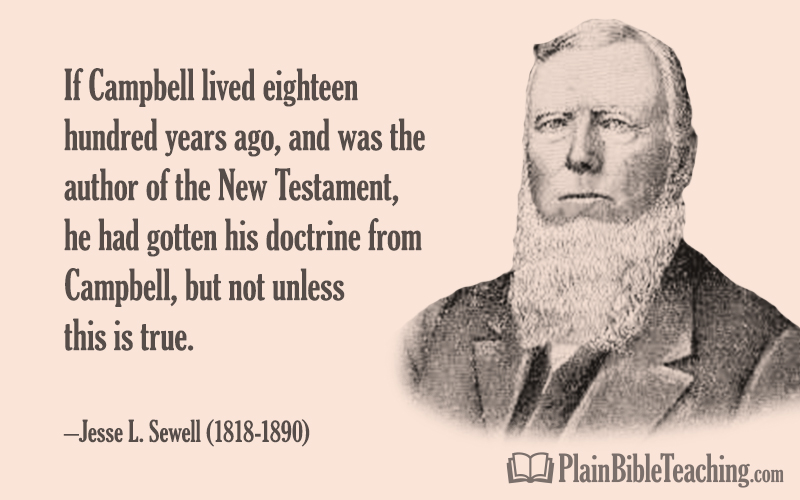
Jesse L. Sewell (1818-1890)Jesse L. Sewell (1818-1890) was a Tennessee preacher who sincerely wanted to please God and to proclaim what he found to be taught in the Bible. Eventually, he became connected with the Restoration Movement. It was common for these preachers to begin their work within the denominations before breaking away to follow the New Testament as their only rule of faith and practice. Sewell followed this course, having his start among the Baptists.



However, his Baptist brethren took exception to his preaching, and he was tried for heresy in December 1842. The charge against him was that he had “run fully into Campbellism” (The Life and Sermons of Jesse L. Sewell, p. 54), a label pejoratively given to those who allegedly followed the teachings of Alexander Campbell (1788-1866), a prominent figure in the Restoration Movement. Peter Ragan, a visiting preacher, offered this definition of “Campbellism”: “It denied faith, repentance and the influence of the Spirit, and made a God of the water” (ibid., p. 54). Sewell dismissed the allegation against him.

“If Campbell lived eighteen hundred years ago, and was the author of the New Testament, he had gotten his doctrine from Campbell, but not unless this is true” (ibid., p. 54).

Continue Reading

Will AI Replace Preachers? (02/26/26)

Subscribe: Apple PodcastsSpotify | RSS

Plain Bible Teaching Podcast

This week, we’re talking about AI and how it will impact work in the future. Already, AI could put some technology workers out of business. But as it becomes more capable, how many other industries could be included? More specifically, for us in the church, could AI replace preachers? That may seem far-fetched, but is it possible? We’re going to consider that in our episode today.Continue Reading

Offering an Invitation at Every Service? (11/27/25)

Subscribe: Apple PodcastsSpotify | RSS

Plain Bible Teaching Podcast

This week, we’re talking about the invitation that is offered at the end of a sermon or gospel message when a church is assembled. Is this something that we have to do each time we assemble? Or is it a man-made practice and unnecessary in every circumstance? We’re going to consider that in this episode.Continue Reading

Does the Preacher Need a Sabbatical? (11/13/25)

Subscribe: Apple PodcastsSpotify | RSS

Plain Bible Teaching Podcast

This week, we’re talking about whether or not a preacher needs a sabbatical. These have started to be talked about more in the religious world – particularly for those preachers/pastors who work with larger (and wealthier) churches. It refers to the practice of giving the preacher/pastor an extended break (often 2-3 months) to give him time to rest, recharge, then be ready to step back into his work with renewed energy and focus. Is this a good practice? What does the Bible teach that will help us with this question? We’re going to discuss that today.Continue Reading