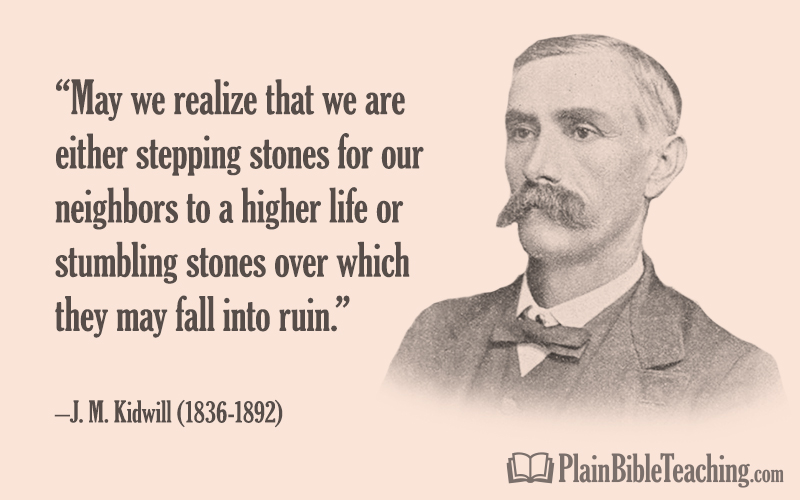
Stepping Stones or Stumbling Stones

J. M. Kidwill (1836-1892)J. M. Kidwill (1836-1892) spent twenty-five years preaching the gospel in Middle Tennessee. During his travels through the area, he came to Dixon Springs in Smith County. When he arrived, there was no church there, but he “saw a door opened to the truth at Dixon Springs, and he went in” (Twenty-Five Years of Trust, p. 76). Through Kidwill’s efforts, a congregation was established there, and the church maintained a close relationship with the preacher.

In a letter to one of the sisters in Dixon Springs (Sister Rose), Kidwill spoke of the opportunity for the members of that congregation to spread the gospel in that area, while also warning about what could hinder their efforts.

“I hope that you will have at no distant day a goodly number of devoted Christians at Dixon Springs, who will not only contend for the Bible in opposition to all humanisms, but who will practice what they preach. I want Bro. Rose’s ear while I say that much, very much, depends on the few members that we have in your vicinity. The Savior compares the influence of example in his disciples to leaven in meal until all is leavened. May we realize that we are either stepping stones for our neighbors to a higher life or stumbling stones over which they may fall into ruin.” (Twenty-Five Years of Trust, p. 79)

Continue Reading

Add to Your Faith (Part 2): Add Moral Excellence

Add to Your Faith

The previous lesson was the start of a series about the characteristics we are to add to our faith. We began by noticing that faith must be the foundation for all that we do. Now we turn our attention to the qualities we are to add. These are not apart from faith, but are the characteristics we “supply” to our faith. The first trait Peter listed was moral excellence.

Now for this very reason also, applying all diligence, in your faith supply moral excellence, and in your moral excellence, knowledge, and in your knowledge, self-control, and in your self-control, perseverance, and in your perseverance, godliness, and in your godliness, brotherly kindness, and in your brotherly kindness, love. For if these qualities are yours and are increasing, they render you neither useless nor unfruitful in the true knowledge of our Lord Jesus Christ” (2 Peter 1:5-8).

Continue Reading

Different Perspectives

Shadows

Each person has a different background, upbringing, life experience, education, and so on. Therefore, we approach things with a unique perspective. Because of this, people can look at one event, fact, or piece of information and react very differently. A simple example of this is in the realm of sports. A fan of one team can watch a game with a fan of the opposing team, and though there is just one outcome (one team wins the game), one fan will celebrate while the other is disappointed.

Following the Babylonian captivity, God’s people assembled in Jerusalem to rebuild the temple. When the foundation of the temple was completed, two contradictory reactions were made to it.

Now when the builders had laid the foundation of the temple of the Lord, the priests stood in their apparel with trumpets, and the Levites, the sons of Asaph, with cymbals, to praise the Lord according to the directions of King David of Israel. They sang, praising and giving thanks to the Lord, saying, ‘For He is good, for His lovingkindness is upon Israel forever.’ And all the people shouted with a great shout when they praised the Lord because the foundation of the house of the Lord was laid. Yet many of the priests and Levites and heads of fathers’ households, the old men who had seen the first temple, wept with a loud voice when the foundation of this house was laid before their eyes, while many shouted aloud for joy, so that the people could not distinguish the sound of the shout of joy from the sound of the weeping of the people, for the people shouted with a loud shout, and the sound was heard far away” (Ezra 3:10-13).

This is an example of people viewing an event from different perspectives and reacting accordingly. Those who had never seen the first temple shouted for joy. Those who had seen the first temple and knew from personal experience the difference between the two wept.

This was not a matter of right and wrong. The people who rejoiced were not wrong to do so, nor was it wrong for the ones who wept to react the way they did. Yet the need at that moment was to build the new temple. Their different perspectives were understandable and were even fine to have as long as they did not hinder them from doing the work the Lord wanted them to do.Continue Reading

Following Paul’s Example

Paul preaching

Now you followed my teaching, conduct, purpose, faith, patience, love, perseverance, persecutions, and sufferings, such as happened to me at Antioch, at Iconium and at Lystra; what persecutions I endured, and out of them all the Lord rescued me” (2 Timothy 3:10-11).

In the passage above, Paul wrote to Timothy about how the young evangelist had followed the apostle’s example in various ways. It is important that we follow examples, in particular, the ones who are worthy of emulation. Paul told the brethren in Philippi, “Brethren, join in following my example, and observe those who walk according to the pattern you have in us” (Philippians 3:17). When Paul wrote to the church in Corinth, he was mindful of the fact that he needed to set an example for them. He wrote, “Be imitators of me, just as I also am of Christ” (1 Corinthians 11:1).

What about us? Are we setting the example that we need to set before others? This was not just something for an apostle like Paul to do. Timothy was told to follow Paul’s example, yet he was also to “show [himself] an example of those who believe” (1 Timothy 4:12). He learned from Paul, and he was to conduct himself in such a way that others could learn from him as well. The same is true for us. We need to set a good example for others, which includes following the example that Paul set for Timothy.

When Paul wrote to Timothy about following his example, he mentioned nine ways in which he set an example. Let us notice each of these to see what we can learn from Paul and how we might be able to follow his lead and show the same type of example to those around us.Continue Reading

The Meekest Man in All the Earth

Moses

Now the man Moses was very meek, above all the men which were upon the face of the earth” (Numbers 12:3, KJV).

While the Israelites were in the wilderness, a complaint arose from Miriam and Aaron against Moses. The original reason for the complaint was something involving Moses’ wife (Numbers 12:1), yet it led his brother and sister to challenge Moses himself (Numbers 12:2). It is in this context that the statement above was made about one of Moses’ character traits – meekness.

In this article, we will discuss meekness – what it is, how it was manifested in Moses’ life, and why we must display this trait today.Continue Reading

Trust in Pastors Falls to Historic Low (03.09.23)

Subscribe: Apple Podcasts | Google Podcasts | Stitcher | Spotify | RSS

Plain Bible Teaching Podcast

This week I’m joined by Kristofer Gardana, and we’re talking about the declining trust in pastors. According to a Gallup survey, fewer people would rate pastors and clergy as having a “high ethical standard and level of honesty.” Why is this the case? And what challenges – or potential opportunities – does this present for gospel preachers? We discuss these questions in the episode today.Continue Reading

Challenges Facing the Church in the New Year (01.05.23)

Subscribe: Apple Podcasts | Google Podcasts | Stitcher | Spotify | RSS

Plain Bible Teaching Podcast

With the start of the new year, we tend to look ahead over the next twelve months to see what we can improve, how we might change, and what goals we want to hit. In the episode last week I talked about some areas of focus that we can use to make the most of our time in the new year. However, when we talk about goals, resolutions, etc., we tend to think of possibilities and opportunities for something good. Today, we want to look at some challenges that could be facing Christians and churches in the new year. The more we are aware of these potential challenges, the better we will be able to prepare.Continue Reading