What Does It Mean to Be Called to Preach?

James M. Mathes: Called to Preach?

James Madison Mathes (1808-1892), like so many religious people in the nineteenth century, was determined to dismiss the religious teachings he had previously been taught to simply learn the Scriptures and follow what they taught. This led him to be immersed for the remission of sins. Later, he joined the ministry and dedicated his life to preaching and teaching the gospel.

Many who begin the work of preaching the gospel speak of being “called” to the ministry or “called” to preach. This is true today as it was in Mathes’ day. However, Mathes had a different understanding of what this meant than many of his religious contemporaries. Notice his criticism of many who claimed to have been “called” by God to preach:

“I have known some enthusiasts who had but little to entitle them to public notice, except their fiery zeal, ignorance, and supportive impudence, who at the same time looked upon themselves as a kind of second edition of the Apostles! Such fanatical spirits frequently tell their hearers, when they get up to preach, that they are going to speak just as God gives it to them—that God has called them by name, qualified, and sent them forth as his ambassadors to a rebellious world—that God had revealed his mind and will to them by direct revelation. 

“But it frequently happens, that such men cannot join two simple sentences together, or deliver one clear intelligible idea in a discourse of an hour long, and that too under the immediate control of the Holy Spirit, if we take their word for it! Now I cannot believe that God even called any man to preach who had not the ability to do it, neither do I believe that God ever sent any man who could not tell his message.” (A Record of Christian Union and Truth, p. 157)

Continue Reading

The Great Commission in the Book of Acts

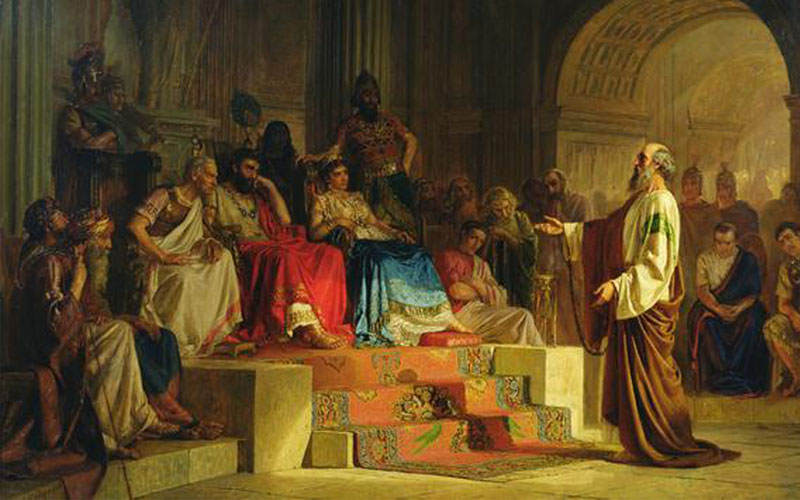
Paul Before Agrippa

After Jesus died on the cross and rose from the dead, He gave His apostles the “Great Commission.” Notice the details of this commission that are recorded in the synoptic gospels:

Go therefore and make disciples of all the nations, baptizing them in the name of the Father and the Son and the Holy Spirit, teaching them to observe all that I commanded you; and lo, I am with you always, even to the end of the age” (Matthew 28:19-20).

And He said to them, ‘Go into all the world and preach the gospel to all creation. He who has believed and has been baptized shall be saved; but he who has disbelieved shall be condemned’” (Mark 16:15-16).

And He said to them, ‘Thus it is written, that the Christ would suffer and rise again from the dead the third day, and that repentance for forgiveness of sins would be proclaimed in His name to all the nations, beginning from Jerusalem. You are witnesses of these things’” (Luke 24:46-48).

In Luke’s account, we also see Jesus’ instruction to “stay in the city [Jerusalem, as] until you are clothed with power from on high” (Luke 24:49). The gospel of Luke closes with the apostles witnessing the ascension of Christ and then returning to Jerusalem as Jesus instructed them to do (Luke 24:50-53).

In the book of Acts, Luke picked up where he left off and provided additional information about what happened during the “forty days” (Acts 1:3) between Jesus’ resurrection and ascension. The final recorded statement Jesus made to His apostles was this:

But you will receive power when the Holy Spirit has come upon you; and you shall be My witnesses both in Jerusalem, and in all Judea and Samaria, and even to the remotest part of the earth” (Acts 1:8).

This verse is essentially a restatement of the Great Commission. It can also be thought of as the theme of the book of Acts, as it tells of the gospel being preached in Jerusalem (Acts 2-7), Judea (Acts 8:1; 11:1), Samaria (Acts 8), and to all the nations (Acts 10; 13-28).

As the book of Acts contains a record of the apostles carrying out the Great Commission, it also shows us two important points about this commission: (1) how to obey the gospel that the apostles were commissioned to preach and (2) how effective the work of preaching can be. Let us consider each of these.Continue Reading

What People Look for in a New Church (01/30/25)

Subscribe: Apple PodcastsSpotify | RSS

Plain Bible Teaching Podcast

This week we’re talking about what people look for in a new church (and the answer may surprise you). Obviously, we are not to compromise the truth or leave the pattern found in the New Testament in order to attract more people. But it is helpful to understand where others may be coming from if we want to help them know how to faithfully serve the Lord.Continue Reading

Sermons with “Stickers”

Myhr: Points Filed Off

In the book Sketches of Our Mountain Pioneers, Preston Gray spoke highly of the preaching of A. I. Myhr (1855-1933). He also recalled a criticism Myhr made of another unnamed preacher.

“Myhr’s visits to all our churches were great occasions. The people soon learned to expect something. He was a thinker, and positively despised sluggish thinking. Of a certain minister, he said to me, one day, ‘He is a capital fellow, but when he preaches, all the points are filed off.’ He told me that he liked sermons and thoughts that had ‘stickers’ in them.” (Sketches of Our Mountain Pioneers, p. 203)

The gospel, when it is preached in its simplicity and purity, is going to have “stickers” that will “prick” people to the heart and spur them to obey the Lord. Notice what happened on the day of Pentecost following the resurrection and ascension of Jesus:

“‘Therefore let all the house of Israel know for certain that God has made Him both Lord and Christ this Jesus whom you crucified.’ Now when they heard this, they were pierced to the heart, and said to Peter and the rest of the apostles, ‘Brethren, what shall we do?’” (Acts 2:36-37).

Continue Reading

Reasons to Be Thankful as a Preacher (11/28/24)

Subscribe: Apple PodcastsSpotify | RSS

Plain Bible Teaching Podcast

This week we’re talking about the reasons to be thankful as a preacher. If you preach, it is good to be reminded of these points from time to time because sometimes the work can be discouraging. But also, if you don’t preach, the points we’re going to discuss today will also help you as you try to encourage and support those who are doing this work.Continue Reading

Not Every Sermon Has to Be Great (10/17/24)

Subscribe: Apple PodcastsSpotify | RSS

Plain Bible Teaching Podcast

This week we’re talking about the number of weeks out of a year that a preacher can preach a “truly great” sermon. A popular pastor recently claimed that the number is maybe 20-30 a year. Yet what makes a sermon “great”? And does a sermon have to be “great” to be effective? We’re going to talk about this today.Continue Reading

Preachers Struggling with Time Management (09/19/24)

Subscribe: Apple PodcastsSpotify | RSS

Plain Bible Teaching Podcast

This week we’re talking about the struggle that many preachers have with time management. The work of preaching is obviously important. Therefore, it is important that we dedicate time to it and use that time wisely. We’re going to talk about what that might look like in this episode.Continue Reading