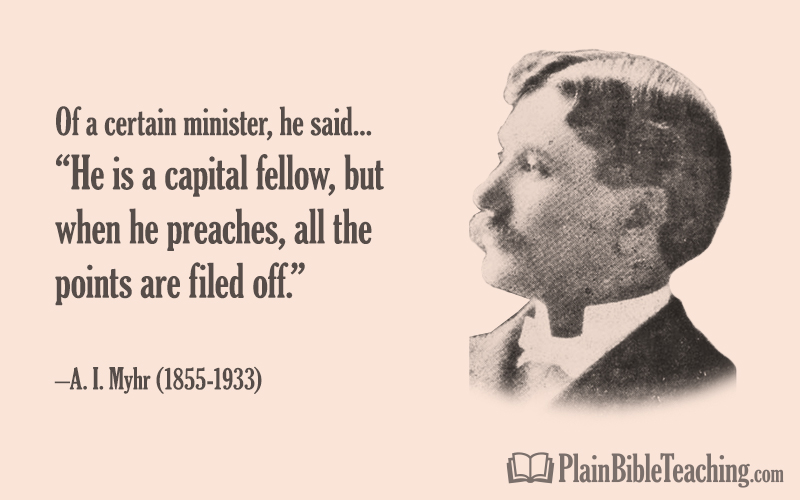
In the book Sketches of Our Mountain Pioneers, Preston Gray spoke highly of the preaching of A. I. Myhr (1855-1933). He also recalled a criticism Myhr made of another unnamed preacher.
“Myhr’s visits to all our churches were great occasions. The people soon learned to expect something. He was a thinker, and positively despised sluggish thinking. Of a certain minister, he said to me, one day, ‘He is a capital fellow, but when he preaches, all the points are filed off.’ He told me that he liked sermons and thoughts that had ‘stickers’ in them.” (Sketches of Our Mountain Pioneers, p. 203)
The gospel, when it is preached in its simplicity and purity, is going to have “stickers” that will “prick” people to the heart and spur them to obey the Lord. Notice what happened on the day of Pentecost following the resurrection and ascension of Jesus:
“‘Therefore let all the house of Israel know for certain that God has made Him both Lord and Christ this Jesus whom you crucified.’ Now when they heard this, they were pierced to the heart, and said to Peter and the rest of the apostles, ‘Brethren, what shall we do?’” (Acts 2:36-37).
These people were convicted of crucifying the Messiah, who was prophesied to come and save them from their sins. This must have been an awful realization! Yet it took them being “pierced to the heart” to lead them to ask what they needed to do (Acts 2:37) and then respond to the gospel by being baptized into Christ (Acts 2:41). If Peter failed to preach clearly enough for them to see their own guilt, the number who would have been converted would be far less than the three thousand who obeyed on that day.
When the prophet Nathan confronted David over his sin with Bathsheba, he told of a rich man who stole the only lamb of a poor man in order to feed a traveler who came to him (2 Samuel 12:1-4). David immediately saw the sin of the man in the story, stating that he “deserves to die” and “must make restitution” (2 Samuel 12:5-6). However, David was oblivious to the fact that HE was the one who was guilty of this injustice until Nathan pointedly said, “You are the man!” (2 Samuel 12:7). If Nathan had simply told David the story, but left him to figure out the application on his own, who knows when (or if) David would have realized that he had done something even worse than the rich man in Nathan’s story and repented.
The teachings contained in the word of God are practical. God revealed His instructions so that we would put them into practice in our lives. James wrote, “But prove yourselves doers of the word, and not merely hearers who delude themselves” (James 1:22). If the only response someone makes to the preaching of God’s word is to nod in agreement, then he goes about his life without any regard to what God’s word instructs him to do, he will never be able to please God.
We need to remember this as we strive to preach and teach the word of God today. Some people will keep their ears closed to the truth, no matter what we do to teach it. We cannot help that. But we do need to make sure we are not filing the points off of the word of God so as not to risk offending anyone. Remember that God’s word is “living and active and sharper than any two-edged sword, and piercing as far as the division of soul and spirit, of both joints and marrow, and able to judge the thoughts and intentions of the heart” (Hebrews 4:12). If we teach the same Spirit-inspired message the apostles taught, that will necessarily include convicting others of sin as we try to point them to the way of righteousness (John 16:8).
So when we preach, let us be clear enough that people get the point so they might be motivated to repent of their sins and obey the Lord.
When we work with and support those who preach the gospel, let us encourage them to boldly proclaim the truth and make the application that people need to hear.
As we listen to the word being taught, let us not shut our ears and get upset with the preacher when we are cut to the heart. Instead, let us appreciate the message and see what needs to change in our lives to be right with the Lord.