Stepping Stones or Stumbling Stones

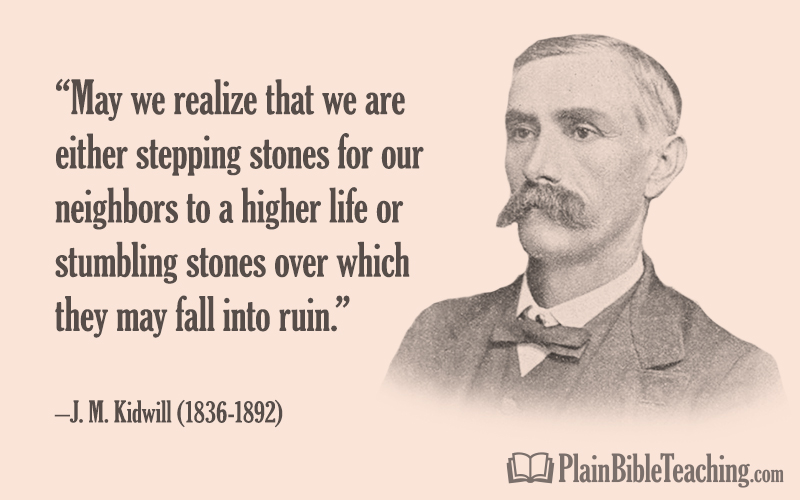
J. M. Kidwill (1836-1892)J. M. Kidwill (1836-1892) spent twenty-five years preaching the gospel in Middle Tennessee. During his travels through the area, he came to Dixon Springs in Smith County. When he arrived, there was no church there, but he “saw a door opened to the truth at Dixon Springs, and he went in” (Twenty-Five Years of Trust, p. 76). Through Kidwill’s efforts, a congregation was established there, and the church maintained a close relationship with the preacher.

In a letter to one of the sisters in Dixon Springs (Sister Rose), Kidwill spoke of the opportunity for the members of that congregation to spread the gospel in that area, while also warning about what could hinder their efforts.

“I hope that you will have at no distant day a goodly number of devoted Christians at Dixon Springs, who will not only contend for the Bible in opposition to all humanisms, but who will practice what they preach. I want Bro. Rose’s ear while I say that much, very much, depends on the few members that we have in your vicinity. The Savior compares the influence of example in his disciples to leaven in meal until all is leavened. May we realize that we are either stepping stones for our neighbors to a higher life or stumbling stones over which they may fall into ruin.” (Twenty-Five Years of Trust, p. 79)
Continue Reading

Reaching Conspiracy Theorists (05/29/25)

Subscribe: Apple PodcastsSpotify | RSS

Plain Bible Teaching Podcast

This week, we’re talking about those who might be labeled as “conspiracy theorists” and whether they can be reached with the gospel. It has been reported that Joe Rogan, a popular podcast host known for embracing or entertaining conspiracy theories, has recently been attending church services. Could someone like that really be converted? We’re going to talk about that today.

Find the script for this episode on Substack.

Related material:

Thanks for listening!

If you found this episode to be helpful, please share it with others. Thanks.

Subscribe: Apple PodcastsSpotify | RSS

The Great Commission in the Book of Acts

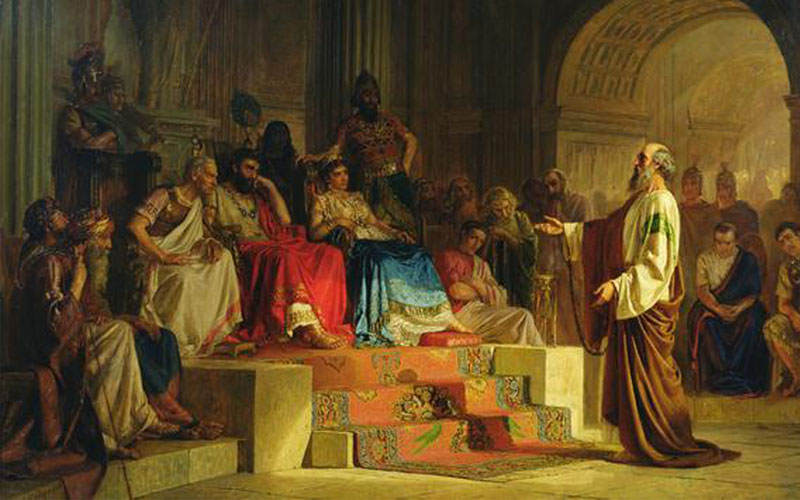
Paul Before Agrippa

After Jesus died on the cross and rose from the dead, He gave His apostles the “Great Commission.” Notice the details of this commission that are recorded in the synoptic gospels:

Go therefore and make disciples of all the nations, baptizing them in the name of the Father and the Son and the Holy Spirit, teaching them to observe all that I commanded you; and lo, I am with you always, even to the end of the age” (Matthew 28:19-20).

And He said to them, ‘Go into all the world and preach the gospel to all creation. He who has believed and has been baptized shall be saved; but he who has disbelieved shall be condemned’” (Mark 16:15-16).

And He said to them, ‘Thus it is written, that the Christ would suffer and rise again from the dead the third day, and that repentance for forgiveness of sins would be proclaimed in His name to all the nations, beginning from Jerusalem. You are witnesses of these things’” (Luke 24:46-48).

In Luke’s account, we also see Jesus’ instruction to “stay in the city [Jerusalem, as] until you are clothed with power from on high” (Luke 24:49). The gospel of Luke closes with the apostles witnessing the ascension of Christ and then returning to Jerusalem as Jesus instructed them to do (Luke 24:50-53).

In the book of Acts, Luke picked up where he left off and provided additional information about what happened during the “forty days” (Acts 1:3) between Jesus’ resurrection and ascension. The final recorded statement Jesus made to His apostles was this:

But you will receive power when the Holy Spirit has come upon you; and you shall be My witnesses both in Jerusalem, and in all Judea and Samaria, and even to the remotest part of the earth” (Acts 1:8).

This verse is essentially a restatement of the Great Commission. It can also be thought of as the theme of the book of Acts, as it tells of the gospel being preached in Jerusalem (Acts 2-7), Judea (Acts 8:1; 11:1), Samaria (Acts 8), and to all the nations (Acts 10; 13-28).

As the book of Acts contains a record of the apostles carrying out the Great Commission, it also shows us two important points about this commission: (1) how to obey the gospel that the apostles were commissioned to preach and (2) how effective the work of preaching can be. Let us consider each of these.Continue Reading

Producing and Developing Disciples

Seedlings

Paul told Timothy of his responsibility to take “the things which [he] heard from [Paul]” and “entrust these to faithful men who will be able to teach others also” (2 Timothy 2:2). The apostle then mentioned three “occupations” that illustrated Timothy’s work – soldiers, athletes, and farmers.

Suffer hardship with me, as a good soldier of Christ Jesus. No soldier in active service entangles himself in the affairs of everyday life, so that he may please the one who enlisted him as a soldier. Also if anyone competes as an athlete, he does not win the prize unless he competes according to the rules. The hard-working farmer ought to be the first to receive his share of the crops” (2 Timothy 2:3-6).

Two of those (soldiers and farmers) were directly related to his work in making disciples. In a similar passage, Paul mentioned another “occupation” connected to this – shepherds.

Who at any time serves as a soldier at his own expense? Who plants a vineyard and does not eat the fruit of it? Or who tends a flock and does not use the milk of the flock?” (1 Corinthians 9:7).

The work of making disciples is ongoing from generation to generation (2 Timothy 2:2), which means we must do it today. But how? By doing the work of the farmer, the shepherd, and the soldier. We will explore this idea in this article.Continue Reading

Using the Internet to Teach the Bible (08/01/24)

Subscribe: Apple PodcastsSpotify | RSS

Plain Bible Teaching Podcast

This week we’re talking about using the internet to teach the Bible. Many churches, preachers, and other Christians are doing this today. Yet there are still many others who are not. Perhaps they don’t think it’s a worthy endeavor. Or maybe they just don’t know how to start. We’re going to get into all of that in this episode.Continue Reading

The Problem with “Instant Evangelism” (02.22.24)

Subscribe: Apple Podcasts | Google Podcasts | Spotify | RSS

Plain Bible Teaching Podcast

This week we’re talking about the problem of “instant evangelism.” Of course, it is possible for someone to be converted quickly. However, we need to be careful that we do not have an expectation to see a proper response to the gospel before a person has a fundamental understanding of God and His word that can provide the foundation for a life of faith. For various reasons, seeing results from our efforts to evangelize is often slower today than in previous generations. What does that mean for us? We’re going to discuss that today.Continue Reading

The Seven Churches (Part 6): Philadelphia

The Seven Churches (Part 6): Philadelphia

The sixth church addressed in the book of Revelation was in Philadelphia. This is the only place where this city is mentioned in the Bible. It was likely a smaller church, yet the Lord told them about their great opportunity to spread the gospel.

And to the angel of the church in Philadelphia write: He who is holy, who is true, who has the key of David, who opens and no one will shut, and who shuts and no one opens, says this: ‘I know your deeds. Behold, I have put before you an open door which no one can shut, because you have a little power, and have kept My word, and have not denied My name. Behold, I will cause those of the synagogue of Satan, who say that they are Jews and are not, but lie—I will make them come and bow down at your feet, and make them know that I have loved you. Because you have kept the word of My perseverance, I also will keep you from the hour of testing, that hour which is about to come upon the whole world, to test those who dwell on the earth. I am coming quickly; hold fast what you have, so that no one will take your crown. He who overcomes, I will make him a pillar in the temple of My God, and he will not go out from it anymore; and I will write on him the name of My God, and the name of the city of My God, the new Jerusalem, which comes down out of heaven from My God, and My new name. He who has an ear, let him hear what the Spirit says to the churches’” (Revelation 3:7-13).

Continue Reading