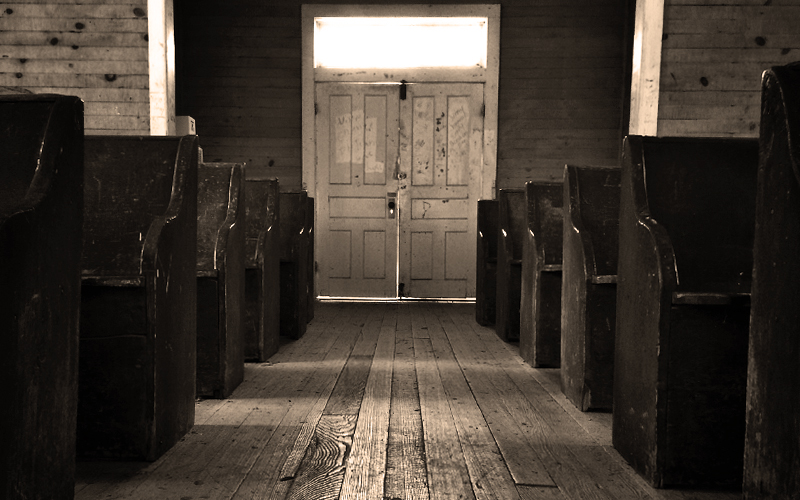
Corydon E. Fuller, in Reminiscences of James A. Garfield, described a period in which he (the author) was working with a school in Hambden, Ohio, in 1851. In this “little village” that “enjoyed no past, and had no hope in the future,” there were two churches which he described in this way:
“The two churches stood like gladiators over against each other, shabby in their weather-beaten habiliments, faded and tattered by winter’s storms and summer’s heat. Without, they were forbidding and repulsive; within, the fires had grown cold upon their altars, and the worshipers had departed, save a few fossils who had come down from a former generation.” (Reminiscences of James A. Garfield, p. 39)
No additional information is given about these churches and how they got into this condition. However, any church could find itself in this condition in the future, no matter its current state.
The churches Fuller described were once active in their work and worship. Yet over time, their services had “grown cold,” and most of the “worshipers had departed.” Whether one condition led to the other or both happened concurrently, they were related (and can also be in our churches today).
How could worship grow cold? Jesus said that the worship we offer to God must be done “in spirit and truth” (John 4:24). Yet when we become stagnant in spirit* and our “reverence for [God] consists of tradition learned by rote” (Isaiah 29:13), our worship becomes hollow. We may be “going through the motions” rather than worshiping from the heart.
Why might worshipers depart? There could be a few reasons for this – unfaithfulness (they fall away from the Lord), relocation (they move away from the church), or death. In reality, even in the best of circumstances, every member will one day be a former member.**
How can we work to prevent our places of worship from becoming lifeless and empty? Obviously, the church is not the building; however, the building is usually the place where the church gathers. What can we do to ensure that these gatherings continue, are beneficial for those who assemble, and are pleasing to God?
- Evangelism – The Lord’s church began on the day of Pentecost when three thousand heard the gospel and were baptized into Christ (Acts 2:38, 41). They then continued to assemble together for worship (Acts 2:42, 46). If churches want to bring more people in from the outside, it must be done by “[sounding] forth the word” (1 Thessalonians 1:8) since “the gospel…is the power of God for salvation” (Romans 1:16). Any growth that comes when churches employ other gimmicks or tactics found in the world is only superficial. Real growth requires a proclamation of the gospel. As Paul told the brethren in Corinth, we are to plant and water and allow God to give the increase (1 Corinthians 3:6).
- Edification – God designed the church to be a self-edifying body*** in which “the proper working of each individual part, causes the growth of the body for the building up of itself in love” (Ephesians 4:16). The most obvious benefit of this is to help prevent unfaithfulness as we “stimulate one another to love and good deeds, not forsaking our own assembling together, as is the habit of some, but encouraging one another; and all the more as you see the day drawing near” (Hebrews 10:24-25). We need to “encourage one another day after day…so that none of you will be hardened by the deceitfulness of sin” (Hebrews 3:13). However, when a local church functions as a healthy, united body in which every part contributes and is dependent upon the others, this may also prevent some members moving away. Of course, some relocation is inevitable, but our congregations should not be such that moving away from our community is more appealing because of the opportunity to leave the stagnant, dysfunctional, or lukewarm church where they currently are.
Brethren who find themselves in churches like the ones described at the beginning of this article are to be commended for doing their best to faithfully serve the Lord in a difficult situation. The “few people in Sardis” who remained faithful were promised that they would “walk with [the Lord] in white, for they are worthy” (Revelation 3:4). Those congregations may still grow – in strength and number – through their diligence and faithfulness.
However, for those who are in churches that currently seem to be healthy, vibrant, and growing, it is important to be reminded that such conditions may not always exist. If we become complacent and fail to carry out the Lord’s work as we should, a once-healthy church will eventually become cold, empty, and close to death.
Let us continue to be diligent in our service to the Lord, faithful in the work He has given us, and strive to equip the next generation to carry on after we are gone.
———
* For more on this point, see the article, Stagnant in Spirit.
** For more on this point, see the article, The Future of the Church. Also, see, Where Will Your Church Be in Twenty Years?
*** For more on this point, see the article, The Church As a Self-Edifying Body.










