Often when people want to emphasize the serious nature of a matter, they describe it as “a matter of life or death.” The gospel is certainly a serious matter as it pertains to our eternal life or death (Romans 6:23). But in another sense, the gospel is a message of either life or death depending on how it is received by the one who hears it. Notice what Paul wrote to the brethren in Corinth:
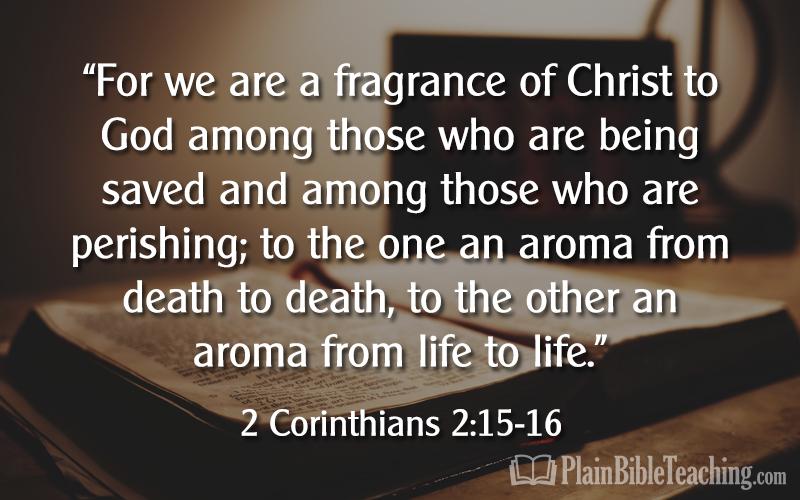
“For we are a fragrance of Christ to God among those who are being saved and among those who are perishing; to the one an aroma from death to death, to the other an aroma from life to life” (2 Corinthians 2:15-16).
For some, the gospel is a message “from life to life.” For others, it is a message “from death to death.” Which one depends on how the hearer perceives it. Let us notice the difference in perspectives.
A Message of Life
The gospel is a message of life – eternal life – and tells of the great spiritual blessings we have in Christ.
- It is a message of salvation – The gospel is “the power of God for salvation to everyone who believes, to the Jew first and also to the Greek” (Romans 1:16). It contains the “words…by which [we] will be saved” (Acts 11:14).
- It is a message of liberty – Paul wrote, “Where the Spirit of the Lord is, there is liberty” (2 Corinthians 3:17). This liberty is not the permission to do as we please. Rather, the gospel speaks of our freedom from the bondage of sin (Hebrews 2:14-15) and freedom from the obligation to follow the commandments of men (Colossians 2:20-23).
- It is a message that speaks of a reward – When many were deserting Jesus, Peter explained why he and the other disciples would not forsake Him: “Lord, to whom shall we go? You have the words of eternal life” (John 6:68). The gospel tells us of “an inheritance which is imperishable and undefiled and will not fade away, reserved in heaven” for those who are faithful (1 Peter 1:4).
A Message of Death
While those who accept the gospel will see it as a positive and beneficial message, those who reject it will see it as a negative message. There are certainly negative parts of the gospel for those who reject it.
- It is a message of condemnation – Jesus said, “He who rejects Me and does not receive My sayings, has one who judges him; the word I spoke is what will judge him at the last day” (John 12:48). The Hebrew writer explained that the word is “able to judge the thoughts and intentions of the heart” (Hebrews 4:12). Those who reject the word will be “condemned” (Mark 16:16).
- It is a message containing restrictions – The gospel instructs us “to deny ungodliness and worldly desires” (Titus 2:12). It teaches us to “abstain from fleshly lusts” (1 Peter 2:11) and to “not let sin reign” in our bodies (Romans 6:12).
- It is a message of punishment – In telling a parable about the kingdom of heaven, Jesus described the one who came unprepared as being bound and thrown “into the outer darkness” where “there will be weeping and gnashing of teeth” (Matthew 22:13). Those who are “not found written in the book of life” will be “thrown into the lake of fire” (Revelation 20:15).
Conclusion
The gospel is a message “from life to life” for “those who are being saved” (2 Corinthians 2:15-16). Unfortunately, the number of people who are being saved is but a “few” when compared with the “many” who follow the path leading to destruction (Matthew 7:13-14). However, the gospel has not and will not change in order to accommodate the “many” who are perishing. Therefore, instead of trying to change the gospel – thereby bringing condemnation upon ourselves (Galatians 1:6-9) – let us work to change the hearts and minds of those around us to conform to the word of God.