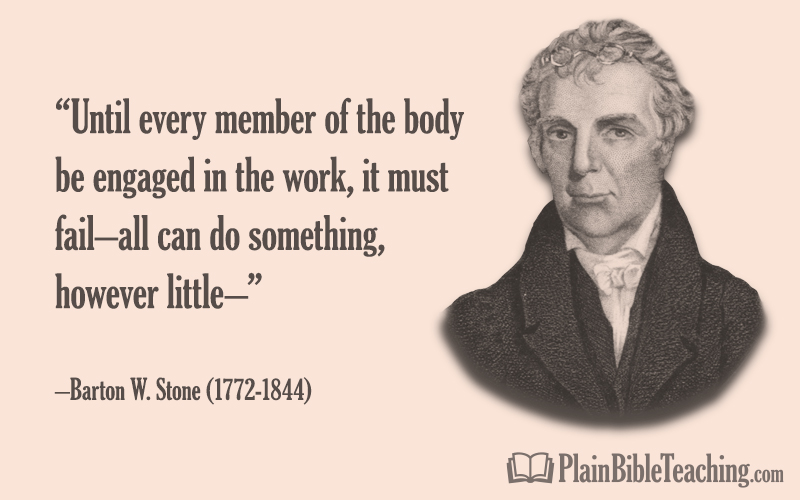
Barton W. Stone (1772-1844) was one of the leading voices for a movement that began in the early nineteenth century to reject the man-made doctrines and creeds of the religious world and enjoy unity on the Bible alone. This is sometimes referred to as the Stone-Campbell Movement due to the influence of Stone (along with Alexander Campbell) among Christians during that time. This message of “restoration” spread and many were won to the cause of Christ.
However, near the end of his life, Stone wrote that this movement had not continued to grow as he believed it could or should have. After traveling through Indiana, Ohio, and Kentucky, the elder Stone wrote in his journal – the Christian Messenger – about what he had observed and why he believed that more progress had not been made. Notice one of the reasons given:
“Another reason is that the preachers are almost solely engaged in working in the Lord’s vineyard, while the people and professors are gazing on without employment, without praying, without exhorting one another, without instructing, admonishing and comforting the young converts, and without building them up in the most holy faith. Until every member of the body be engaged in the work, it must fail—all can do something, however little—all are hired into the vineyard—all must labor or lose the reward.” (A Plea for the Union of All Christians, p. 292-293)
Stone observed that the preachers of the gospel were busy doing the Lord’s work. However, the rest of the brethren were “gazing on” and not helping in the work of teaching, exhorting, and encouraging others – particularly the new converts. As long as this was going on, he said “the work…must fail.”
His analysis harmonizes with the teaching of the New Testament. Obviously, preachers are to be engaged in the work of preaching the gospel. Paul told Timothy, “Preach the word; be ready in season and out of season; reprove, rebuke, exhort, with great patience and instruction. […] But you, be sober in all things, endure hardship, do the work of an evangelist, fulfill your ministry” (2 Timothy 4:2, 5). The apostle wrote about the importance of this work in his letter to the Romans when he said, “How then will they call on Him in whom they have not believed? How will they believe in Him whom they have not heard? And how will they hear without a preacher?” (Romans 10:14).
At the same time, the rest of the brethren are also to be engaged in the Lord’s work. In his letter to the church at Ephesus, Paul described the church as a self-edifying body*: “From whom the whole body, being fitted and held together by what every joint supplies, according to the proper working of each individual part, causes the growth of the body for the building up of itself in love” (Ephesians 4:16). In writing to the brethren in Corinth, he explained that the church is like a body with many different parts, yet each one had a vital role to play (1 Corinthians 12:14-27). As Stone said in the quote above, “All can do something, however little.” Each one of us can contribute to the work of the church.
When the situation arises in which the work of spreading the gospel is done exclusively by the preacher (or nearly so), it indicates that at least one of the following two responsibilities has been neglected:
- The members of the church have neglected their responsibility to help teach the gospel to others – Peter said we are to be “ready to make a defense to everyone who asks you to give an account for the hope that is in you” (1 Peter 3:15). He did not write this to preachers, but to all Christians. When persecution arose against the church in Jerusalem and all but the apostles had to flee the city, Luke recorded, “Therefore, those who had been scattered went about preaching the word” (Acts 8:4). They were not idle; instead, these brethren were actively engaged in the Lord’s work.
- The preachers have neglected their responsibility to equip others to share in the work with them – Just before Paul explained that each member is to contribute to the growth of the body (Ephesians 4:16), he said that preachers (or evangelists, as well as pastors and teachers) were given by God “for the equipping of the saints for the work of service, to the building up of the body of Christ” (Ephesians 4:11-12). Paul told Timothy, “The things which you have heard from me in the presence of many witnesses, entrust these to faithful men who will be able to teach others also” (2 Timothy 2:2). Part of the work of a preacher (along with pastors/elders and teachers) is to help prepare their brethren to be able to teach, exhort, and admonish others so that the work can continue in the absence of the preacher.
Those who faithfully and diligently carry out the work of a preacher can have a great impact in the cause of Christ – not because of the greatness of the preacher, but because of God who gives the increase (1 Corinthians 3:6). Yet the cause of Christ will always be hindered if it is only the preachers who are engaged in the work.
Let those of us who are not preachers commit to being involved in the Lord’s work. And let those of us who are preachers commit to continuing in the work – which includes preparing others to work alongside us in the cause of Christ. As Stone said, “Until every member of the body be engaged in the work, it must fail—all can do something, however little—all are hired into the vineyard—all must labor or lose the reward.”
———
* For more on this point, see the article – The Church as a Self-Edifying Body