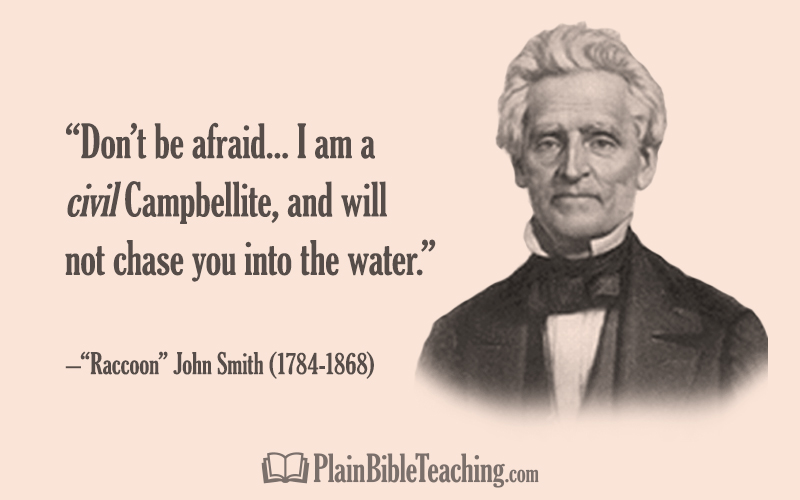
“Raccoon” John Smith (1784-1868) stopped at an inn while traveling and preaching in Alabama. As the landlady began preparing his breakfast, they struck up a conversation. When she learned that he was from Kentucky, she asked him about the “strange sort of people” she heard about “up there in Kentucky called Campbellites” (The Life of Elder John Smith, Williams, p. 393).
“Yes, madam,” replied he, “there are some in my own neighborhood.”
“You have seen some of them then?” said she.
“Yes, madam, but they don’t like that name.”
“Well, how do they look?” said she. “Do tell me, sir” (ibid. p. 394).
The reason she was anxious to learn what these “Campbellites” were like was because of the stories she heard about them. As she explained to Smith, she was told about them taking anyone who wanted to join them and putting them under the water, sometimes even taking them by force and dragging them down to the water. She told of one legend in which the “Campbellites” chased a man for five miles, plunged him in the water, and then abandoned him to find his own way home. Upon hearing all this, Smith asked what she imagined these people would look like. She said they must have “a sort of wild, fierce, fanatical look about them” (ibid. p. 394). To this, he replied:
“Madam…look right at me, and you will see one! But don’t be afraid,” continued he, seeing her start, and then blush with confusion, “I am a civil Campbellite, and will not chase you into the water” (ibid. p. 394).
This humorous account illustrates an important truth relating to our efforts to preach the gospel to the people around us: We will often have to overcome unfair prejudices and misrepresentations that close many people’s ears against the truth we proclaim before they ever have a chance to hear it. This woman heard these wild fabrications and wanted to see one of these people, much like crowds used to gather to see the sideshow performers at a circus. But until her conversation with Smith, she did not seem interested in hearing them.
This treatment of those who preach the ancient gospel is nothing new. In Philippi, Paul and Silas were falsely accused of “throwing [the] city into confusion” and “proclaiming customs” which were “not lawful” for Roman citizens to accept (Acts 16:20-21). In Jerusalem, Paul learned from the elders of the church that some were wrongly accusing him of teaching his fellow Jews “not to circumcise their children” (Acts 21:21). Later, during the same visit, some Jews from Asia lied to the crowd when they said that Paul “brought Greeks into the temple and has defiled this holy place” (Acts 21:28). When Paul eventually came to Rome, he met with the Jews there. They had not heard about him, but they had heard about the church, which they were told was a “sect” and was “spoken against everywhere” (Acts 28:21-22).
Today, faithful Christians may be accused of being bigots, misogynists, homophobic, fanatics, Pharisees, orphan-haters, “antis,” or even “Campbellites.” And those who want to turn others against us will exaggerate statements, embellish events, assign evil motives, and even fabricate falsehoods – whatever they can do to prejudice the minds of others against us.
So how should we respond? When “Raccoon” John Smith heard these outlandish stories of the “Campbellites” (a name derisively given by the opponents of the disciples in the 19th century), he did not take personal offense, get upset, and berate the woman for believing such things. Instead, he acted in a “civil” way toward her and, through his words and behavior, showed what a Christian is to be.
However, an example even better than Smith’s was related by the apostle Peter:
“For you have been called for this purpose, since Christ also suffered for you, leaving you an example for you to follow in His steps, who committed no sin, nor was any deceit found in his mouth; and while being reviled, He did not revile in return; while suffering, He uttered no threats, but kept entrusting Himself to Him who judges righteously” (1 Peter 2:21-23).
Jesus demonstrated how to react to such situations. Rather than stoop to the level of those who are falsely accusing us, we are to maintain our composure and conduct ourselves in a way that is “beyond reproach, so that the opponent will be put to shame, having nothing bad to say about us” (Titus 2:8). Peter wrote, “Keep your behavior excellent among the Gentiles, so that in the thing in which they slander you as evildoers, they may because of your good deeds, as they observe them, glorify God in the day of visitation” (1 Peter 2:12).
Timothy was a young evangelist who was taught by Paul. In the apostle’s second letter to Timothy, he reminded him about how he was to conduct himself when people would treat him unfairly for teaching the truth:
“The Lord’s bond-servant must not be quarrelsome, but be kind to all, able to teach, patient when wronged, with gentleness correcting those who are in opposition, if perhaps God may grant them repentance leading to the knowledge of the truth” (2 Timothy 2:24-25).
He needed to remember that his goal was not to defend himself against unfair attacks but to teach others the truth and turn them to Christ. As we do this today, we need to act in a “civil” manner, lest our overreaction to our unfair treatment causes others to think that there is some truth to the accusations, leading them to close their ears to the message we are trying to proclaim.