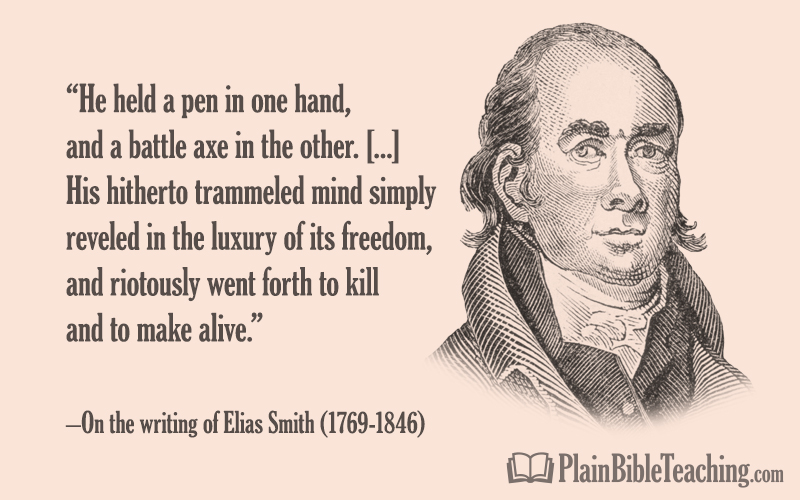
Elias Smith (1769-1846) was one of the early Restoration Movement figures in New England. His independent-thinking led him to question the commonly-held religious doctrines of his day. However, more than merely questioning such things, J. F. Burnett described Smith as having “an intense hatred for everything ecclesiastical” (Biographical Sketches, p. 68) as he observed the empty forms and traditions in the churches of his day. Eventually, he began the work of writing and publishing his own religious magazine as a way to combat the religious establishment.
“In 1805, Elder Smith began the publication of a magazine. He named it ‘The Christian’s Magazine.’ It was published once in three months, and paid for when delivered to subscribers, at twelve and one-half cents each. In this publication he scathingly criticized the established ministry of the church, and their popular sermons. He held a pen in one hand, and a battle axe in the other. All that pent-up feeling against useless forms, powdered wigs and church paraphernalia now had outlet through this printed mouthpiece. His hitherto trammeled mind simply reveled in the luxury of its freedom, and riotously went forth to kill and to make alive.” (Ibid., p. 77).
We sometimes hear the phrase, “The pen is mightier than the sword.” This is intended to emphasize just how powerful the written word can be in advancing a cause or in defeating an enemy. This is exactly what Smith set out to do through his writing.
The New Testament uses military terminology to describe the work that is done in preaching the gospel. Jude said we are to “contend earnestly for the faith” (Jude 3). Timothy was told to “fight the good fight of faith” (1 Timothy 6:12). Paul explained that although we “do not war according to the flesh,” we are involved in a spiritual war in which we are “destroying speculations and every lofty thing raised up against the knowledge of God” (2 Corinthians 10:3-5).
As we take up “the sword of the Spirit, which is the word of God” (Ephesians 6:17) in order to take “every thought captive to the obedience of Christ” (2 Corinthians 10:5), the written word can be a powerful tool in our efforts. Even today in an age of digital and video communication, writing has several advantages:*
- Words can sometimes be better expressed through writing.
- Writings can be spread around more easily.
- Writings are a lasting resource.
Through his writing and the publication of his magazine, Elias Smith was able to reach a far wider audience than he ever could within the walls of a local church’s meetinghouse. Obviously, we should not conclude from this that the local church is unimportant; rather, the point is that a message can spread broadly and efficiently through the written word. If we are not taking advantage of this medium today in spreading the truth – either in the form of our own writing or the writings of others – we need to seriously consider doing so.
At the same time, we need to recognize that such writings can make a powerful impact either positively or negatively. Burnett explained the power that an editor of a “church paper” like Smith had:
“His opportunity is to construct or destroy, to elevate or degrade, to build up or tear down, to inspire or discourage, to unite or divide the church” (Ibid., p. 78).
Whether we are writing in a “church paper” or in other “brotherhood publications,” books, blogs, or social media posts, we need to recognize the potential power of our words. A “battle axe” can be very effective in defeating an enemy, but it can also be very destructive if not used properly. With the technology available to us today, we have abundant opportunities to use the written word to help lead people to the truth, discredit the arguments of error, and influence others for good. Yet if we are reckless in the words that we use – either what we write ourselves or what we share from others – we could end up turning people away from the truth, winning sympathy for false teachers, or being a negative influence on others.
As we have opportunities to take up the metaphorical “sword” or “battle axe” in defending the truth, let us be mindful of the words that we use so that we can be as effective as possible in our efforts to teach the truth.
———
*For more on each of these points, check out this article: Preaching and Writing