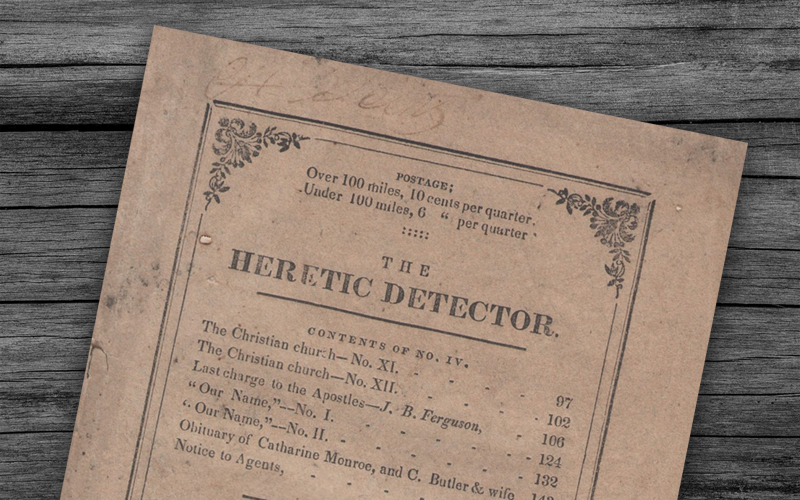
 In the nineteenth century, religious journals were a common and effective way for those who were making the “restoration plea” to spread their message far and wide. Alexander Campbell’s Christian Baptist and Millennial Harbinger were two of the most prominent journals, yet others also received wide circulation, including Barton W. Stone’s Christian Messenger, Benjamin Franklin’s American Christian Review, and the Gospel Advocate, which was started by Tolbert Fanning.
In addition to these, numerous other journals were published across the country, including the curiously named Heretic Detector, edited by Arthur Crihfield (1803-1852) and published in Middleburgh, Ohio. In a letter to the editor, Crihfield received a letter from a man named Corbly Martin, criticizing the practice of writers using “fictitious names” in these journals.
“Dear Brother Detector:—
“Among the innumerable popular evils to be detected, there is one which, although not the least, I opine, has hitherto almost entirely escaped the notice of every ‘detector’ of this detecting age. It is certainly a part of the spirit of ‘all deceivableness of unrighteousness,’ and ought to be speedily detected…
“‘Well, what is it?’ say you:—It is simply this: The practice of writing letters, essays, &c. over fictitious names. Is it in accordance with the avowed spirit of this reformation, with the simple and honest, truth loving, and unfeigning genius of the Christian religion, to publish what I would not acknowledge to be the effusion of my own pen, or head, or heart? What I could not patronize with the influence of my own proper name? Or what needed some fictitious name of great renown, of Latinized form, or of magical sound, as a passport to the world, or to the congregation of the faithful?”
“Why do not you Editors require of your contributors that which is just and equal? When you write yourselves, you assume ‘the responsibility:’—as an enterprising merchant you run the risk of ‘loss and gain.’—Why do you burden yourselves and ease your correspondents!” (The Heretic Detector, Volume 1, pp. 271-272).




 “In these pages, personal knowledge and gathered data have, in part, supplied this lack. But this source of information is, with the passing generation, rapidly going down to the dumb grave; the silent receptacle of all things human.