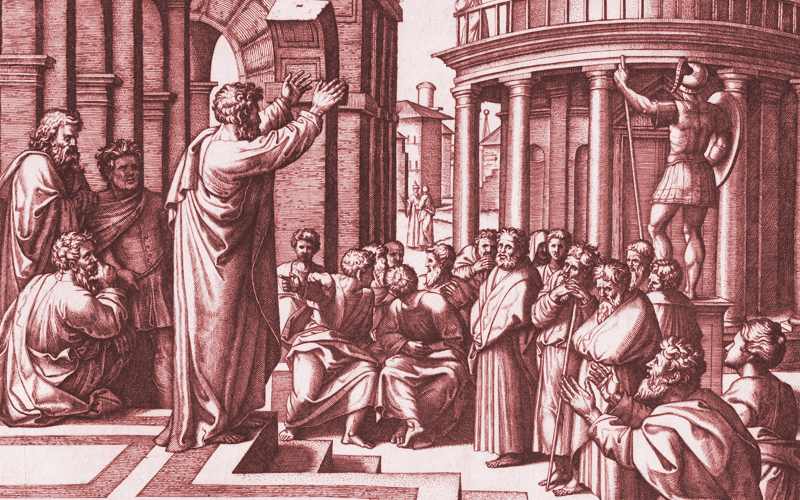
When Paul was in Athens, Luke recorded that “his spirit was being provoked within him as he was observing the city full of idols” (Acts 17:16). This prompted him to teach “in the synagogue” and “in the market place every day with those who happened to be present” (Acts 17:17). His message piqued the interest of the philosophers who brought him to the Areopagus so they could hear more about the “strange things” (Acts 17:20) he was teaching.
Though the people of the city were “very religious” (Acts 17:22), the God of heaven was “unknown” (Acts 17:23) to them. So Paul proceeded to teach them about the one true God.
“The God who made the world and all things in it, since He is Lord of heaven and earth, does not dwell in temples made with hands; nor is He served by human hands, as though He needed anything, since He Himself gives to all people life and breath and all things; and He made from one man every nation of mankind to live on all the face of the earth, having determined their appointed times and the boundaries of their habitation, that they would seek God, if perhaps they might grope for Him and find Him, though He is not far from each one of us; for in Him we live and move and exist, as even some of your own poets have said, ‘For we are His children.’ Being then the children of God, we ought not to think that the Divine Nature is like gold or silver or stone, an image formed by the art and thought of man” (Acts 17:24-29).
We encounter many today who are like the Athenians. They simply do not know God. How can we begin to teach them? Consider what Paul explained on this occasion to these pagan philosophers.
- God gives life and breath and all things – We had to come from somewhere, and we are here because God created us. Paul said that God “gives to all people life and breath and all things” (Acts 17:25). No matter who we are or where we have come from, we have been made “in the image of God” (Genesis 1:27). All that we have in this life – including life itself – is a blessing from Him. James wrote, “Every good thing given and every perfect gift is from above, coming down from the Father of lights, with whom there is no variation or shifting shadow” (James 1:17). Everything that is good in this life is ultimately from the Lord.
- God blesses us whether we serve Him or not – Paul explained that the God of heaven “does not dwell in temples made with hands; nor is He served by human hands, as though He needed anything” (Acts 17:24-25). As we noticed in the previous point, God gives “life and breath and all things” (Acts 17:25). But why does He provide these things for us? It is not because of any service we have rendered to Him. As Paul said, He does not need anything from us. He is not offering us a trade (if we serve Him, He will bless us). So many people are simply not serving the Lord. Yet, as Jesus said, “[God] causes His sun to rise on the evil and the good, and sends rain on the righteous and the unrighteous” (Matthew 5:45). Even those who have rejected God still receive blessings from Him, which is an indication of His great love for mankind.
- God blesses us whether we know of Him or not – The Athenians had an altar dedicated to “an Unknown God” (Acts 17:23). This was the God whom Paul proclaimed, but He was not known to the people here. Yet God continued to bless them even though they did not even know who He was. Earlier in his travels, Paul explained to the people of Lystra why God would do this: “In the generations gone by [God] permitted all the nations to go their own ways; and yet He did not leave Himself without witness, in that He did good and gave you rains from heaven and fruitful seasons, satisfying your hearts with food and gladness” (Acts 14:16-17). Why did God continue to bless the ones who had forgotten about Him? It was to serve as a “witness” to His existence and His goodness.
- God has made it so that we can find Him – Why would God continue to provide blessings to people who did not serve Him or even know Him? It was so they might eventually recognize His goodness and decide to “seek” Him (Acts 17:27). This search for the higher power who has provided life and all the blessings in it would not be a hopeless pursuit. Rather, Paul said, “He is not far from each one of us” (Acts 17:27). Paul wrote elsewhere that the created world reveals God’s “invisible attributes, His eternal power and divine nature,” and that these are so “clearly seen, being understood through what has been made…that they are without excuse” (Romans 1:20). Though God was “unknown” to the men of Athens (and to so many today), He was knowable; and He will reward “those who seek Him” (Hebrews 11:6).
Why should people seek after God? After all, as Paul explained, He continues to bless us with “life and breath and all things” (Acts 17:25) even if we do not serve Him or know of Him. Why not just continue to enjoy these blessings without being concerned with the one who gives them? Paul continued:
“Therefore having overlooked the times of ignorance, God is now declaring to men that all people everywhere should repent, because He has fixed a day in which He will judge the world in righteousness through a Man whom He has appointed, having furnished proof to all men by raising Him from the dead” (Acts 17:30-31).
Though God blesses us here – even if we do not serve Him or know Him – this world is only temporary. One day “the earth and its works will be burned up” (2 Peter 3:10). And even if that day is far in the future, we know that we will not live forever here on the earth. “It is appointed for men to die once and after this comes judgment” (Hebrews 9:27). The second part of that phrase – the judgment that comes after death – is why we need to seek after God. There is something beyond this life. There is a part of us that will live on after our earthly existence has come to an end.
So what should we do? Paul told the Athenians that God has called us to “repent, because He has fixed a day in which He will judge the world in righteousness” (Acts 17:30-31). One day we will all stand before the Lord in judgment (2 Corinthians 5:10) and will be judged according to His word (John 12:48). Therefore, we need to do more than just acknowledge His existence; we need to turn from our sins and follow Him.
Paul said that the resurrection of Jesus was proof of life after death (Acts 17:31). If we want to hope for eternal life with Him after this life is over, we need to turn to Him. The Hebrew writer explained that Jesus is “to all those who obey Him the source of eternal salvation” (Hebrews 5:9).
Let us recognize who God is, believe who Jesus is, turn from our sins, and faithfully obey Him. And as we encounter people in the world every day who do not know Him or serve Him, let us be ready to proclaim to them the “unknown God” so that they might know Him and follow Him as well.