After Islamist militants attacked Israeli civilians on October 7, 2023, Israel went to war against Hamas – the Palestinian militant Islamist group in Gaza. Israel’s stated mission was to wipe them out.
When this conflict escalated, many wondered how it might fit into the prophecies contained in the Bible. There was speculation that it could be a possible sign of the “end times.” This is nothing new. Anytime there is a significant military conflict involving Israel, these discussions arise.
It is helpful to know what (if anything) the Bible says about this. Matthew 24 is a key chapter to help us on this point. Unfortunately, many people misunderstand and misinterpret this chapter. However, understanding what Jesus taught there will help us answer questions about whether some current event is a sign of the end.
The Disciples’ Questions
To understand this chapter, we need to start with the questions Jesus’ disciples asked Him.
“Jesus came out from the temple and was going away when His disciples came up to point out the temple buildings to Him. And He said to them, ‘Do you not see all these things? Truly I say to you, not one stone here will be left upon another, which will not be torn down.’ As He was sitting on the Mount of Olives, the disciples came to Him privately, saying, ‘Tell us, when will these things happen, and what will be the sign of Your coming, and of the end of the age?’” (Matthew 24:1-3).
After telling His disciples that the temple would be destroyed, Jesus was asked three questions:
- When will these things happen?
- What will be the sign of Your coming?
- What will be the sign at the end of the age?
He answered these questions in this chapter.
Two Mistakes in Interpretation
If we ignore the questions posed to Jesus, it is easy to misinterpret what He taught on this occasion. Those who do this fall into two general categories:
- The Premillennialist – This person believes that Jesus is returning to establish His kingdom on the earth and reign for a thousand years. His mistake is reading Matthew 24 as if it is all about the end and possibly unfolding either now or very soon. The problem with this is the timing. Jesus said, “Truly I say to you, this generation will not pass away until all these things take place” (Matthew 24:34). The events that Jesus described in the verses leading up to that statement took place during the lifetimes of those who were listening to him on that occasion.
- The Preterist (from the word preterit, which means past) – This person believes that the second coming, the judgment, the end of the world, and the resurrection are in the past, having occurred in A.D. 70 when Jerusalem was destroyed by the Romans. His mistake is in reading Matthew 24 as if it is all about the destruction of Jerusalem in A.D. 70. The problem with this is that Jesus described a day in which they could not know when it was approaching (Matthew 24:36-37). Yet, there would be obvious signs that the Romans were coming to destroy the city.
What Jesus Taught in Matthew 24
Let us briefly consider what Jesus taught in this chapter. First, Jesus spoke of things that would take place before “the end.”
“And Jesus answered and said to them, ‘See to it that no one misleads you. For many will come in My name, saying, “I am the Christ,” and will mislead many. You will be hearing of wars and rumors of wars. See that you are not frightened, for those things must take place, but that is not yet the end. For nation will rise against nation, and kingdom against kingdom, and in various places there will be famines and earthquakes. But all these things are merely the beginning of birth pangs.
“‘Then they will deliver you to tribulation, and will kill you, and you will be hated by all nations because of My name. At that time many will fall away and will betray one another and hate one another. Many false prophets will arise and will mislead many. Because lawlessness is increased, most people’s love will grow cold. But the one who endures to the end, he will be saved.
“‘This gospel of the kingdom shall be preached in the whole world as a testimony to all the nations, and then the end will come’” (Matthew 24:4-14).
Many read Jesus’ statements about wars, earthquakes, persecution, and more and think that they are signs for us that indicate the Lord is returning soon. Yet Jesus was talking about “the end” that would occur during “this generation” (Matthew 24:34) – the generation of those who were listening to Him, not our generation today. Jesus said this “end” would come after the gospel was “preached in the whole world” (Matthew 24:14). We can use the Bible to see when this would have been. When Paul wrote to the church in Colossae (around 62 A.D.), he said the gospel had been “proclaimed in all creation under heaven” by that point (Colossians 1:23).
Second, Jesus spoke of events that would take place immediately before “the end.”
“‘Therefore when you see the Abomination of Desolation which was spoken of through Daniel the prophet, standing in the holy place (let the reader understand), then those who are in Judea must flee to the mountains. Whoever is on the housetop must not go down to get the things out that are in his house. Whoever is in the field must not turn back to get his cloak. But woe to those who are pregnant and to those who are nursing babies in those days! But pray that your flight will not be in the winter, or on a Sabbath.
“‘For then there will be a great tribulation, such as has not occurred since the beginning of the world until now, nor ever will. Unless those days had been cut short, no life would have been saved; but for the sake of the elect those days will be cut short.
“‘Then if anyone says to you, “Behold, here is the Christ,” or “There He is,” do not believe him. For false Christs and false prophets will arise and will show great signs and wonders, so as to mislead, if possible, even the elect. Behold, I have told you in advance’” (Matthew 24:15-25).
In the first part of the chapter, Jesus gave His disciples signs to look for that would let them know “the end” was coming. In these verses, He told them when they were to drop everything, leave the city, and run for their lives. He cited Daniel’s prophecy of the “Abomination of Desolation…in the holy place” (Matthew 24:15), which would mark the time when “the regular sacrifice is abolished” (Daniel 12:11; cf. 11:31).
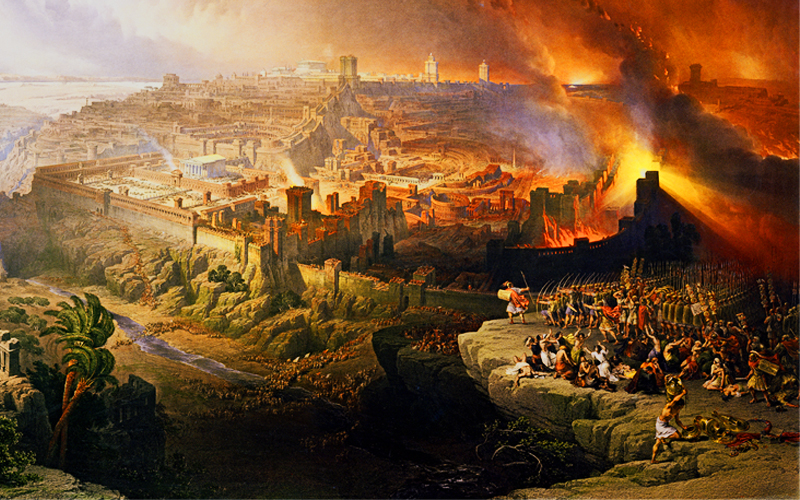
In other words, the temple in Jerusalem was going to be destroyed. This was God’s judgment against the city of Jerusalem, which would be carried out by the Romans in A.D. 70. He told His disciples to “flee to the mountains” and “pray that your flight will not be in the winter” when travel would be more difficult, “or on a Sabbath” when the city gates would be shut, and it would be hard to escape.
Third, Jesus told the parable of the fig tree.
“Now learn the parable from the fig tree: when its branch has already become tender and puts forth its leaves, you know that summer is near; so, you too, when you see all these things, recognize that He is near, right at the door. Truly I say to you, this generation will not pass away until all these things take place. Heaven and earth will pass away, but My words will not pass away” (Matthew 24:32-35).
Just as they would be able to look at the fig tree and know what season was approaching, Jesus’ disciples could look at the signs He gave them in the verses leading up to this and know that this judgment against Jerusalem was near. They would be able to see this coming, and it would occur in “this generation” (Matthew 24:34).
Fourth, Jesus spoke of a different “coming of the Son of Man.”
“But of that day and hour no one knows, not even the angels of heaven, nor the Son, but the Father alone. For the coming of the Son of Man will be just like the days of Noah. For as in those days before the flood they were eating and drinking, marrying and giving in marriage, until the day that Noah entered the ark, and they did not understand until the flood came and took them all away; so will the coming of the Son of Man be. Then there will be two men in the field; one will be taken and one will be left. Two women will be grinding at the mill; one will be taken and one will be left.
“Therefore be on the alert, for you do not know which day your Lord is coming. But be sure of this, that if the head of the house had known at what time of the night the thief was coming, he would have been on the alert and would not have allowed his house to be broken into. For this reason you also must be ready; for the Son of Man is coming at an hour when you do not think He will” (Matthew 24:36-44).
It is clear that Jesus was speaking of a different day than the judgment of Jerusalem. The first day (when Jerusalem was destroyed) was preceded by observable signs. However, “that day” (Matthew 24:36) was different. Jesus said it would occur at an unknown and unknowable date. Consider what else Jesus said about this future day of judgment:
- It would be like the flood (Matthew 24:37) in which the only “sign” was preaching that warned of judgment (cf. 2 Peter 2:5; Acts 17:30-31).
- It would result in a separation – “one…taken and one…left” (Matthew 24:40-41). Many believe Jesus was talking about a “rapture” here, but He explained in the next chapter what this separation was (Matthew 25:31-46). He was talking about the final judgment in which the righteous will be rewarded and the wicked will be punished – something He discussed on a previous occasion (cf. John 5:28-29).
- It would bring blessings for the faithful and punishment for the unfaithful. He concluded His description of this judgment with the statement, “These will go away into eternal punishment, but the righteous into eternal life” (Matthew 25:46).
- For those who were punished, this judgment would result in “eternal punishment” (Matthew 25:46). Yet the suffering that came during the judgment against Jerusalem that occurred in A.D. 70 was “cut short” (Matthew 24:22).
To summarize the points above, Jesus was not referring to just ONE event in Matthew 24. He began by warning of the hardships that would come when Jerusalem was destroyed by the Romans. He did this to prepare His disciples so they might flee when they saw the signs that the day was approaching and avoid the terrible fate coming against the city. After that, He spoke of a final day of judgment that would affect the whole world. He also discussed this in the next chapter: “But when the Son of Man comes in His glory, and all the angels with Him, then He will sit on His glorious throne. All the nations will be gathered before Him; and He will separate them from one another, as the shepherd separates the sheep from the goats” (Matthew 25:31-32). There would be no signs that would indicate when this day would be.
What This Means for Us Today
Once we understand what Jesus was teaching in Matthew 24, there are a few points we need to learn from it.
First, we need to be careful about connecting current events to Bible prophecies. Jesus warned that false prophets would try to mislead His people then (Matthew 24:23-25), and false teachers do the same today. A number of so-called prophets build a following for themselves by convincing people that the events in the news today show that the end of the world is coming. Yet time and time again, their “prophecies” come to nothing, and the world still stands because the day that God has appointed (cf. Acts 17:31) has not yet come. We are not to listen to those who claim to prophesy for God, whose prophecies continue to fail.
Second, we need to prepare for a final judgment when the Lord returns. Paul wrote, “For we must all appear before the judgment seat of Christ, so that each one may be recompensed for his deeds in the body, according to what he has done, whether good or bad” (2 Corinthians 5:10). The standard this judgment will be based upon is the Lord’s word (John 12:48). Therefore, we need to make sure that the things we do are in harmony with the will of the Lord that has been revealed in the Scriptures.
Third, we need to be ready at all times. Jesus said, “Therefore be on the alert, for you do not know which day your Lord is coming” (Matthew 24:42). Just as a thief targets our house at an unexpected time, Jesus will return “at an hour when you do not think He will” (Matthew 24:43-44). Rather than looking for signs that indicate it is time to prepare, we need to look to God’s word and follow it so that we will always be prepared whenever the end comes.
Conclusion
The city of Jerusalem was destroyed because the Jewish nation (as a whole) rejected Christ. Jesus warned His disciples about this so they could escape before the Roman army came in. He also warned of a final judgment – one for which there will be no signs to warn us that it is drawing near. Therefore, we must always be ready for this day by faithfully serving Him throughout our lives.