“Jesus summoned His twelve disciples and gave them authority over unclean spirits, to cast them out, and to heal every kind of disease and every kind of sickness. Now the names of the twelve apostles are these: The first, Simon, who is called Peter, and Andrew his brother; and James the son of Zebedee, and John his brother; Philip and Bartholomew; Thomas and Matthew the tax collector; James the son of Alphaeus, and Thaddaeus; Simon the Zealot, and Judas Iscariot, the one who betrayed Him” (Matthew 10:1-4).
After spending an extensive amount of time with them over a period of three years, Jesus sent His apostles into all the world to preach the gospel. These men were chosen from various backgrounds. We do not know what all of them did before Jesus called them, but we do know this for a few.
For those whose backgrounds are known, there are some lessons we can learn. We can also see that Jesus offered them (and us) something far better than any earthly employment.
Their Professions Before Becoming Apostles
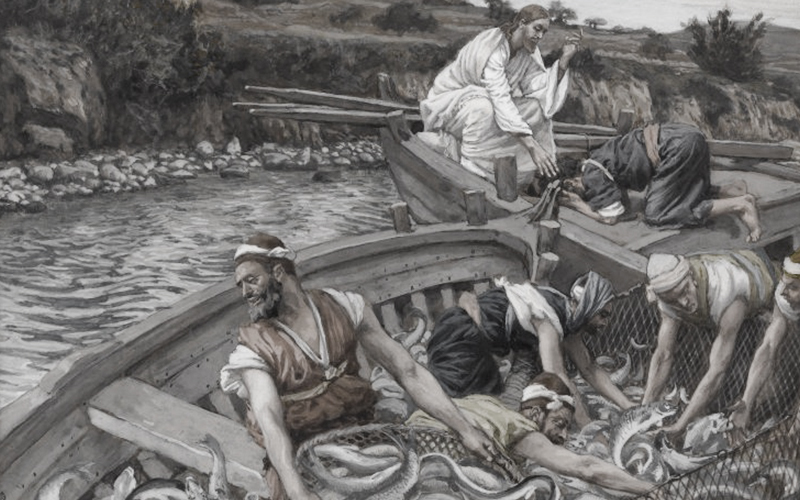
Fishermen – “Now as Jesus was walking by the Sea of Galilee, He saw two brothers, Simon who was called Peter, and Andrew his brother, casting a net into the sea; for they were fishermen. And He said to them, ‘Follow Me, and I will make you fishers of men.’ Immediately they left their nets and followed Him. Going on from there He saw two other brothers, James the son of Zebedee, and John his brother, in the boat with Zebedee their father, mending their nets; and He called them” (Matthew 4:18-21). Of the twelve original apostles, a third of them were fishermen. This work was physically demanding and required them to work into the night (cf. Luke 5:1-7). Not everyone was cut out for that type of employment. It was also a dangerous work, as even experienced fishermen could get caught up in a violent storm (cf. Luke 8:22-24). In many cases, it was also a family business (cf. Matthew 4:21-22). This is what they knew, and it was part of their identity.
Tax collector – “After that He went out and noticed a tax collector named Levi sitting in the tax booth, and He said to him, ‘Follow Me.’ And he left everything behind, and got up and began to follow Him” (Luke 5:27-28). Levi, or Matthew (Matthew 10:3), was a tax collector. This work connected him with the Romans, and many looked down on tax collectors for this reason. They were associated with sinners (cf. Luke 5:29-30), and many of them earned a bad reputation by defrauding people (Luke 19:8) and collecting more than they were told to collect (Luke 3:12-13).
Zealot – “…and Matthew and Thomas; James the son of Alphaeus, and Simon who was called the Zealot…” (Luke 6:15). This was not a “profession” in the sense of a job like the others. Instead, it was a profession of allegiance. Unlike the tax collectors who worked for the Romans, the Zealots opposed them. They followed the same ideology as Judas of Galilee who “rose up in the days of the census” (Acts 5:37). However, they were not rebels simply for the sake of being rebellious. They were religiously motivated. As Thayer pointed out, the zealots “endeavored even by a resort of violence to prevent religion from being violated by others.”
Tentmaker – “And because he was of the same trade, [Paul] stayed with them and they were working, for by trade they were tent-makers” (Acts 18:3). Making tents involved skilled labor. It was a step up from the fishermen, but still very much involved in manual labor. It was the type of work that would be useful in every location Paul visited, as he regularly needed to work to provide for himself while he preached the gospel (cf. Acts 20:34; 2 Thessalonians 3:8).
How Jesus Offered Something Better
Fishers of men – Jesus made this connection when He called Peter and Andrew to follow Him: “Follow Me, and I will make you fishers of men” (Matthew 4:19). It is good to be productive in one’s profession, and these men certainly were, but it is far more important to help lead souls to Christ. The wise man wrote, “The fruit of the righteous is a tree of life, and he who is wise wins souls” (Proverbs 11:30). However, if we are going to “win souls” as “fishers of men,” we need to use the right “bait.” To use another analogy, the word of God is the seed we plant in the hearts of men (Luke 8:5, 11) because the gospel “is the power of God for salvation” (Romans 1:16). Therefore, we must remember Paul’s admonition to Timothy as we seek to lead people to Christ: “Preach the word; be ready in season and out of season; reprove, rebuke, exhort, with great patience and instruction” (2 Timothy 4:2).
Citizens of a heavenly kingdom – Unlike the Roman Empire, God’s kingdom would “endure forever” (Daniel 2:44). When Jesus stood before Pilate, He told the Roman governor, “My kingdom is not of this world. If My kingdom were of this world, then My servants would be fighting so that I would not be handed over to the Jews; but as it is, My kingdom is not of this realm” (John 18:36). As citizens of this kingdom, we must keep our allegiance in the proper place. This is why Peter told the Jewish rulers, “We must obey God rather than men” (Acts 5:29). While we live and work in and among the kingdoms of men today, we need to remember that “our citizenship is in heaven” and “eagerly wait” for the Lord’s return (Philippians 3:20-21).
True freedom – The zealots wanted freedom from their Roman oppressors, but Jesus offered a better freedom. As His disciples, we can be made free from sin (John 8:31-36). Yet Paul explained that we have this freedom if we become slaves of righteousness: “Do you not know that when you present yourselves to someone as slaves for obedience, you are slaves of the one whom you obey, either of sin resulting in death, or of obedience resulting in righteousness? But thanks be to God that though you were slaves of sin, you became obedient from the heart to that form of teaching to which you were committed, and having been freed from sin, you became slaves of righteousness” (Romans 6:16-18). Because we are servants of Christ, we can “act as free men” (1 Peter 2:16) even under a tyrannical government (1 Peter 2:13-15; cf. Acts 5:29).
A house not made with hands – Earthly tents are temporary, no matter how skilled the tentmaker is, but God offers something eternal. The world in which we live is passing away (1 John 2:17) and will one day be destroyed (2 Peter 3:10). Our bodies were not made to last forever, as Paul wrote, “Therefore we do not lose heart, but though our outer man is decaying, yet our inner man is being renewed day by day” (2 Corinthians 4:16). Yet God has prepared for us an eternal home in heaven with Him: “For we know that if the earthly tent which is our house is torn down, we have a building from God, a house not made with hands, eternal in the heavens. For indeed in this house we groan, longing to be clothed with our dwelling from heaven” (2 Corinthians 5:1-2).
Conclusion
One did not need a certain educational or professional background to be called as an apostle. We also do not need these to become a Christian. Instead, we need to believe in Christ and obey His will, just as the apostles did.