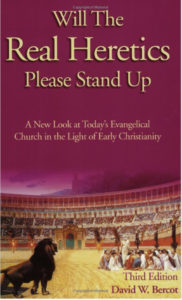
 David W. Bercot’s book, Will the Real Heretics Please Stand Up, compares Christianity today (defined by the author as the Evangelical Church) with the early Christians (2nd through 4th centuries). The book is very easy to read, but contains some challenging and thought-provoking material, specifically for Evangelicals. But it is helpful for others as well.
This book shows the sharp contrast between what many denominations today teach and what the early Christians taught. The early Christians believed that salvation by grace was conditioned upon obedience, that baptism was tied to salvation, and that predestination refers to God’s foreknowledge, rather than His selection of certain individuals for salvation. Many denominations teach just the opposite (salvation by grace/faith alone, baptism not essential for salvation, God predestined some individuals for salvation and some for damnation).
This book helps one get an insight into what the early church was like and what they taught. But before I can recommend the book, I need to caution you about a few things:
- The writings of the early Christians are not inspired. We should not base our beliefs and practices on what they said. They can provide good insight, but the Bible is the inspired word of God. These writings should not be placed on that level. If we should find a conflict between what the early Christians wrote and what the apostles wrote, we must accept the words of the apostles (1 John 4:6).
- The primary audience is the “Evangelical Church” (Protestantism, denominationalism). This book is really about getting back to the time before there were denominations. While there are certainly lessons for those who are already following Christ apart from the churches of men, the value of this book is much greater when we understand the author’s intended audience. I ignored this the first time I read this book. I’ve read it two more times since then with this understanding and I’ve gotten much more out of it as a result.
- The author does not necessarily call readers to abandon the doctrines of men, just that they be more open and tolerant of other viewpoints. This is unfortunate. It is the viewpoints that have arisen apart from the word of God that have led to the division and corruption in the religious world today. We must abandon the teachings of men and embrace the doctrine of Christ. Tolerating and accepting viewpoints that stand in conflict with God’s revealed word is not the answer.
- The author spends a good deal of time going through religious history – the early church, rise of Roman Catholicism, the Reformation, the Radical Reformation, the Church of England. But oddly, he does not even mention the Restoration Movement that began in this country in the 1800’s. The Restoration plea was for people to abandon the beliefs and practices of men and leave the churches of men in order to serve the Lord in His church according to His word alone. It seems the direction of the book would naturally lead to this same plea, so it would have been logical to talk about those who began the movement in this country. Sadly, Bercot left all of this out.
With these limitations understood, I would recommend this book for those looking for a brief study of the writings of early Christians and how they compare with common denominational doctrines today.
It could be that when you read this book, you find a few (or many) things that you believe are not in harmony with the early Christians the author cites. If this is the case, I would not encourage you to immediately change your beliefs and practices. However, I would strongly urge you to search the Scriptures as the noble-minded Bereans did (Acts 17:11). After an honest and thoughtful investigation of the word of God, follow what it teaches. We must believe and practice the things contained in the doctrine of Christ, whether that’s what we’ve always believed, what the early Christians believed, or something in between.
This book is available at Amazon.com – Will the Real Heretics Please Stand Up: A New Look at Today’s Evangelical Church in the Light of Early Christianity (affiliate link)