The Heresy Trial of Jesse L. Sewell

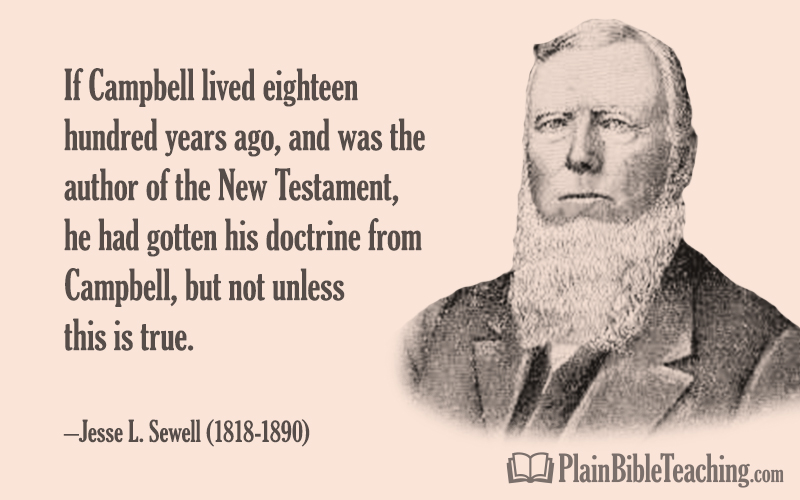
Jesse L. Sewell (1818-1890)Jesse L. Sewell (1818-1890) was a Tennessee preacher who sincerely wanted to please God and to proclaim what he found to be taught in the Bible. Eventually, he became connected with the Restoration Movement. It was common for these preachers to begin their work within the denominations before breaking away to follow the New Testament as their only rule of faith and practice. Sewell followed this course, having his start among the Baptists.

However, his Baptist brethren took exception to his preaching, and he was tried for heresy in December 1842. The charge against him was that he had “run fully into Campbellism” (The Life and Sermons of Jesse L. Sewell, p. 54), a label pejoratively given to those who allegedly followed the teachings of Alexander Campbell (1788-1866), a prominent figure in the Restoration Movement. Peter Ragan, a visiting preacher, offered this definition of “Campbellism”: “It denied faith, repentance and the influence of the Spirit, and made a God of the water” (ibid., p. 54). Sewell dismissed the allegation against him.

“If Campbell lived eighteen hundred years ago, and was the author of the New Testament, he had gotten his doctrine from Campbell, but not unless this is true” (ibid., p. 54).
Continue Reading

Studying the History of Fallible Religious Leaders

Restoration Movement Leaders

Besides studying the Bible, the topic I enjoy learning about the most is religious history – particularly the history of the Restoration Movement (sometimes called the Stone-Campbell Movement). This was a period in the 19th and early 20th centuries in the United States in which many were troubled by the divisions they saw in the religious world and endeavored to correct this by striving to simply go back to the Bible and follow it alone as their only rule of faith and practice.

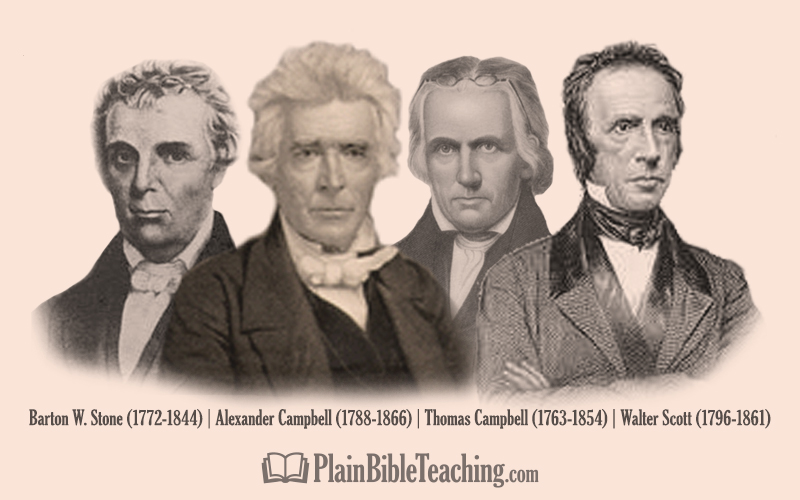
Some of the more influential figures in this movement were Thomas and Alexander Campbell, Barton W. Stone, and Walter Scott. Usually when people think of this history today, these are the men who come to mind. As we begin to study this history, we learn of others who played a significant role in the direction of this movement – men like Moses Lard, Benjamin Franklin, Daniel Sommer, and David Lipscomb. Going deeper into the study of this history, we can learn about the contributions of others like David Purviance, Pardee Butler, Samuel Robert Cassius, and more – men who may have been largely forgotten, but can provide us with some valuable lessons.*Continue Reading

The Reformation and the Restoration: A Tale of Two Movements

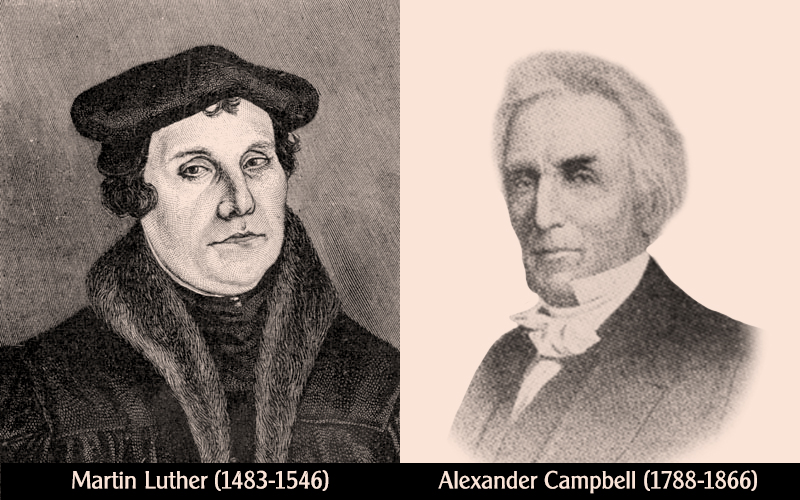
Martin Luther and Alexander Campbell

The New Testament repeatedly warns about drifting; in particular, drifting away from the faith. This can be done either individually or collectively.

  • The Hebrew writer warned the Christians to whom he wrote that they “must pay much closer attention to what [they had] heard, so that [they would] not drift away from it” (Hebrews 2:1).
  • The Lord Himself rebuked the church in Ephesus because they had “left [their] first love” (Revelation 2:4).

There is always a danger that any one of us – or any one of our churches – could drift away from the faith. However, Paul also warned about a great apostasy that was coming not long after his lifetime.

Let no one in any way deceive you, for it [the return of Christ, as] will not come unless the apostasy comes first, and the man of lawlessness is revealed, the son of destruction, who opposes and exalts himself above every so-called god or object of worship, so that he takes his seat in the temple of God, displaying himself as being God. Do you not remember that while I was still with you, I was telling you these things?” (2 Thessalonians 2:3-5).

Paul explained that this “mystery of lawlessness [was] already at work” (2 Thessalonians 2:7). As he described this “man of lawlessness,” he was not referring to one person, but an attitude. This apostasy would take place over some period of time. It was a spirit of error, an attitude that led Christians to depart from the pattern revealed in the New Testament. It was “restrained” for a time (2 Thessalonians 2:6-7) by the persecution from the Roman authorities. However, once that opposition was removed, the departures from the faith would increase exponentially.Continue Reading

Thomas Campbell: “Where the Bible Speaks, We Speak; Where the Bible Is Silent, We Are Silent”

Thomas Campbell: "Where the Bible Speaks, We Speak"

Thomas Campbell (1763-1854) was one of the leading figures of the Restoration Movement that began in this country in the 19th century. He, along with men like Alexander Campbell (his son), Barton W. Stone, and Walter Scott, sought to unite believers by abandoning the creeds and denominations of men. In a speech delivered in 1808, Thomas Campbell set forth an idea that became a motto for the movement.
Continue Reading

Audio: Gospel Meeting at the Eastside church of Christ

I had the privilege of speaking in a Gospel Meeting at the Eastside church of Christ in Morgantown, KY this past week – October 17-19, 2013. The three lessons I preached are listed below.
Continue Reading

Book Review: Torn Asunder

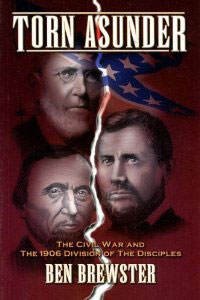
Torn Asunder (cover)I recently finished reading Torn Asunder: The Civil War and the 1906 Division of the Disciples by Ben Brewster. The book is about the history of the Restoration Movement leading up to the officially recognized division between the Disciples of Christ and the churches of Christ in 1906. But the author took an interesting approach by looking at how the Civil War impacted this division. An excerpt from the book is below:
Continue Reading

Book Review: Will the Real Heretics Please Stand Up

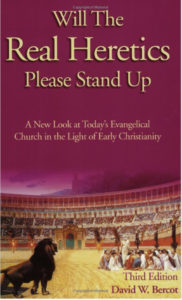
Will the Real Heretics Please Stand Up (cover)David W. Bercot’s book, Will the Real Heretics Please Stand Up, compares Christianity today (defined by the author as the Evangelical Church) with the early Christians (2nd through 4th centuries). The book is very easy to read, but contains some challenging and thought-provoking material, specifically for Evangelicals. But it is helpful for others as well.

This book shows the sharp contrast between what many denominations today teach and what the early Christians taught. The early Christians believed that salvation by grace was conditioned upon obedience, that baptism was tied to salvation, and that predestination refers to God’s foreknowledge, rather than His selection of certain individuals for salvation. Many denominations teach just the opposite (salvation by grace/faith alone, baptism not essential for salvation, God predestined some individuals for salvation and some for damnation).

This book helps one get an insight into what the early church was like and what they taught. But before I can recommend the book, I need to caution you about a few things:
Continue Reading