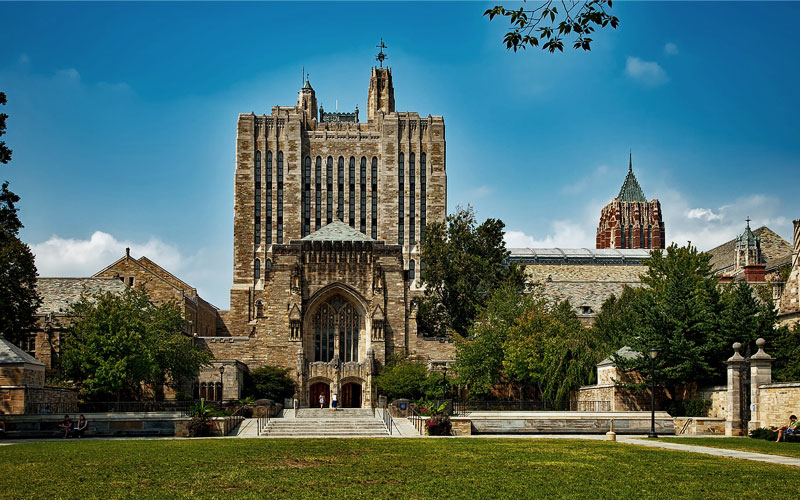
In our society, a great deal of emphasis is placed upon obtaining a college education in order to prepare for secular employment. For many careers, this is helpful. For some, it is essential. Therefore, many people pursue a secular education in an institution of higher learning in order to best prepare themselves to find what they consider to be good jobs.
However, there is a type of education that is far more important than the education that prepares one for employment. This higher education is not for secular pursuits, but spiritual. It prepares us not for the work force (at least not directly), but for our service to God. Its purpose is not to help us obtain a high-paying job with good benefits, but to help us obtain eternal life.
Strangely, some act as though an institution devoted to secular education is also the preferred institution for their spiritual education. But God has created His own institution of higher education – the church. It has everything we need for the pursuit of a higher (i.e. from God) education. Let us notice what the Bible says about this institution of higher education.
God’s Institution of Higher Education
The Institution – The institution that God ordained with the mission of educating the world of His will is the local church. Paul described the church as “the pillar and support of the truth” (1 Timothy 3:15). When the Holy Spirit needed to find teachers who would instruct others of God’s message, the institution He visited was not a college or any other human organization. He went to the local church: “Now there were at Antioch, in the church that was there, prophets and teachers… The Holy Spirit said, ‘Set apart for Me Barnabas and Saul for the work to which I have called them’” (Acts 13:1-2). This body, working properly according to God’s design, would result in “the growth of the body for the building up of itself in love” (Ephesians 4:16). The institution God established and ordained for the purpose of instructing people in His ways is the church.
The Curriculum – The subject matter to be taught by God’s divinely appointed institution – the church – is His word. Again, Paul said the church was “the pillar and support of the truth” (1 Timothy 3:15). But what is “the truth”? The word of God is truth (John 17:17; Psalm 119:160). The Scriptures contain the words that are “inspired by God” (2 Timothy 3:16). The church, as God’s institution of higher education, must “retain the standard of sound words” (2 Timothy 1:13) found in the Scriptures – not go beyond it (2 John 9), fall short of it (Acts 20:27), or change any part of it (Galatians 1:6-9). The curriculum that God expects His church to teach is the pure and plain truth found in His word.
The Instructors – The instructors found in the church today are evangelists, elders, and teachers. Paul told the Ephesians, “And He gave some as apostles, and some as prophets, and some as evangelists, and some as pastors and teachers, for the equipping of the saints for the work of service, to the building up of the body of Christ” (Ephesians 4:11-12). Apostles held the special role of being Christ’s “ambassadors” (2 Corinthians 5:20) and had to be witnesses of Christ on the earth (Acts 1:8, 21-22). Therefore, there are no living apostles today. There are also no living prophets today since the word of God has been completely revealed (1 Corinthians 13:8-10). But we do have evangelists (preachers), pastors (elders), and teachers. These instructors have the responsibility to speak “the utterances of God” (1 Peter 4:11). This is accomplished by doing what Paul did as he “reasoned…from the Scriptures” (Acts 17:2). Any instructor that fails to do this and teaches another doctrine instead “is to be accursed” (Galatians 1:8-9).
The Administrators – The administrators that God put in place to oversee the local church are the elders. Peter instructed the elders: “Shepherd the flock of God among you, exercising oversight” (1 Peter 5:2). Paul told the elders in Ephesus: “Be on guard for yourselves and for all the flock, among which the Holy Spirit has made you overseers, to shepherd the church of God which He purchased with His own blood” (Acts 20:28). The eldership is not open to just anyone, but only to those who meet certain qualifications (1 Timothy 3:1-7; Titus 1:5-9). We also do not find any congregation being overseen by a single elder. Instead, we read of “elders” being appointed “in every church” (Acts 14:23). Their primary responsibility is to “keep watch over [the] souls” of the congregation in which they serve (Hebrews 13:17).
The Students – The student body of this divine institution of higher education (the local church) is made up of Christians. Those who obey the gospel and are baptized into Christ (Acts 2:37-41) are then added by God to the universal church (Acts 2:47). Those who obey the gospel become “disciples” (Matthew 28:19) – which means they are learners – and are then taught to follow the word of God (Matthew 28:20). However, the instruction found in the assembly of the local church is open to anyone who is willing to listen (1 Corinthians 14:24-25; Matthew 11:15). When Paul met with the disciples in Ephesus in“the lecture hall of Tyrannus” (Acts 19:9, NIV), not only did the disciples hear his teaching, but “all who lived in Asia heard the word of the Lord” (Acts 19:10).
The Exams – We will regularly be tested on what we learn. This will not come in the form of written exams. Rather, we will be tested through the trials (James 1:2-4), temptations (James 1:13-16; 1 Corinthians 10:13), questions (1 Peter 3:15), and persecutions (2 Timothy 2:13; Revelation 2:10) that exist in life.
The Final Exam – In the end, we will “all appear before the judgment seat of Christ, so that each one may be recompensed for his deeds in the body, according to what he has done, whether good or bad” (2 Corinthians 5:10). This judgment will be based upon how we have lived according to the curriculum we are expected to learn – the word of the Lord (John 12:48).
Summary
The local church as God designed it is the best place for one to pursue his spiritual education. Any deficiencies, real or perceived, in a particular congregation are not there because God’s design is flawed, but because the congregation is not living up to God’s design. This could happen for any number of reasons (elders failing to oversee as they should, preachers proclaiming something other than or in addition to the word of God, members not being interested in spiritual things, etc.). But God’s design of the local church cannot be improved upon when it comes to our spiritual education.
Secular Institutions for Spiritual Education?
There is a question that ought to be considered when it comes to our spiritual education: Is there a good way to include both secular and spiritual instruction in a man-made institution of higher learning?
It may seem like a good idea to combine secular and spiritual education in a college operated by brethren. It has been tried many times. But history has shown that every education institution among brethren – from Bethany College to Florida College – will, over time, fall from the original good intentions of their founders and follow the path of liberalism and compromise of Biblical principles.
Why does this happen? Simply put, no man or group of men can make a human institution (college) that can come close to rivaling the divinely designed church of Christ. Any efforts by these human institutions to provide for one’s spiritual education will be inferior at best and, at worst, hazardous to one’s soul.
Why Secular Institutions Fall Short
There are a few reasons why secular institutions (i.e. colleges) are simply not able to provide a spiritual education as effectively as the church.
- They were designed by men – God’s ways and thoughts are higher than man’s (Isaiah 55:8-9). Paul said, “The foolishness of God is wiser than men” (1 Corinthians 1:25). God, in His infinite wisdom, designed the church to proclaim the truth (educate man to know His word). Regardless of intentions, fallible men will never design an institution that can provide a spiritual education that rivals the institution that God designed.
- Their focus is divided – Though many churches involve themselves in secular pursuits, churches that follow the New Testament pattern will be focused on upholding and teaching the truth (1 Timothy 3:15; Ephesians 4:11-16). The college that seeks to provide a spiritual education cannot focus exclusively on it the way a sound church can. The college must direct much of its focus to secular education. Not only this, but attention must also be given to things like athletics, performing arts, social clubs and events, etc. The local church that is following the pattern in the New Testament does not distract itself with any of these.
- Compromise is a necessity – Why has every college established by brethren followed the path of compromise with regard to the spiritual principles they are supposedly trying to teach to their students? It is because such compromise is necessary for the survival of the college. Compromise makes it easier to keep a full faculty. Compromise also allows them to appeal to a broader base of potential students and benefactors whose tuition fees and donations allow the college to stay in business (do not forget that it is a business). This is not so much an issue if the college limits itself to secular education; but when it seeks to do the spiritual work of teaching the word of God (through Bible classes, chapel services, and lectureships), the individuals involved ought to respect the Scriptural bounds of fellowship (2 John 9-11; Romans 16:17; Ephesians 5:11; 2 Thessalonians 3:6).
The Church is Sufficient
The institution God designed and established – the church – is fully sufficient to do the work He gave it to do. Brethren often look to the “brotherhood colleges” for certain things that they ought to look to the church for instead.
- Spiritual growth – Many choose to attend a “brotherhood college” for the purpose of growing spiritually. Yet the local church, functioning as God intended, “causes the growth of the body for the building up of itself in love” (Ephesians 4:16).
- Training preachers – Some look to “brotherhood colleges” to train preachers. Yet Paul told Timothy, “The things which you have heard from me in the presence of many witnesses, entrust these to faithful men who will be able to teach others also” (2 Timothy 2:2). Paul trained Timothy to preach and he was to help train others to do the same. How did Paul train Timothy? He taught him – not as part of a college course open only to those who paid a tuition fee to enter, but rather “in the presence of many witnesses.” In other words, the instructions used to train Timothy were not just for aspiring preachers, but for all men.
- Fellowship with like-minded brethren – The appeal of “brotherhood colleges” is often the fact that by attending, one is surrounded by those who are, for the most part, like-minded Christians. The reality is that one is surrounded by those who believe and practice many things contrary to the word of God. It is then often easier to compromise than to practice the Scriptural rules of fellowship (2 John 9-11; Romans 16:17; Ephesians 5:11; 2 Thessalonians 3:6). It is better to pursue “the unity of the faith” in “the body of Christ” that God designed (Ephesians 4:12-13). There will still be times when sin must be disciplined (1 Corinthians 5:1-3, 11) and error must be opposed (Galatians 2:11-14), but it is much more difficult to do this in a religio-secular institution like a college than a wholly spiritual institution like a local church.
- A “spiritual atmosphere” – Many love the “spiritual atmosphere” they find at a “brotherhood college.” But what exactly does this mean? Often, emotional is mistaken for spiritual. There is no human institution that can rival the “spiritual atmosphere” of the church as God designed it.
Conclusion
Colleges – even colleges operated by brethren – may be able to do a great job at providing a secular education. But when it comes to providing a spiritual education, no human organization can compare with the church – the institution that has been designed and ordained by God for this work. Instead of looking to colleges or any other human organization for our higher (spiritual) education, let us look to the Lord’s organization – the local church.











Andy, this article should be read by all concern Christian, and especially parents of young Christian, a lot of time they go to these places to looking for a spouse, these places will all eventually all go the way of man, Jeremiah 10:23 say it not in man to direct his steps, and Proverbs 16:25 says, there is a way that seems right to a man, but in the end it leads to death. Thanks for your good work for our Lord.
Carlos Raymer
Thank you, Carlos. I appreciate your support. I wish more young people & their parents would think about these things and recognize the limitations of these schools and the potential dangers that come from misunderstanding their proper purpose.
Andy,
You have written another excellent article and I admire your determination to speak the truth in every situation. Keep up the good work and continue to “speak the truth in love” as the truth is the only thing that will save our soul.
Thank you, Wayne. I hope brethren receive this in the spirit it was intended.