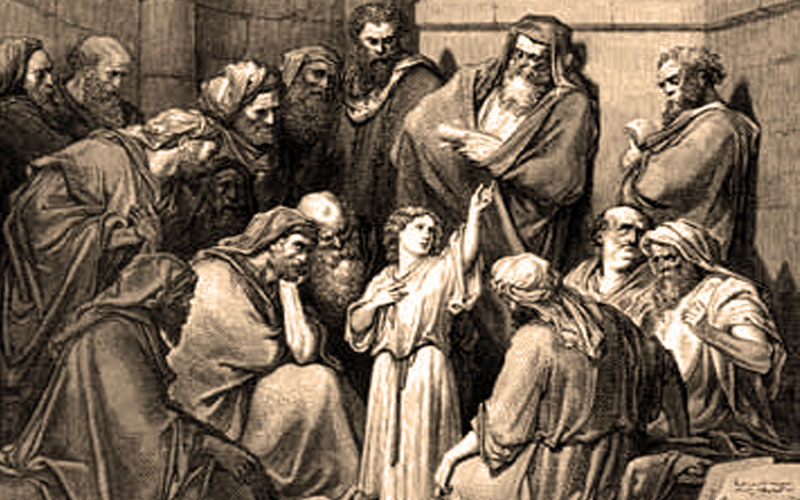
In our last article, we looked at some good questions asked of a teacher that related to spiritual things. However, not all questions are asked by those needing information. Sometimes questions are asked by a teacher as a way to challenge his audience. Notice the example of Jesus when He was a young boy:
“Then, after three days they found Him in the temple, sitting in the midst of the teachers, both listening to them and asking questions. And all who heard Him were amazed at His understanding and His answers” (Luke 2:46-47).
Jesus was God in the flesh (John 1:1, 14). He was not asking questions because He lacked understanding and was seeking instruction. He asked questions as a way to teach. The understanding and answers He imparted while His flesh and blood body was just twelve years old amazed those who heard Him.
This was not the only time Jesus employed this method of teaching. In this article, we will notice just a few examples in the Scriptures of questions that were asked by teachers as a way to lead their hearers to the truth.
“Who do people say that the Son of Man is?” “But who do you say that I am?” (Matthew 16:13, 15) – When Jesus asked these two questions of His disciples, He was challenging them to do two things. First, He wanted them to recognize what others were saying about Him. It is important to know what others teach that is contrary to the truth – particularly those who may have some influence over us. Paul said, “Keep your eye on those who cause dissensions and hindrances contrary to the teaching which you learned.” Those who are “unsuspecting” run the risk of being deceived by such errorists (Romans 16:17-18). Second, Jesus wanted them to be able to articulate what they believed. It was not enough to mentally believe in Jesus – they needed to be able to speak out about their belief (1 Peter 3:15).
“The baptism of John was from what source, from heaven or from men?” (Matthew 21:25) – Jesus asked this in response to the question posed to Him by the chief priests and elders [see previous article]. They questioned Jesus about authority (Matthew 21:23). Though they were challenging Jesus, their question was actually a good one. When Jesus responded with this question, He forced them to recognize that there were only two sources of authority – “from heaven or from men.” He issued a challenge to them to examine a specific practice (the baptism of John) and determine the source of its authority. This is a good question to ask people today. What is the source of authority for a particular practice. There are only two options. If it is “from heaven,” then we must accept and practice it.
“Are we to continue in sin so that grace may increase?” (Romans 6:1) – In the first century, some were turning “the grace of God into a license for immorality” (Jude 4, NIV). This was the mentality that Paul had to address when he wrote to the saints in Rome. By asking a question, he challenged their belief and attempted to cast doubt on what they erroneously believed to be true. Once he asked the question to introduce the subject and cast doubt on their conclusion, he immediately answered it: “May it never be! How shall we who died to sin still live in it?” (Romans 6:2) [Note: It is not always necessary to wait for a response to a question for it to be effective in teaching. The question can be posed and answered by the teacher, just as Paul did here.] Paul went on to explain that those who have been baptized and raised to walk in newness of life (Romans 6:3-4) are obligated to “consider [themselves] to be dead to sin, but alive to God in Christ Jesus” (Romans 6:11). Questions may be asked to cast doubt on a position, then answered with the truth on the subject.
“You were running well; who hindered you from obeying the truth?” (Galatians 5:7) – After warning about the danger that exists for a Christian to fall from grace (Galatians 5:4), Paul asked this question to encourage them to reflect on the reason why they were stumbling. The Hebrew writer explained that we must “lay aside every encumbrance and the sin which so easily entangles us” (Hebrews 12:1). Do we recognize what is hindering us? Do we notice the sin in our lives that needs to be eliminated? Are we aware of the things in our lives that may otherwise be harmless in themselves, but are distracting us from serving the Lord as we ought? We need to examine ourselves (2 Corinthians 13:5) and see what stumbling blocks exist in our lives so that we might work to remove them. Questions like the one Paul asked of the Galatians are good to help us remember the importance of self-evaluation and continued growth and faithfulness in our service to God.
These are just a few examples of questions that were asked not to obtain information, but to challenge the hearers and direct them toward spiritual truths. As we teach others, we can use the same method of asking questions as we try to lead others to a life of obedient faith.










