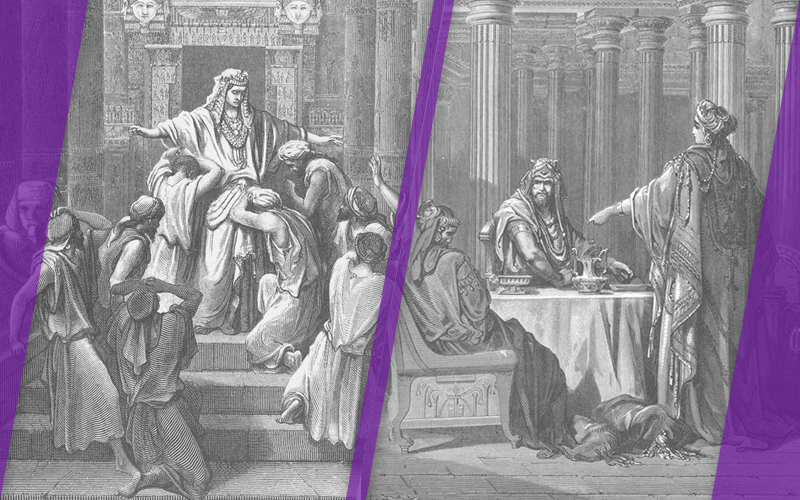
In this article, we will examine the lives of two young people we can read about in the Bible – Joseph and Esther. Their lives were separated by about 1,400 years, and they are both much further separated from us today. Yet their examples teach us some important lessons.
Many young people are tempted to sin in various ways (using bad language, dressing immodestly, using drugs or alcohol, identifying themselves with the LGBTQ ideology, etc.) because they feel the need to have the approval of others. Of course, this problem is not limited to those who are young – everyone can face these same pressures. What makes them especially challenging for young people is that they have not yet learned how to deal with these pressures. Because of this, they feel as if they are, in a sense, dependent upon the approval of those around them. This can be difficult and stressful because other people are constantly changing their values, priorities, morals, etc. What they want from us can differ from one day to the next.
However, there is a peace that comes by being dependent upon God. This will make us, in a sense, independent of the approval of others. In other words, gaining the favor of the world for our opinions and behaviors will not seem nearly as important when we focus on God and gaining His approval. Yet in order for this to work correctly, we must never see ourselves as independent from God.
So let us consider what we can learn from Joseph and Esther – how they demonstrated their dependence upon God and how we can do the same today.
Similarities between Joseph and Esther
Why are we considering these two particular individuals? It is not just that both show us a positive example. It is also because their lives were similar in many ways:
- Both were young people in a foreign land – Joseph in Egypt (Genesis 37:25-28; 39:1) and Esther in Persia (Esther 2:5-7).
- Both were put in a certain position without any choice on their part – Joseph was over Potiphar’s house (Genesis 39:2-6), and Esther became queen (Esther 2:8, 16-17).
- Both kept their identities a secret – Joseph from his brothers when they came to buy food (Genesis 42:7) and Esther from the king and others in the palace for her safety (Esther 2:10, 20).
- Both maintained their faith in God – Joseph knew God would bring them back to their homeland (Genesis 50:24-25), and Esther put her trust in God as she prepared to go to the king on behalf of her people (Esther 4:14-16). This point is critical!
- Both saved the people of God – Joseph from the famine (Genesis 45:4-11) and Esther from genocide (Esther 8:3-14).
Now that we have briefly listed the similarities between these two young people, let us see how they demonstrated their dependence on God.
How Joseph Demonstrated His Dependence on God
Joseph refused to sin with Potiphar’s wife – Many young people face the temptation to commit fornication. Joseph found himself being tempted by his master’s wife to “lie with [her]” (Genesis 39:7). Joseph understood that doing this would not only violate his master’s trust, it would also be a “sin against God” (Genesis 39:9). Even though “she spoke to [him] day after day, he did not listen to her to lie beside her or be with her” (Genesis 39:10). When the house was empty and “she caught him by his garment…he left his garment in her hand and fled, and went outside” (Genesis 39:11-12). He might have been able to give in to her temptations, and no one in the house would find out; however, God would know. That was enough to keep Joseph from sinning with her.
Joseph faithfully served while in jail – After Joseph refused the advances of his master’s wife, she falsely accused him, and he was thrown in jail (Genesis 39:12-20). Despite his unfair treatment, he served the chief jailer faithfully while in confinement (Genesis 39:21-23).
Joseph credited God with his interpretations of dreams – While in jail, Joseph met “the chief cupbearer and the chief baker” who formerly served Pharaoh (Genesis 40:1-4). Both of these men had dreams that Joseph interpreted. Yet he did not take the credit for himself. Instead, he said, “Do not interpretations belong to God? Tell it to me, please” (Genesis 40:8). He explained that the cupbearer’s dream meant that he would be restored to his position (Genesis 40:9-13). Unfortunately for the baker, the message of his dream was not so favorable as he would be executed in three days (Genesis 40:16-19). Later, when Pharaoh had a dream that no one could interpret, the cupbearer, who had been restored to his position, told Pharaoh about Joseph and his ability to interpret his dream. When Pharaoh sent for Joseph and asked him to interpret his dream, Joseph replied, “It is not in me; God will give Pharaoh a favorable answer” (Genesis 41:16). Rather than trying to take the credit for interpreting this dream and make himself look good, he was honest about this and pointed to God.
Joseph prepared for the famine – The message of Pharaoh’s dream was that there would be seven years of plenty followed by seven years of famine (Genesis 41:25-32). Pharaoh put Joseph in charge of preparing for the famine. During the seven years of plenty, Joseph “gathered all the food” in preparation for the seven years of famine that were coming. He did not wait until some point after the seven years of plenty started. He began right away. The text tells us that “he gathered all the food of these seven years” (Genesis 41:48). He knew it would all be necessary, so he wasted no time in gathering it up.
Joseph credited God for his position to save his family – Just as he refused to take credit away from God for the ability to interpret dreams, he refused to portray himself as being “better” than his brethren because of the position he had attained. When his brothers came, and he finally revealed himself to them, he said, “God sent me before you to preserve life” (Genesis 45:5). He may not have understood this as the events unfolded. However, by this point, he saw that all of this was God’s plan in order to “preserve for [them] a remnant in the earth” (Genesis 45:7).
How Esther Demonstrated Her Dependence on God
Esther recognized the opportunity she had to help her people – Of course, she had to be urged by Mordecai to do this because of Haman’s plot to destroy the Jews (Esther 4:7-8). He told her, “For if you remain silent at this time, relief and deliverance will arise for the Jews from another place and you and your father’s house will perish. And who knows whether you have not attained royalty for such a time as this?” (Esther 4:14). It is important to note that Mordecai did not know if God was behind the events that led to Esther being in this position (unlike Joseph, which we noticed earlier). However, regardless of whether he could say with certainty that God had orchestrated these events, he knew that Esther was uniquely positioned to appeal to the king on behalf of her people. It is clear from the text and how the rest of the book unfolds that she also came to recognize this great opportunity.
Esther fasted before going to the king – In Esther’s response to Mordecai, she asked for the Jews to fast for her while she and her maidens also fasted (Esther 4:16). Throughout Scripture, fasting is connected with prayer (cf. Psalm 35:13; Daniel 9:3; et al.). Therefore, given the circumstances, we can safely conclude that the fasting done by Esther, her maidens, and the rest of the Jews was accompanied by prayer. This shows her trust and faith in God.
Esther was willing to give her life to help save her people – Esther was hesitant at first to go to the king uninvited because anyone who “comes to the king in the inner court who is not summoned” could be “put to death” (Esther 4:11). After requesting that the people fast for her before she went to see the king, she said, “If I perish, I perish” (Esther 4:16). She was willing to do what was right no matter what.
How We Demonstrate Our Dependence on God
After reflecting upon the examples of Joseph and Esther, let us consider how we can do the same as them.
We must do good even when others tempt us to sin – “Do not love the world nor the things in the world. If anyone loves the world, the love of the Father is not in him. For all that is in the world, the lust of the flesh and the lust of the eyes and the boastful pride of life, is not from the Father, but is from the world. The world is passing away, and also its lusts; but the one who does the will of God lives forever” (1 John 2:15-17). Whenever we are tempted to sin, we have a choice between pleasing God or pleasing the world. What we choose to do in those situations will depend on whether we properly love God or if we love the world more. John wrote later in the same epistle, “For this is the love of God, that we keep His commandments; and His commandments are not burdensome” (1 John 5:3). When we face temptation, we must choose to do what God wants us to do and not sin. Of course, “we have an Advocate with the Father” if we do sin; but the goal that we are striving for is that we “may not sin” (1 John 2:1).
We must do right even when treated unfairly – “Fixing our eyes on Jesus, the author and perfecter of faith, who for the joy set before Him endured the cross, despising the shame, and has sat down at the right hand of the throne of God. For consider Him who has endured such hostility by sinners against Himself, so that you will not grow weary and lose heart” (Hebrews 12:2-3). If anyone could complain about being treated unfairly, it was Jesus. Yet Peter said of Him, “While being reviled, He did not revile in return, while suffering, He uttered no threats, but kept entrusting Himself to Him who judges righteously” (1 Peter 2:23). Even though others may “slander [us] as evildoers,” we must continue to engage in “good deeds” and “keep [our] behavior excellent” (1 Peter 2:12).
We must speak the truth even among those who do not believe – “So that you will prove yourselves to be blameless and innocent, children of God above reproach in the midst of a crooked and perverse generation, among whom you appear as lights in the world, holding fast the word of life, so that in the day of Christ I will have reason to glory because I did not run in vain nor toil in vain” (Philippians 2:15-16). The generation in which we live can absolutely be described as “crooked and perverse,” yet the church in Philippi faced a similar type of environment. They were to hold onto the word of God and hold it out to others. Peter talked about the need for each of us to be “ready to make a defense…for the hope that is in [us]” (1 Peter 3:15). As Christians, we are going to be different from the world. We need to be able to explain why we choose to be this way.
We must make preparations for what God said will happen – “Do not store up for yourselves treasures on earth, where moth and rust destroy, and where thieves break in and steal. But store up for yourselves treasures in heaven, where neither moth nor rust destroys, and where thieves do not break in or steal; for where your treasure is, there your heart will be also” (Matthew 6:19-21). Just as Joseph stored up the food in Egypt, we are to store up our treasures in heaven. Because we “do not know the day nor the hour” when the Lord will return, we must “be on the alert” (Matthew 25:13) so that we are ready to “appear before the judgment seat of Christ” (2 Corinthians 5:10) and receive the eternal reward of heaven.
We must help others when opportunities arise – “So then, while we have opportunity, let us do good to all people, and especially to those who are of the household of the faith” (Galatians 6:10). We never know when opportunities may arise to help others. Yet we need to remember what James said about this: “What use is it, my brethren, if someone says he has faith but he has no works? Can that faith save him? If a brother or sister is without clothing and in need of daily food, and one of you says to them, ‘Go in peace, be warmed and be filled,’ and yet you do not give them what is necessary for their body, what use is that? Even so faith, if it has no works, is dead, being by itself” (James 2:14-17). How we use our opportunities to help those we encounter who are in need demonstrates our faith in God (or a lack thereof). God has blessed us abundantly, and some of these blessings can be used to help others.
We must pray to God when facing challenges – “Be anxious for nothing, but in everything by prayer and supplication with thanksgiving let your requests be made known to God. And the peace of God, which surpasses all comprehension, will guard your hearts and your minds in Christ Jesus” (Philippians 4:6-7). We can have the peace of God despite our troubles, but we have to remember the place of prayer in this. James wrote, “Is anyone among you suffering? Then he must pray” (James 5:13). We need to recognize our dependence upon God and do the same thing.
We must make sacrifices in order to fulfill God’s mission – “But whatever things were gain to me, those things I have counted as loss for the sake of Christ. More than that, I count all things to be loss in view of the surpassing value of knowing Christ Jesus my Lord, for whom I have suffered the loss of all things, and count them but rubbish so that I may gain Christ, and may be found in Him, not having a righteousness of my own derived from the Law, but that which is through faith in Christ, the righteousness which comes from God on the basis of faith, that I may know Him and the power of His resurrection and the fellowship of His sufferings, being conformed to His death; in order that I may attain to the resurrection from the dead” (Philippians 3:7-11). With Paul’s background, ambition, and zeal, he was on track to becoming one of the most powerful members of the Sanhedrin council during his time. Yet he gave all of that up in order to follow Christ and do the work he was called to do. In the same way, we have been called to “take up [our] cross daily and follow [Christ]” (Luke 9:23). If we trust that God will keep His promises, just as Paul did, we will be willing to give up anything in this life in order to please the Lord and have the hope of the resurrection.
Conclusion
Those actions relating to how we demonstrate our dependence on God can be perceived as independence because we do them regardless of what others think. We are not merely going along with those around us.
Yet this independence is really a dependence upon God – a humble and fearless trust in Him. Joseph showed this. Esther showed this. We must show it in our lives as well.