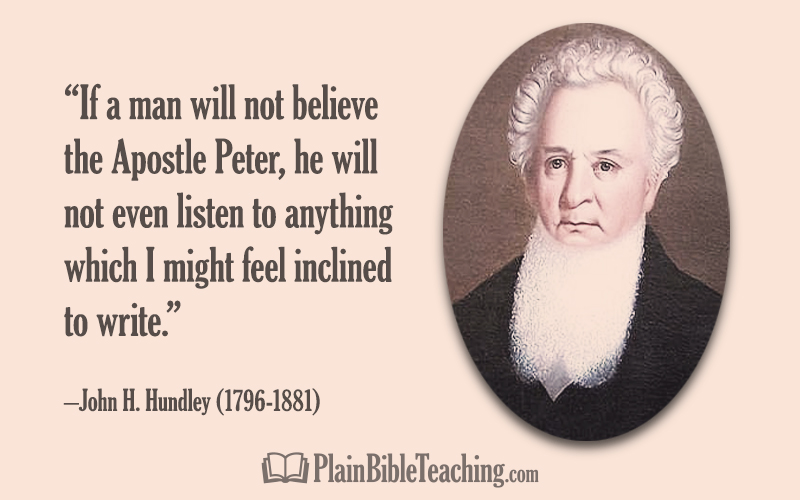
John H. Hundley (1796-1881) was a gospel preacher who spent most of his life in Alabama. Though not as familiar to us as men like Alexander Campbell and Barton W. Stone, Hundley, like them, sought to go back to the Bible for his authority in religious matters. His open mind and study of the Scriptures (as well as the influence of Walter Scott’s journal The Evangelist) led him to leave the Presbyterian church. He was immersed into Christ and helped found the church of Christ in Mooresville, Alabama.
In 1858, Hundley published a book titled The Plan of Salvation in which he explained what the New Testament taught about what one had to do to be saved. In it, he cited Peter’s words on the day of Pentecost:
Again, on the day of Pentecost, when the three thousand believed, and requested what they should do to be saved, Peter replied, “Repent, and be baptized, every one of you, in the name of Jesus Christ, for the remission of sins.” (The Plan of Salvation, p. 80)
A common misconception that many religious people have is that someone is baptized because his sins have already been forgiven. But Hundley explained that if this were so, then one would have to repent because his sins have already been forgiven. This, Hundley said, was “too absurd a proposition to be entertained for a moment” because no one sorrows (an indication of true repentance, 2 Corinthians 7:10) because his sins are forgiven. Instead, we repent and are baptized in order to obtain forgiveness.
Hundley then addressed the charge that those who believe that baptism is necessary for salvation are putting their trust in water rather than in God. Yet as he cited the conversion of Paul, he explained: “Paul is told to wash away his sins by baptism—not that the virtue is in the water, but simply because God has chosen to make that His ordinance.” He then cited the Old Testament example of the sins being laid upon the scapegoat, which was then released into the wilderness. Notice Hundley’s explanation:
Does any man think the virtue to bear off sins was in a goat? Of course not. It was God’s command, and there lay all the merit. So in the case of water baptism. God has commanded us to perform the ordinance in order to remission, and it is obedience to God’s Word that ensures salvation and cleanses us from all sin, and not the mere washing of water. (ibid., p. 82)
Hundley capably and clearly explained the connection between baptism and salvation, even citing Peter’s statement in his first epistle: “The like figure whereunto baptism doth now save us (not the putting away of the filth of the flesh, but the answer of a good conscience toward God,) by the resurrection of Jesus Christ” (1 Peter 3:21).
However, many people heard Hundley’s teaching on this subject and refused to obey the gospel by being baptized into Christ. Today, we may diligently and earnestly appeal to people to believe in Christ and obey His word. Yet many scoff at the idea of baptism being necessary for salvation, no matter how airtight our arguments are.
This can be discouraging. We may rack our brains trying to figure out a “better” way to explain these passages or a more convincing argument that would persuade people to obey the gospel as the three thousand did on the day of Pentecost (Acts 2:41). However, we should consider a statement Hundley made as he concluded his argument:
This much will suffice on the subject of immersion, for if a man will not believe the Apostle Peter, he will not even listen to anything which I might feel inclined to write. (ibid., p. 82)
We often want to believe that if we are clear, articulate, passionate, and convincing enough, we can lead anyone to be converted. But that is just not the case. The Scriptures are clear enough for those who want to obey the Lord. Jesus said, “If anyone is willing to do His will, he will know of the teaching, whether it is of God or whether I speak from Myself” (John 7:17). Those who are not willing will reject it.
The word of God has been revealed in a way that we can understand it. So in our efforts to teach, we need to “speak as the oracles of God” (1 Peter 4:11, KJV). Because false teaching is so prevalent, we must work to “destroy arguments and every lofty opinion raised against the knowledge of God, and take every thought captive to obey Christ” (2 Corinthians 10:5, ESV). But in the end, all we can do is point people to the words of Jesus and the apostles that we find in the New Testament. We will not come up with a “better” message than the gospel they taught. If someone is going to be saved, they will have to listen to them.
So let us not get discouraged when we do not see the results we hope to see from our efforts to teach the gospel. Instead, let us continue to faithfully point people to the word of God and pray that it falls on good and honest hearts who are willing to accept the same message that Peter preached on the day of Pentecost: “Repent, and each of you be baptized in the name of Jesus Christ for the forgiveness of your sins; and you will receive the gift of the Holy Spirit” (Acts 2:38).
———
Read the whole excerpt from Hundley’s book in which he discussed baptism here: Immersion in Water.