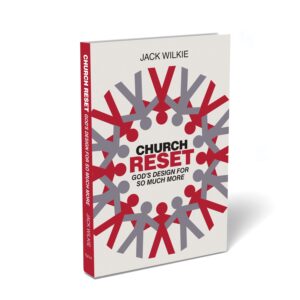
 This book is about restoring a sense of community in the local church. While many churches do a good job at engaging in Scriptural worship and following the New Testament pattern for their organization and work, the sense of community is missing in many places. Being part of a local church ought to mean being a bigger part in one another’s lives.
The author asked, “How many ‘every time the doors are open’ Christians know little about their fellow Christians? How many have perfect attendance yet don’t see anybody else outside the building?” (p. 148). Elsewhere he posed the question: “What if we realized that passively listening to lessons three to four hours per week and ‘being there every time the doors are open’ does not constitute being an active member of the church?” (p. 22).
From the book’s description:
Shouldn’t church be… more?
If you’ve ever driven home on a Sunday with that question on your mind, you are not alone. When we read about the church in the Bible there’s a beauty and an appeal to it that so often seems missing. In our busy, distracted, consumeristic world it seems as though becoming a self-sacrificial, tight-knit, Christlike family like the early Christians is a pipe dream.
In Church Reset: God’s Design for So Much More, Jack Wilkie traces the problem back to its roots to show how we’ve deviated from God’s plan and how we can get back on track. How can we stop operating as an organization and start living like a family? How do we stop creating church customers and start making dedicated disciples? How do we abandon man-made strategies and rediscover the power of God’s design? Church Reset casts an exciting vision for what Christ’s church can be by pointing back to what it was meant to be from the very start.
This book is a challenge for us to do more as members of the local body and that each member should be expected to be actively involved in the work of the church (in addition to “being there every time the doors are open”). And this should not be about churches adding “programs” or social events that go beyond the work the Lord has authorized it to do; instead, this is about each member realizing the importance of spending time with their brethren outside of the assembly.
Ironically, the author mentioned that he started writing this book around September 2019 – a few months before the pandemic which would close churches and isolate brethren from their fellow-Christians. But that would be a wake-up call. The author wrote, “As we’ve watched worship services online we’ve figured out just how hollow that experience can be without each other’s presence” (p. 176). If the pandemic should have taught us anything, it is that brethren need one another – not only for in-person worship services, but also for the help and encouragement we can give to one another throughout the week.
Though I may not endorse every idea presented in this book, I do recommend it for challenging us to think about our involvement in the local church – that this should be more than just attending the worship services, Bible classes, and other events that the congregation puts on. Instead, we should be actively involved in the work of the church and in the lives of our brethren.
This book is available from Focus Press: Church Reset: God’s Design for So Much More










