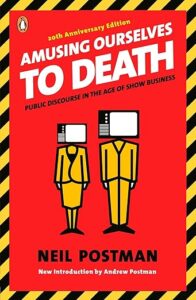
 Over the past few years, I have posted reviews for two books by Chris Martin: Terms of Service: The Real Cost of Social Media and The Wolf in Their Pockets: 13 Ways the Social Internet Threatens the People You Lead. Both of these books examine how social media (or the social internet) affects us (and, in the case of “church leaders,” the people in their churches). Although social media has only been around for twenty years or so, the author frequently cited a book that was published in 1985, Amusing Ourselves to Death: Public Discourse in the Age of Show Business, by Neil Postman. I finally got around to reading this book for myself.
Postman’s book dealt with how television affected public discourse. As Martin explained in his books, social media has done the same thing, but at a much larger scale. So Postman’s book, although it is now forty years old, can help us understand how television (and now the internet and social media) affect the way we understand the world around us.
From the book’s description:
Originally published in 1985, Neil Postman’s groundbreaking polemic about the corrosive effects of television on our politics and public discourse has been hailed as a twenty-first-century book published in the twentieth century. Now, with television joined by more sophisticated electronic media—from the Internet to cell phones to DVDs—it has taken on even greater significance. Amusing Ourselves to Death is a prophetic look at what happens when politics, journalism, education, and even religion become subject to the demands of entertainment. It is also a blueprint for regaining control of our media, so that they can serve our highest goals.
Postman argued that the danger of television was not in the mindless entertainment that it offered, but that it presented itself as a serious channel through which the public could be informed about the news and issues of the day.
“Television, as I have implied earlier, serves us more usefully when presenting junk-entertainment; it serves us most ill when it co-opts serious modes of discourse—news, politics, science, education, commerce, religion—and turns them into entertainment packages. We would all be better off if television got worse, not better. The A-Team and Cheers are no threat to our public health. 60 Minutes, Eye-Witness News and Sesame Street are.” (Amusing Ourselves to Death, p. 159-160)
Providing news and commentary in short sound bites and constantly switching contexts from tragedies to trivialities and back again made it difficult for people to take seriously what was important and nearly impossible for them to do anything about such things. The necessary result of this was that the news – followed by politics, religion, and education – became a form of entertainment. This problem has become exponentially worse with the rise of social media.
In the first chapter, Postman wrote this:
“To say it, then, as plainly as I can, this book is an inquiry into and a lamentation about the most significant American cultural fact of the second half of the twentieth century: the decline of the Age of Typography and the ascendancy of the Age of Television. This change-over has dramatically and irreversibly shifted the content and meaning of public discourse, since two media so vastly different cannot accommodate the same ideas. As the influence of print wanes, the content of politics, religion, education, and anything else that comprises public business must change and be recast in terms that are most suitable to television.” (Ibid., p. 8)
In previous generations, information and ideas were spread through reading (books, newspapers, etc.). When television came along, people began watching to learn about the world around them. This changed how they learned and how to best reach them.
This is significant for Christians, since we follow a message that was written down by inspiration and completed in the first century (2 Timothy 3:16). This message has not changed and will not change (Galatians 1:6-9). But we run into a challenge when trying to reach people today. Instead of searching the Scriptures like the noble-minded Bereans (Acts 17:11), they are more likely to search YouTube, TikTok, and ChatGPT. Although these channels were not around when Postman wrote his book, the following statement is appropriate:
“Most Americans, including preachers, have difficulty accepting the truth, if they think about it at all, that not all forms of discourse can be converted from one medium to another. It is naive to suppose that something that has been expressed in one form can be expressed in another without significantly changing its meaning, texture or value.” (Ibid., p. 117)
When conveying a message to the public, not every form of communication is equal. At the same time, as much as we wish the current state of our society was different, we cannot turn back the clock to the pre-television era. So what do we need to do now that we are in the era of social media? Here are a couple of suggestions:
- Recognize what reaches people – We cannot teach anyone if we do not have their attention. For better or worse, this attention is often focused on the internet and social media. As Postman argued in his book about television (and it is even more true about social media), this is inherently dangerous and makes serious discourse much more challenging. However, it is also reality. So if we want to get people’s attention in the hopes of having a chance to plant the seed of the gospel in their hearts (cf. Luke 8:5-8, 11-15; 1 Corinthians 3:6), we cannot ignore social media.
- Recognize the limits of social media – We can plant a lot of “seeds” and reach a broad range of people through social media. But this will never be an adequate substitute for the local church, in-person Bible studies, real-life gospel preaching, and face-to-face relationships. More importantly, the internet will never replace the timeless, true, and inspired written word of God that is found in the Scriptures.
There is much more that could be said of this book. Even though it was written before the age of social media, the principles and conditions discussed in the book apply so much today. I would encourage every Christian to read this book and consider how we use the media we consume and what this media does to us.
———
This book is available on Amazon – Amusing Ourselves to Death: Public Discourse in the Age of Show Business (affiliate link)