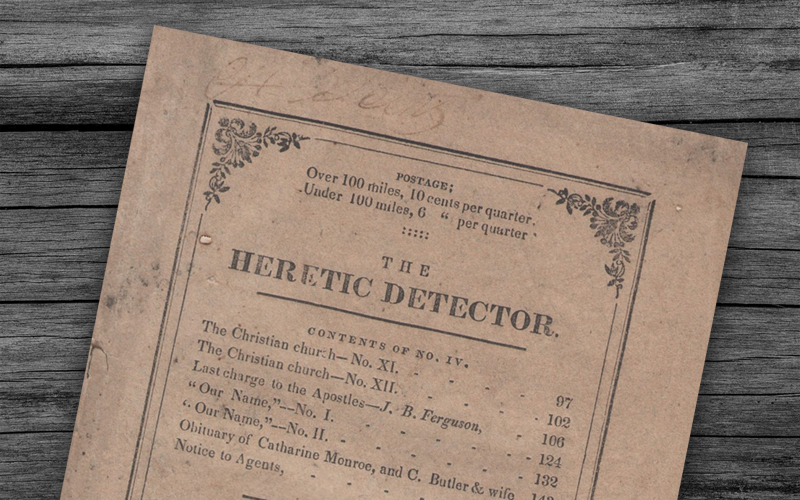
 In the nineteenth century, religious journals were a common and effective way for those who were making the “restoration plea” to spread their message far and wide. Alexander Campbell’s Christian Baptist and Millennial Harbinger were two of the most prominent journals, yet others also received wide circulation, including Barton W. Stone’s Christian Messenger, Benjamin Franklin’s American Christian Review, and the Gospel Advocate, which was started by Tolbert Fanning.
In addition to these, numerous other journals were published across the country, including the curiously named Heretic Detector, edited by Arthur Crihfield (1803-1852) and published in Middleburgh, Ohio. In a letter to the editor, Crihfield received a letter from a man named Corbly Martin, criticizing the practice of writers using “fictitious names” in these journals.
“Dear Brother Detector:—
“Among the innumerable popular evils to be detected, there is one which, although not the least, I opine, has hitherto almost entirely escaped the notice of every ‘detector’ of this detecting age. It is certainly a part of the spirit of ‘all deceivableness of unrighteousness,’ and ought to be speedily detected…
“‘Well, what is it?’ say you:—It is simply this: The practice of writing letters, essays, &c. over fictitious names. Is it in accordance with the avowed spirit of this reformation, with the simple and honest, truth loving, and unfeigning genius of the Christian religion, to publish what I would not acknowledge to be the effusion of my own pen, or head, or heart? What I could not patronize with the influence of my own proper name? Or what needed some fictitious name of great renown, of Latinized form, or of magical sound, as a passport to the world, or to the congregation of the faithful?”
“Why do not you Editors require of your contributors that which is just and equal? When you write yourselves, you assume ‘the responsibility:’—as an enterprising merchant you run the risk of ‘loss and gain.’—Why do you burden yourselves and ease your correspondents!” (The Heretic Detector, Volume 1, pp. 271-272).
This is a reasonable complaint. If one truly believes what he is writing – especially about spiritual matters – why should he hide his identity? The author of this letter to the editor acknowledged that there could be times when an editor would choose not to run a good essay because of the bad reputation of the author. However, generally speaking, he contended that the practice of writing in anonymity was inconsistent with the “spirit of this reformation,” yet it had become a common practice and was widely accepted without question.
This issue is even more widespread today with the internet. In the nineteenth century, if someone wished to publish an anonymous article, he could not do so himself, otherwise it would be easy for people to find out the source. So he had to find an editor willing to publish his anonymous article, and the only way the editor would do so was if he thought the comments were interesting or helpful to his readership. There was no guarantee that an article written in anonymity would ever be made public. It is very different today, as anyone with an internet connection can create an anonymous social media account and share his thoughts (potentially) with the world.
In this article, as we think about this issue of writing under “fictitious names,” I am not referring to those who may write about news, politics, or other such matters. There may be times when it is advantageous to write under a pseudonym. Instead, this is about those who write on spiritual topics, as these articles may be used to teach Biblical truth. There may be occasions when the threat of persecution makes it prudent to write anonymously. However, generally speaking, when it comes to our writing on spiritual matters – especially if there is no immediate threat to our families or congregations – we ought to include our name and stand behind what we write. There are a few reasons for this.
- Transparency – In speaking of the contribution for the needy saints in Jerusalem, Paul spoke of the need to “have regard for what is honorable, not only in the sight of the Lord, but also in the sight of men” (2 Corinthians 8:21). This is the principle of transparency. Suspicions arise when we appear to be hiding something – whether that involves the funds that have been designated for a particular work or our identity when we are teaching the Scriptures. Being transparent about who wrote a particular article (especially now that we are in the age of AI), is critical for the reasons that follow.
- Consistency – The enemies of Paul claimed that he was not the same in person as he was in his writing: “For they say, ‘His letters are weighty and strong, but his personal presence is unimpressive and his speech contemptible’” (2 Corinthians 10:10). In answering this charge, Paul said, “Let such a person consider this, that what we are in word by letters when absent, such persons we are also in deed when present” (2 Corinthians 10:11). Our teaching and character should be the same whether we are speaking with others face-to-face or if we are writing to them. We are not to pretend to be someone we are not (which is very easy to do with online anonymity). When it comes to teaching the word of God, there should be no difference between our online persona and our conduct in the local church.
- Fearlessness – Paul was set for the defense of the gospel (Philippians 1:16-17). In his preaching, he “did not shrink from declaring…the whole purpose of God” (Acts 20:27), even if it meant he would “be bound” or even “die” for the faith (Acts 21:13). We need to have this same disposition in our efforts to teach the word of God, which means we should not be afraid to attach our name to an article, letter, or social media post in which we are explaining what the will of God is as it has been revealed in His word.
- Accountability – James warned of the scrutinity that was an inherent part of publicly teaching the word of God: “Let not many of you become teachers, my brethren, knowing that as such we will incur a stricter judgment” (James 3:1). It is good for people to search the Scriptures to test what we teach before accepting it (Acts 17:11). If we teach something that is contrary to the word of God, we should want someone to pull us aside, as Priscilla and Aquila did with Apollos, and “[explain] to [us] the way of God more accurately” (Acts 18:26). It is much more difficult for someone to offer correction to an anonymous writer. If someone writing in anonymity teaches something false, it is harder to receive the correction he needs.
- Opportunities – When the identity of a teacher or writer is known, it is much easier for someone to approach them to gain clarity about a topic discussed and ask follow-up questions. It also lets people know who they can ask if they have questions about spiritual matters in the future. (I regularly receive Bible questions from people because they know me through my writings and are comfortable asking for help.) We have a responsibility to be “ready to make a defense to everyone who asks [us] to give an account for the hope that is in [us]” (1 Peter 3:15). We generally receive more of these opportunities when people see us (not our anonymous persona) teaching the word of God.
While there may be times in which it is in the best interest of the cause of Christ to teach anonymously, it should not be the standard practice of those who are proclaiming the gospel and teaching the word of God to others.
We do not want others to think we have anything to hide. We want to be consistent in our words and actions, whether in person or not. We must be bold in proclaiming the truth. We need to be held accountable so we can receive correction when necessary. And we want to create as many opportunities as we can to teach the word of God to others. For all of these reasons, we should not feel the need to hide behind “fictitious names.”
———
One additional point on “fictitious names” as it pertains to our use of the internet today… Some will hide behind anonymous social media profiles because they are saying things they should not say, following accounts that promote worldly and sinful behavior, and consuming content that no Christian has any business seeing. Even if no one is aware of your identity, God knows. “And there is no creature hidden from His sight, but all things are open and laid bare to the eyes of Him with whom we have to do” (Hebrews 4:13). We cannot hide behind a screen name on the day of judgment. Our behavior online needs to be righteous before God.