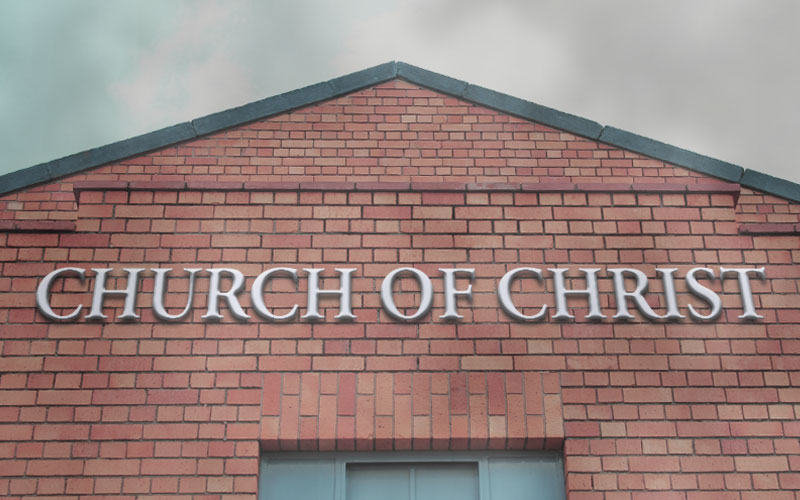
“Greet one another with a holy kiss. All the churches of Christ greet you” (Romans 16:16).
When talking about spiritual matters with other religious people, we often find many things that we will agree about – God is the creator, Jesus died for our sins and was raised from the dead, there is hope that the faithful will have eternal life in heaven, etc.
However, there are also some significant differences between churches of Christ and other churches. Some who belong to other churches are curious about this, and we want to be ready to give an explanation for what we believe (cf. 1 Peter 3:15).
Before we begin, I want to be clear that there is no “official” position for churches of Christ. We do not have a written creed, nor do we have a denominational headquarters deciding on doctrine. I cannot speak for any other congregation that calls itself a church of Christ. However, there are some teachings and practices that are generally common among churches of Christ but differ from those of most other churches. In this article, we will look at some of these unique characteristics and briefly examine the New Testament to see why we believe and practice them.
Bible Authority
Generally, there is a strong emphasis on Bible authority among churches of Christ. To be fair, some denominations will also claim this, but their application of the Scriptures is different, which leads to some more visible differences (which we will notice in the points that follow).
Why is there an emphasis on Bible authority? We recognize the Lordship of Christ. Jesus told His apostles, “All authority has been given to Me in heaven and on earth” (Matthew 28:18), and this was the basis for the commission He gave them to “make disciples of all the nations, baptizing them in the name of the Father and the Son and the Holy Spirit, teaching them to observe all that I commanded” (Matthew 28:19-20). Because Jesus is Lord, we must do what He says, hence the reason for His question, “Why do you call Me, ‘Lord, Lord,’ and do not do what I say?” (Luke 6:46).
Jesus has all authority, and His will is expressed in the Scriptures. They are “inspired by God” and make us “adequate, equipped for every good work” (2 Timothy 3:16-17). Paul admonished Timothy, “Hold fast the pattern of sound words which you have heard from me, in faith and love which are in Christ Jesus” (2 Timothy 1:13, NKJV). We must be able to show “book, chapter, and verse” for everything we believe, teach, and practice, and we will be citing these for the other points we will consider.
Congregational Autonomy
Most churches in the religious world are part of a large denominational structure. Yet churches of Christ are independent and autonomous (self-governing). This is the reason I stated at the beginning that there is no “official” position for churches of Christ.
Why do churches of Christ practice congregational autonomy? God designed local churches to be overseen by elders. When Paul and Barnabas visited the churches they established on their first preaching tour, they “appointed elders for them in every church” (Acts 14:23). Paul told the elders of the church in Ephesus (Acts 20:17) to oversee the flock (church) among them (Acts 20:28). These passages are part of a consistent pattern in the New Testament that shows a plurality of elders overseeing local congregations. Furthermore, they did not appoint just anyone; these men had to meet certain qualifications in order to be appointed to this office (1 Timothy 3:1-7; Titus 1:5-9).
Peter instructed the elders, “Shepherd the flock of God among you, exercising oversight not under compulsion, but voluntarily, according to the will of God; and not for sordid gain, but with eagerness” (1 Peter 5:2). He then reminded them that they were answerable to “the Chief Shepherd” (1 Peter 5:4), which was Jesus Christ. The New Testament describes no larger hierarchy to which the elders are answerable, and no position between Jesus and the elders of the local church.
A Cappella Singing
It is common for churches to use instrumental music in their worship, from simple piano accompaniment to the singing to a full rock band performing “worship” songs. However, churches of Christ do not have this (and this is often one of the first things people from other churches notice when they visit our assemblies). We worship using congregational singing (no choirs, solos, etc.), which is done a cappalla (no musical instruments).
Why do we sing without instrumental accompaniment? We are told to sing: “Speaking to one another in psalms and hymns and spiritual songs, singing and making melody with your heart to the Lord” (Ephesians 5:19; cf. Colossians 3:16). The “instrument” that is specified for us to use is our voice. Many believe that musical instruments are permitted because the New Testament does not specifically prohibit them. Yet the Hebrew writer expressed the principle that when God specifies something, everything else is excluded. He explained that Jesus could not be a priest under the old law because He came from the tribe of Judah. The law did not explicitly prohibit people from the tribe of Judah from being priests, but God specified the tribe of Levi to serve in this capacity; therefore, no one from Judah – even Jesus – could serve as a priest under the Law of Moses (Hebrews 7:12-14). In the same way, the fact that the New Testament specifies singing as the type of music Christians use to worship God necessarily excludes other types of music, including instrumental music.
Some will object to this, pointing out that instruments were used in the Old Testament for worship in the temple. This is true, but the difference was that “the command” to use these instruments in the temple worship “was from the Lord” (2 Chronicles 29:25). However, as the church follows the instructions given in the New Testament, we do not use the commands in the Old Testament for our authority to bring in musical instruments (or animal sacrifices, a separate priesthood, or anything else). That law has been “nailed…to the cross” (Colossians 2:14), and we must go to the New Testament to find the pattern we are to follow as we worship God.
Weekly Lord’s Supper
Many churches observe the Lord’s Supper (communion) occasionally – monthly, quarterly, annually, etc. Yet churches of Christ partake of the Lord’s Supper each first day of the week.
Why do we observe the Lord’s Supper every week? This was the standard practice of the early church. When Paul came to Troas on his way to Jerusalem, Luke records this: “On the first day of the week, when we were gathered together to break bread, Paul began talking to them, intending to leave the next day, and he prolonged his message until midnight” (Acts 20:7). The fact that Paul and his travelling companions could show up to a local church on a random Sunday and find them observing the Lord’s Supper shows that this was a standard practice. Also, Paul waiting in Troas for seven days, while he was in a hurry to get back to Jerusalem (Acts 20:6, 16), indicates that they were expected to meet with a local church on the first day of the week to observe the Lord’s Supper if at all possible.
This is parallel to the example of the Sabbath day under the Law of Moses. The people of Israel were commanded to work six days and rest on the seventh day (Exodus 20:8-11). Did this mean every seventh day? Of course it did, and this was so clear that God instructed a man to be put to death for violating the law of the Sabbath just one time (Numbers 15:32-36). While we are not under the same law today (as we noticed in the previous point), this is instructive (Romans 15:4). Just as the instruction to remember the Sabbath meant doing this every week, our following the example of the early church in partaking of the Lord’s Supper on the first day of the week means doing it every week.
Baptism
Many churches do practice some form of baptism. Some will baptize believers, and others will baptize infants. Some will practice baptism by immersion, while others will sprinkle or pour water over someone and call it baptism. Some people will be baptized as a sign that they have already been saved. Others will be baptized in order to join a particular denomination. However, churches of Christ baptize believers for the purpose of salvation.
Why do we practice baptism in this way? First, we baptize believers because the prerequisites to baptism found in the New Testament exclude infants. These prerequisites include belief, repentance, and confession (Mark 16:16; Acts 2:37-38; Acts 8:36-38), and only those who have reached a certain level of maturity and understanding can do these things.
The New Testament also describes baptism as being immersion in water. Jesus told Nicodemus, “Truly, truly, I say to you, unless one is born of water and the Spirit he cannot enter into the kingdom of God” (John 3:5). Paul wrote about being “buried with [Christ] in baptism” (Colossians 2:12; cf. Romans 6:4), which eliminates sprinkling or pouring.
Also, the Scriptures are clear that baptism is for salvation. Many will cite Paul’s statement to the saints in Rome – “Whoever will call on the name of the Lord will be saved” (Romans 10:13) – and claim that we are saved by praying a “sinner’s prayer” or inviting Jesus into our hearts. However, when Paul recounted his conversion, he explained what it meant to call on the name of the Lord. Ananias said to him, “Now why do you delay? Get up and be baptized, and wash away your sins, calling on His name” (Acts 22:16). He was not being baptized because he was forgiven, but to be forgiven. The same is true for us today. We “call on the name of the Lord” by being baptized in order to have our sins washed away. The Christians in Rome had already done that (Romans 6:3-4, 17-18), so they knew what Paul meant by that statement. Peter plainly said, “Corresponding to that, baptism now saves you—not the removal of dirt from the flesh, but an appeal to God for a good conscience—through the resurrection of Jesus Christ” (1 Peter 3:21). Many churches, even though they practice baptism in some form and for some purpose, teach that baptism does not save you. However, the inspired apostle said, “Baptism now saves you.”
Conclusion
There may be other differences we could point to, but these are a few of the major ones. Why does this matter? It goes back to the point we started with – Bible authority. We do not practice these things because they are our preference, opinion, or tradition. We do them because we find them taught and practiced in the New Testament. This is what we have been called to follow. Remember the commission given by Jesus to His apostles:
“All authority has been given to Me in heaven and on earth. Go therefore and make disciples of all the nations, baptizing them in the name of the Father and the Son and the Holy Spirit, teaching them to observe all that I commanded you; and lo, I am with you always, even to the end of the age” (Matthew 28:18-20).
As His disciples, we want to observe all that He commanded and follow those commands in a way that is pleasing to Him. We can do that by following the pattern handed down by the apostles and preserved for us in the pages of the New Testament.