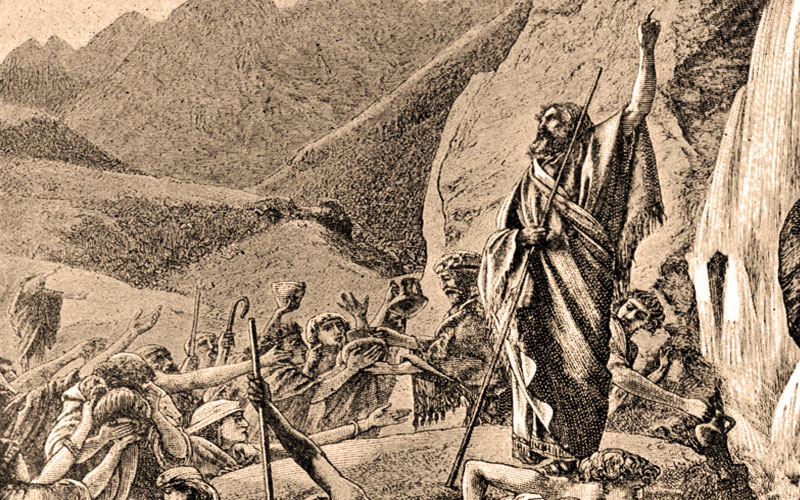
The Hebrew writer quoted the psalmist’s description of the Israelites testing God in the wilderness (Hebrews 3:7-11; cf. Psalm 95:7-11). Testing God is directly connected to one’s faith. Immediately after mentioning the Israelites testing God, the Hebrew writer warned about the danger of “an evil, unbelieving heart that falls away from the living God” (Hebrews 3:12). He closed the chapter with a statement about the “unbelief” exhibited by those who tested God (Hebrews 3:19).
In this article, we will briefly consider three examples given in Scripture that show how one can be guilty of testing God. After noting these examples, we will also consider the severe consequences of testing God so we might learn not to do this ourselves.
How One Tests God
One tests God by disobeying His word – The Hebrew writer quoted the psalmist: “Today if you hear His voice, do not harden your hearts as when they provoked Me…where your fathers tried Me by testing Me, and saw My works for forty years. Therefore I was angry with this generation, and said, ‘They always go astray in their heart, and they did not know My ways’” (Hebrews 3:7-10). In straying from God, the Israelites were guilty of sinning and being disobedient (Hebrews 3:17-18). Such disobedience was directly tied to their unbelief (Hebrews 3:19). James explained the reason for this connection: “Faith without works is dead” (James 2:26). When one does not obey God, he is guilty of testing God.
One tests God by adding to His word – When the issue of circumcision was debated in Jerusalem, Peter reminded the brethren of God’s acceptance of the Gentiles: “Brethren, you know that in the early days God made a choice among you, that by my mouth the Gentiles would hear the word of the gospel and believe. And God, who knows the heart, testified to them giving them the Holy Spirit, just as He also did to us; and He made no distinction between us and them, cleansing their hearts by faith. Now therefore why do you put God to the test by placing upon the neck of the disciples a yoke which neither our fathers nor we have been able to bear?” (Acts 15:7-10). Though some were trying to bind the law of Moses on new disciples, this law had been “nailed…to the cross” (Colossians 2:14). We are not to impose upon others this law that has been “taken…out of the way” (Colossians 2:14) or any other form of “self-made religion” (Colossians 2:23; cf. Matthew 15:9). When one does not remain within the confines of the law of Christ, he is guilty of testing God.
One tests God by demanding that He prove Himself – Once when the devil tempted Jesus he used (or rather misused) Scripture in an attempt to convince Jesus to do what he wanted Him to do: “Then the devil took Him into the holy city and had Him stand on the pinnacle of the temple, and said to Him, ‘If You are the Son of God, throw Yourself down; for it is written, “He will command His angels concerning You”; and “On their hands they will bear You up, so that You will not strike Your foot against a stone.”’ Jesus said to him, ‘On the other hand, it is written, “You shall not put the Lord your God to the test”’” (Matthew 4:5-7). One might reason that it would have taken a great deal of faith for someone to jump from the pinnacle of the temple and trust that God would save him. In reality, to do what the devil wanted Jesus to do would have demonstrated a lack of faith in God. How so? Even if the devil’s interpretation of the passage he quoted was correct, there was no reason for one to jump from the pinnacle of the temple. The word of God is sufficient to produce faith (Romans 10:17). We have ample evidence to believe in God and in His promises. We ought to have enough faith that we do not feel the need to “put…God to the test” (Matthew 5:7) and demand Him to do what we think He ought to do. When one demands evidence from God beyond what He has already revealed, he is guilty of testing God.
The Consequences of Testing God
The Hebrew writer listed four consequences that come against one who tests God.
One provokes God when he tests Him – “For who provoked Him when they had heard? Indeed, did not all those who came out of Egypt led by Moses?” (Hebrews 3:16). To provoke God is to invite His wrath against us. Thankfully, God is patient toward us (2 Peter 3:9). Yet His patience has a limit. When we test God through disobedience, false teaching, and refusing to believe what He has revealed, we are “storing up wrath” that will one day be revealed against us if we do not repent (Romans 2:5).
One angers God when he tests Him – “And with whom was He angry for forty years? Was it not with those who sinned…?” (Hebrews 3:17). After God has been provoked long enough, His patience will eventually give way to His anger. We should want to avoid this at all costs. The Hebrew writer said, “It is a terrifying thing to fall into the hands of the living God” (Hebrews 10:31).
One will fall when he tests God – “…those who sinned, whose bodies fell in the wilderness” (Hebrews 3:17). The fate of the Israelites serves as an example to us (1 Corinthians 10:11). We may not die in the wilderness as they did; but if we test God and refuse to repent, we will face a spiritual death (Romans 6:23) in which we will “pay the penalty of eternal destruction, away from the presence of the Lord and from the glory of His power” (2 Thessalonians 1:9).
One will not enter His rest when he tests God – “And to whom did He swear that they would not enter His rest, but to those who were disobedient? So we see that they were not able to enter because of unbelief” (Hebrews 3:18-19). In the next chapter, the Hebrew writer discussed the rest that remained for God’s people (Hebrews 4:9). This rest is the eternal reward of heaven. Those who “die in the Lord” will enjoy “rest from their labors” (Revelation 14:13). Those who test God put their soul in jeopardy.
Learn from the Mistakes of Others
We must not test God as others did. In concluding the discussion about the unfaithfulness of the Israelites, the Hebrew writer said, “Therefore let us be diligent to enter that rest, so that no one will fall, through following the same example of disobedience” (Hebrews 4:11). Rather than testing God, let us faithfully obey Him, trust His word, and be content with what He has chosen to reveal to us.