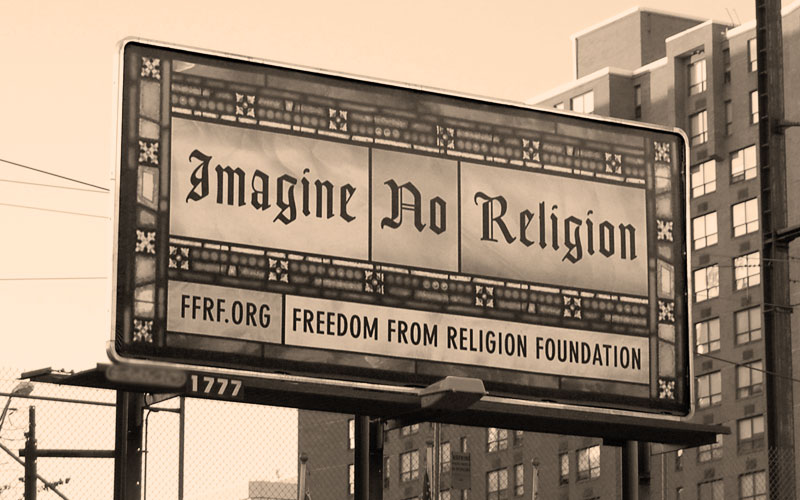
In his letter to the saints in Rome, Paul described the condition of the Gentile world as a whole: “And just as they did not see fit to acknowledge God any longer, God gave them over to a depraved mind, to do those things which are not proper” (Romans 1:28). They had rejected God in favor of their “gods.” Their “gods” – since they were a product of their own imagination – allowed them to do anything they wanted to do. As a result, they no longer felt hindered by God’s laws.
We live under similar conditions today. People in our society do not serve the same idols, but the similarity is in the sense that people see no reason to follow God’s laws. They are content to live without seeing any need for religion. This is secularism.
We live in an increasingly secular society. There are certain challenges that come with this. But why is a secular society a challenge for Christians? Let us consider secularism and the challenges it presents in this article.
Define “Secularism”
The term was invented by George Jacob Holyoake (1817-1906), a British writer. He used the term to describe his views of promoting a social order separate from religion without actively dismissing or criticizing religious belief. What that means is that he was not antagonistic to religion; he just thought it was unnecessary.
Today, secularism is about limiting or eliminating the influence of religion on society. Politically it is seen in the separation of religion/faith from government (institutions, laws, and policies). Culturally it is manifested in the separation of religion/faith from public life (faith is to be private and kept to oneself).
Like many things, secularism is inherently progressive. We will briefly consider how it is manifested and how it progresses.
The Separation of Church and State
This is good and necessary – the church and the state must be separate because they are two distinct entities. The church is Christ’s body (Ephesians 1:22-23) and it was prophesied that it would crush earthly governments (Daniel 2:44). The church upholds the truth (1 Timothy 3:15) while the state punishes evil (Romans 13:4). When Jesus built His church, He never intended it to be allied with or attached to any human government.
However, the arguments from secularists for the separation of church and state is a “red herring.” Secularism, at least in our modern culture, is not about the separation of church and state; it is more than that. If we were to stop here, we would agree with the secularists; but they do not stop here. Again, secularism is inherently progressive.
The Separation of Religion from Government
This is the next step for secularism. But how is this different from the “separation of church and state”? The separation of church and state means there is no attachment between any church and the government. The separation of religion from government means that lawmakers are not to rule based upon religious convictions.
If we agree that the separation of church and state is necessary, why would we disagree with the idea that lawmakers should not make laws and policies based upon religious convictions? We need to remember that governments are made up of people. How do these people decide what to do? The secularist believes that those decisions cannot be based upon personal religious beliefs (cannot oppose abortion, must support same-sex “marriage,” no Ten Commandments, etc.). The secularist claims that making laws that are in line with “religion” is like setting up a theocracy.
However, there is a fundamental problem with the separation of religion from government. Once this is done, there is no longer a standard. God’s law is the basis of right and wrong (cf. Psalm 119:160; John 17:17; Romans 7:7) and civil authorities are to be “a cause of fear…for evil [behavior]” and be “an avenger who brings wrath on the one who practices evil” (Romans 13:3-4). But what is good and evil? Paul went on to explain that “love is the fulfillment of the law” (Romans 13:8-10). This is the principle that we do no harm to others. The Ten Commandments (Exodus 20:3-17) are also more than just a religious law – they provide a foundation for a godly society. For any society to function properly, it must be based upon the principles expressed in the Ten Commandments (the sanctity of human life, the importance of the home, personal property rights, etc.). When these standards are discarded because they are considered merely religious, what standard will be used?
The Separation of Faith from Public Life
Once the secularists separate religion/faith from government, this is the next step. They believe that the way people interact with one another in society should not be influenced by religion. Therefore, attacks are made against individuals for acting according to the principles of their faith (forcing Christian bakers to participate in same-sex “marriage” ceremonies, introducing “transgender” bathroom laws, etc.).
This is an attempt to force Christians to compartmentalize their faith. In other words, secularists today want Christians to limit the practice of their faith to their religious assemblies and that it not dictate how they live their lives the rest of the week. Satan has tried to get Christians to do this for a long time. Secularism is now one of the ways that this can be accomplished. However, our entire lives are to be given to the Lord – not just the time when we assemble with the church. Paul wrote, “Present your bodies a living and holy sacrifice, acceptable to God, which is your spiritual service of worship. And do not be conformed to this world, but be transformed by the renewing of your mind, so that you may prove what the will of God is, that which is good and acceptable and perfect” (Romans 12:1-2). Also, our faith is to be active and visible. Regarding an active faith, James wrote, “For just as the body without the spirit is dead, so also faith without works is dead” (James 2:26). With respect to the visibility of our faith, Jesus said, “Let your light shine before men in such a way that they may see your good works, and glorify your Father who is in heaven” (Matthew 5:16).
The Results of Secularism
As a society becomes more secular, there are certain consequences that will affect us. Consider a few such consequences:
- Disinterest in spiritual things – There will be fewer people who want to study or discuss the Bible and fewer who will attend worship services. We need to continue to sow the seed, even along the roadside (Luke 8:5-8), and continue to make time to assemble anyway (Hebrews 10:25).
- Opposition to divine truth – Those influenced by secularism will scoff at the idea of absolute truth and that truth is from God. We need to hold fast to the standard He has given us (2 Timothy 1:13) and continue to speak His truth (1 Peter 4:11; Acts 20:27).
- Persecution of Christians – Secularism does not start this way, but it will progress to this. Paul wrote, “Indeed, all who desire to live godly in Christ Jesus will be persecuted. But evil men and impostors will proceed from bad to worse, deceiving and being deceived” (2 Timothy 3:12-13). Knowing this, we must prepare for persecution. Do not fear (Matthew 10:28; Revelation 2:10); instead, rejoice and glorify God in the face of persecution (Acts 5:41-42; 1 Peter 4:16).
Secularism around us should not prevent us from faithfully serving the Lord. However, we must be ready for how it will impact us.
Conclusion
As we can see around us, we live in an increasingly secular society. While it is possible that this trend can be slowed or reversed, there is a distinct possibility that it will not. As Christians, we need to recognize the challenges of living in a secular society and continue serving the Lord in spite of them.











When a society wants to be without godly influence, there will be persecution against any reminder of God. Secularism will not and cannot allow the mention of God to be spoken or lived in their presence. When people are reminded of God they are reminded of their deficiencies without Him. This reminder hurts their conscience and this they cannot allow. They will do everything in their power to snuff out all mention and reminders of God from their lives. Christians have to anticipate this and continue to allow God to be seen in and through their lives regardless of the consequences.
Thank you for this article. I grow increasingly alarmed and confused at the fervor of those who seek to abolish God in our lives. The answer is really simple. It’s Satan at work, and we must continue the Lord’s work and not be afraid to do so.