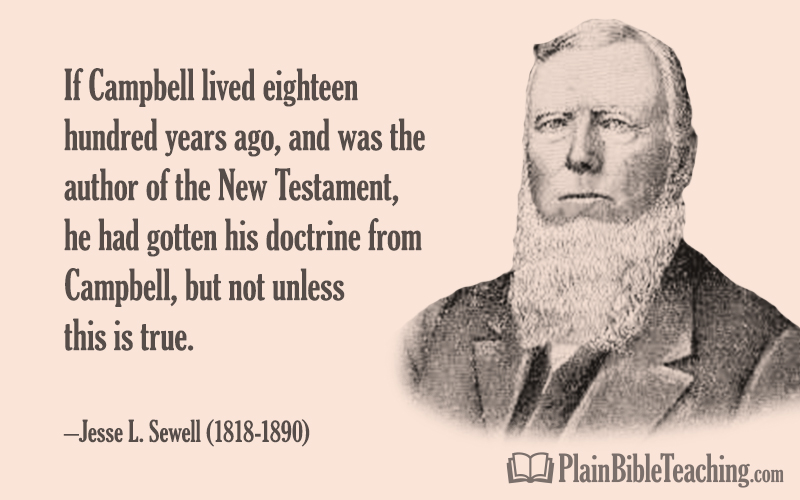
 Jesse L. Sewell (1818-1890) was a Tennessee preacher who sincerely wanted to please God and to proclaim what he found to be taught in the Bible. Eventually, he became connected with the Restoration Movement. It was common for these preachers to begin their work within the denominations before breaking away to follow the New Testament as their only rule of faith and practice. Sewell followed this course, having his start among the Baptists.
However, his Baptist brethren took exception to his preaching, and he was tried for heresy in December 1842. The charge against him was that he had “run fully into Campbellism” (The Life and Sermons of Jesse L. Sewell, p. 54), a label pejoratively given to those who allegedly followed the teachings of Alexander Campbell (1788-1866), a prominent figure in the Restoration Movement. Peter Ragan, a visiting preacher, offered this definition of “Campbellism”: “It denied faith, repentance and the influence of the Spirit, and made a God of the water” (ibid., p. 54). Sewell dismissed the allegation against him.
“If Campbell lived eighteen hundred years ago, and was the author of the New Testament, he had gotten his doctrine from Campbell, but not unless this is true” (ibid., p. 54).

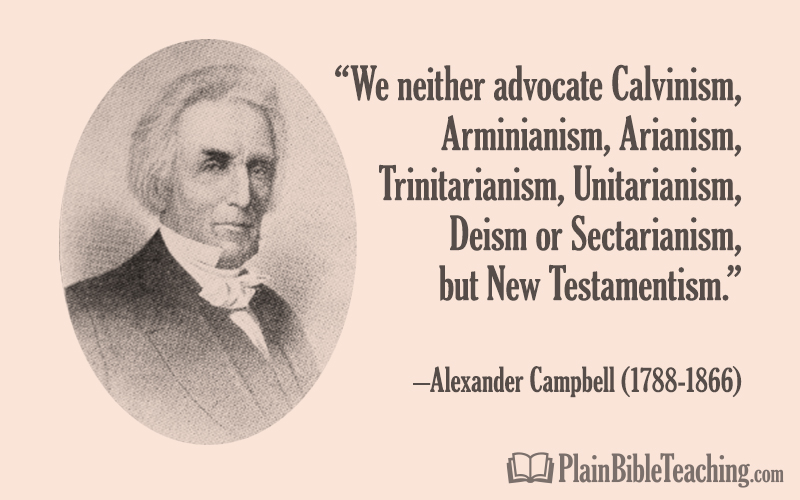
 Alexander Campbell did not start the church of Christ. The church of Christ began in 30 AD on the Day of Pentecost (Acts 2:38, 47). Campbell was born in 1788, long after the first century. Jesus Christ founded the church that bears his name. In Matthew 16:18, Jesus said, “I will build my church.” God gave him to be head over all things to the church which is his body (Ephesians 1:22-23). Further, the Hebrew writer tells us that Jesus is the minister of the true tabernacle which the Lord erected and not man (Hebrews 8:2). Since Jesus Christ erected his own church, Campbell could not have possibly started the church of Christ. The apostle Paul wrote in 58 AD, “The churches of Christ salute you” (Romans 16:16).