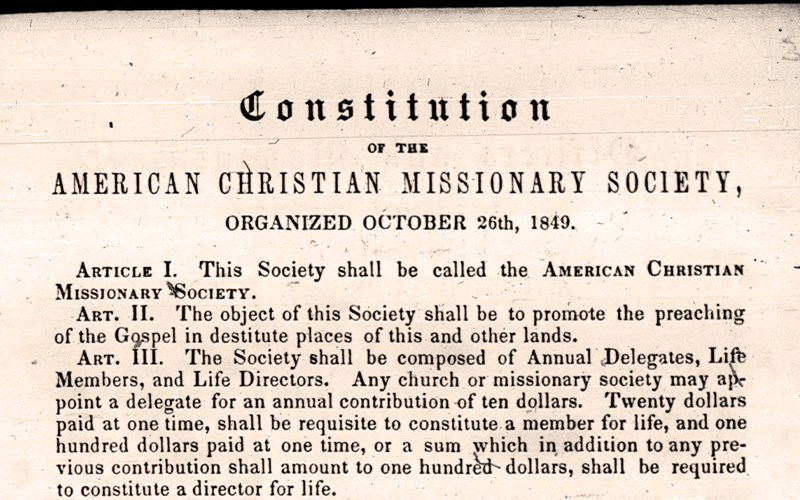
The Missionary Society was the source of the first major controversy and division among those associated with the Restoration Movement. What began as informal “association” meetings evolved into formal organizations to which churches would send delegates, and evangelists would be commissioned to preach in a particular area while receiving financial support from the society. As time passed and the brethren involved desired to extend the reach of their state societies, a larger society was created at the national level – the American Christian Missionary Society, which was formed in 1849.
The fundamental problem with this arrangement is that the New Testament contains no authority for the practice. Instead, it describes the local church as the only collectivity through which Christians engaged in the work of evangelism. The Missionary Society, in contrast, was a human institution that was founded, organized, directed, and funded by men. Yet in the first century, with only the work of individual Christians and local churches (which were designed by the Lord and followed His direction), the gospel spread quickly and broadly throughout the world.
Often, when brethren discuss the concept of the Missionary Society, they focus on this point: The local church is the organization specified by the Lord in the New Testament for spreading the gospel; therefore, every other organization used for this work (including the Missionary Society) is unauthorized.
That is a valid argument. However, this was not the only argument used by the opponents of the Missionary Society when it was first introduced. In the book Restoration Principles and Personalities, author Dabney Phillips described four general arguments that were used against the Missionary Society.Continue Reading