Do Not Look at His Appearance

Handshake

After God had rejected Saul as king over Israel, He sent Samuel to Bethlehem to anoint one of the sons of Jesse to be the next king. Before God indicated that Jesse’s youngest son David would be chosen, Samuel assumed that his oldest son Eliab would be the Lord’s choice.

When they entered, he looked at Eliab and thought, ‘Surely the Lord’s anointed is before Him.’ But the Lord said to Samuel, ‘Do not look at his appearance or at the height of his stature, because I have rejected him; for God sees not as man sees, for man looks at the outward appearance, but the Lord looks at the heart’” (1 Samuel 16:6-7).

David was “a man after [God’s] heart” (Acts 13:22). Yet Samuel, having never met any of these men previously, did not know the heart of David, Eliab, or any of the others. He was passing judgment and making assumptions based upon what these men looked like. God indicated to Samuel that this was the wrong way to evaluate their worthiness to lead God’s people.
Continue Reading

Bible Lessons for Times of Civil Unrest

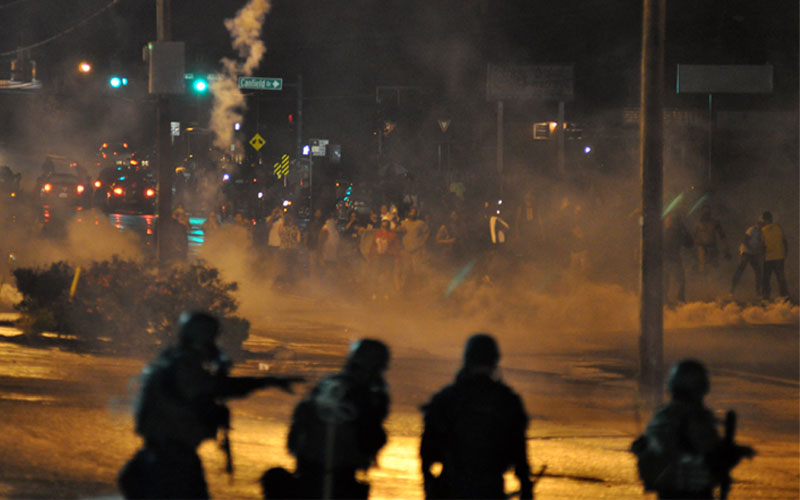
Ferguson Riots

Then all the city was provoked, and the people rushed together, and taking hold of Paul they dragged him out of the temple, and immediately the doors were shut. While they were seeking to kill him, a report came up to the commander of the Roman cohort that all Jerusalem was in confusion. At once he took along some soldiers and centurions and ran down to them; and when they saw the commander and the soldiers, they stopped beating Paul. Then the commander came up and took hold of him, and ordered him to be bound with two chains; and he began asking who he was and what he had done. But among the crowd some were shouting one thing and some another, and when he could not find out the facts because of the uproar, he ordered him to be brought into the barracks. When he got to the stairs, he was carried by the soldiers because of the violence of the mob; for the multitude of the people kept following them, shouting, ‘Away with him!’” (Acts 21:30-36).

In the passage above, Luke recorded an episode of civil unrest in the city of Jerusalem. When we see news stories about protesting, rioting, and looting in major cities, we need to remember that this is nothing new (cf. Ecclesiastes 1:9). The unrest in Jerusalem was marked by violence, confusion, an increased military presence, and protests. In a similar situation in Philippi, there was also injustice on display as the authorities had Paul and Silas wrongly beaten and imprisoned (Acts 16:22-24, 37). We see the same things today during times of civil unrest.

These news stories of protesting, rioting, and looting in response to an act of injustice (real or perceived) by law enforcement happen much too frequently in our society. During such times of civil unrest, while specific details may vary in each situation, there are certain Biblical principles that we need to remember. Let us be reminded of some of these principles now.
Continue Reading








