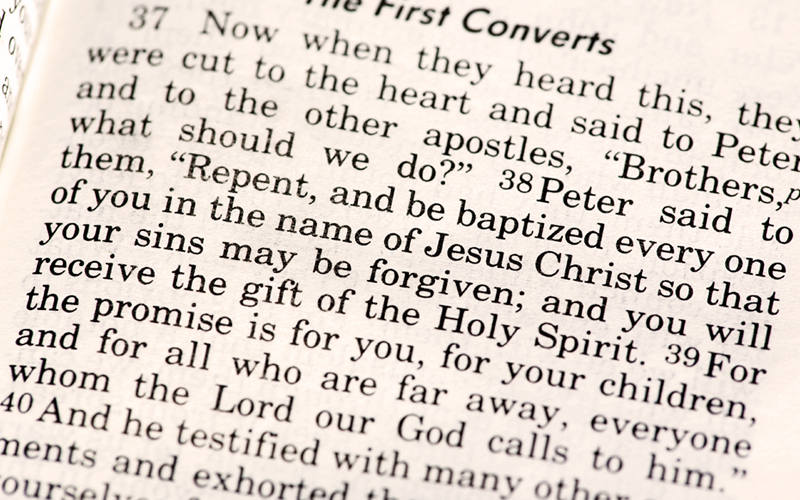
“Peter said to them, ‘Repent, and each of you be baptized in the name of Jesus Christ for the forgiveness of your sins; and you will receive the gift of the Holy Spirit. For the promise is for you and your children and for all who are far off, as many as the Lord our God will call to Himself’” (Acts 2:38-39).
When Peter preached the first gospel sermon on the day of Pentecost, he convicted his audience of being guilty of putting the Savior to death. Yet the Lord provided a way for them to be forgiven of their sins and be saved. One of the promises they would receive when they obeyed the gospel was “the gift of the Holy Spirit.” What did Peter mean by this? There are a few ideas that have been suggested:
- Some believe that this “gift” is the Holy Spirit Himself.
- Others have concluded that this refers to the miraculous gifts of the Spirit.
- Some see “the gift of the Holy Spirit” as synonymous with salvation.
Which of these views is correct? Or did Peter mean something else by this phrase?
To answer that question, we should start with what we know from the text:
- The gift of the Holy Spirit would come after one obeyed the command to repent and be baptized (Acts 2:38), not before this.
- Peter said they will receive the gift of the Holy Spirit (Acts 2:38). It was a certainty, not merely a possibility.
- The promise of forgiveness and the gift of the Holy Spirit was for the audience at Pentecost, their children, and those who were far off (Acts 2:39).
- The promise of forgiveness and the gift of the Holy Spirit were for “as many as the Lord our God will call to Himself” (Acts 2:39). This directly connects it to the preaching of the gospel since we are “called…through [the] gospel” (2 Thessalonians 2:14). This means it would apply to everyone because the gospel was to be preached to everyone throughout the world (Mark 16:15).
- Peter distinguished between the forgiveness of sins and the gift of the Holy Spirit. This means they are two different things, though they are certainly related.
Understanding what the context reveals about “the gift of the Holy Spirit,” do any of the theories we mentioned earlier fit with what Peter said?
- Is the gift the Holy Spirit Himself? Those who affirm this confuse Peter’s promise with the instances in which the Holy Spirit was poured out upon certain individuals, such as the apostles on the day of Pentecost (Acts 2:1-4) and Cornelius and his household (Acts 10:44-46). Peter explained that what happened to Cornelius and his household was the same as what happened to the apostles at Pentecost (Acts 10:47; 11:15), not the promise to all believers who would obey the gospel (Acts 2:38-39). Also, the Holy Spirit was poured out upon the household of Cornelius before they were baptized (Acts 10:45-48). In contrast, the gift of the Holy Spirit Peter promised on the day of Pentecost would be given after they were baptized (Acts 2:38).
- Is the gift the same as the miraculous gifts of the Spirit? When Paul wrote to the Corinthians, he described the various gifts of the Holy Spirit: “For to one is given the word of wisdom through the Spirit, and to another the word of knowledge according to the same Spirit; to another faith by the same Spirit, and to another gifts of healing by the one Spirit, and to another the effecting of miracles, and to another prophecy, and to another the distinguishing of spirits, to another various kinds of tongues, and to another the interpretation of tongues. But one and the same Spirit works all these things, distributing to each one individually just as He wills” (1 Corinthians 12:8-11). Yet Peter promised the “gift” (singular) of the Holy Spirit on the day of Pentecost. Furthermore, the miraculous gifts were temporary until God’s word would be completely revealed (1 Corinthians 13:8-10).* They were used to confirm the word that the apostles were preaching (Mark 16:20; Hebrews 2:4), but once this revelation had been written down, continued miracles and gifts of the Spirit would be unnecessary and would cease. Yet the promise of the “gift of the Holy Spirit” was for everyone who would respond to the gospel from the first century until the time when the Lord returns and the gospel no longer needs to be preached.
- Is the gift synonymous with salvation? There is no question that salvation is related to the gift of the Holy Spirit. The two are inseparable from one another. However, remember that Peter made a distinction between “forgiveness of…sins” and the “gift of the Holy Spirit” (Acts 2:38), even though they are related and inseparable from one another. So, while it is understandable for some to think of the gift of the Holy Spirit as synonymous with salvation, they are technically not the same.
If these ideas do not fit the description, what is “the gift of the Holy Spirit”? Notice a couple of other clues in the broader context of that chapter:
- Peter cited this prophecy from David: “The Lord has sworn to David a truth from which He will not turn back: ‘Of the fruit of your body I will set upon your throne. If your sons will keep My covenant and My testimony which I will teach them, their sons also shall sit upon your throne forever’” (Psalm 132:11-12; cf. Acts 2:30).
- Those who obeyed the gospel were added to the Lord’s church (Acts 2:47).
Remember that this “gift” was promised to those who would “repent” and “be baptized…for the forgiveness of [their] sins” (Acts 2:38). Why was it so important for one to have his sins forgiven? It is because sin separates us from God (Isaiah 59:2). John wrote, “This is the message we have heard from Him and announce to you, that God is Light, and in Him there is no darkness at all. If we say that we have fellowship with Him and yet walk in the darkness, we lie and do not practice the truth” (1 John 1:5-6). His point was that God cannot have fellowship with those in sin. Therefore, we can only have fellowship with God after our sins are forgiven.
This ties into the prophecy that Peter quoted. One of David’s descendants (Christ) would sit on his throne (Psalm 132:11). Yet that prophecy went on to state that those who would obey God would sit with Him – “their sons also shall sit upon your throne forever” (Psalm 132:12). This means that we are no longer separated from God. We are one with Him and enjoy fellowship with Him now that our sins have been forgiven.
This harmonizes with what Paul wrote to the Galatians. He spoke of the fact that “in Christ Jesus,” we “receive the promise of the Spirit” (Galatians 3:14). Later in that chapter, he wrote, “For you are all sons of God through faith in Christ Jesus. For all of you who were baptized into Christ have clothed yourselves with Christ. There is neither Jew nor Greek, there is neither slave nor free man, there is neither male nor female; for you are all one in Christ Jesus. And if you belong to Christ, then you are Abraham’s descendants, heirs according to promise” (Galatians 3:26-29). Those who receive the promise of the Spirit are those who are baptized into Christ (thus having their sins forgiven, Acts 2:38) and are one in Christ (now enjoying fellowship with Him).
So what is the “gift of the Holy Spirit” promised on the day of Pentecost and available to all people even today? It is the fellowship we enjoy with God after having our sins forgiven and becoming one with Him. We enter into this state of oneness with God when we obey the gospel by repenting of our sins and being baptized into Christ (Acts 2:38). When we do this, God adds us to His church (Acts 2:47), which is the body of Christ (Ephesians 1:22-23). We continue to “have fellowship” with God as we “walk in the Light as He Himself is in the Light” (1 John 1:7). Knowing this, we continue to serve the Lord and share the message of the gospel with others so that they too might respond as the three thousand did on the day of Pentecost (Acts 2:41), thus obtaining the forgiveness of sins and receiving the gift of the Holy Spirit (Acts 2:38).
———
* For more on this point, see the article Do Miracles Happen Today? by Tim Haile