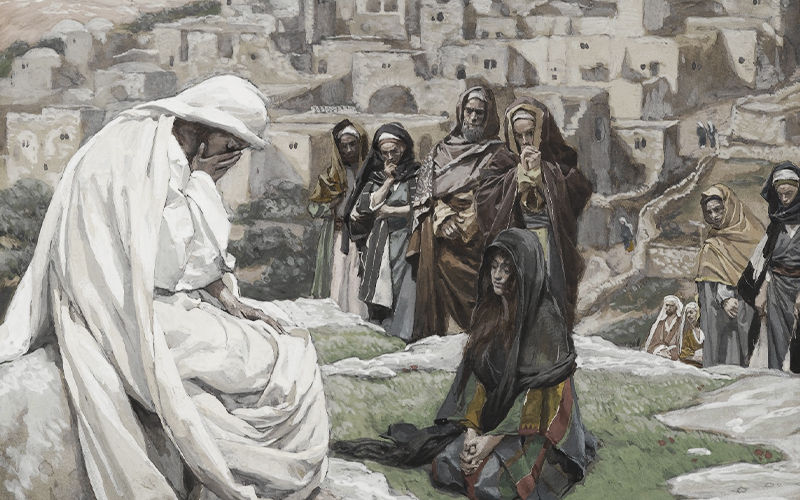
The shortest verse in the English Bible contains just two words: “Jesus wept” (John 10:35). Yet there is much to be learned from this brief statement. The context describes Jesus’ response to the death of Lazarus, who was a personal friend of His. Jesus would raise Lazarus from the dead, but an emotional scene preceded this event.
“Therefore, when Mary came where Jesus was, she saw Him, and fell at His feet, saying to Him, ‘Lord, if You had been here, my brother would not have died.’ When Jesus therefore saw her weeping, and the Jews who came with her also weeping, He was deeply moved in spirit and was troubled, and said, ‘Where have you laid him?’ They said to Him, ‘Lord, come and see.’ Jesus wept” (John 11:32-35).
What can we learn from this passage? Let us consider a few points.
Jesus Displayed Emotion
Emotions are part of being human. We have them because we were made “in the image of God” (Genesis 1:27). Jesus displayed emotion on other occasions as well, including compassion (Matthew 20:34) and anger (John 2:13-16). God also displays emotion (Hebrews 3:7-11), so it is not surprising that Jesus would do the same while He was here on the earth.
However, we must learn to control our emotions. Peter warned of the need to be “of sober spirit” because of the threat posed by the devil (1 Peter 5:8). To be sober-minded means we are not allowing ourselves to be controlled by our emotions, even as we display emotions. What does it look like to be controlled by our emotions?
- Sorrow can turn into excessive sorrow. Paul warned the brethren in Corinth that this could lead a penitent brother back into the world: “Sufficient for such a one is this punishment which was inflicted by the majority, so that on the contrary you should rather forgive and comfort him, otherwise such a one might be overwhelmed by excessive sorrow. Wherefore I urge you to reaffirm your love for him” (2 Corinthians 2:6-8). Feeling the guilt of sin can provoke one to turn back to God, but uncontrolled sorrow can lead one to give up on trying to serve the Lord.
- Too much rejoicing can lead to one forgetting God. This is why the wise man said that sorrow is better than laughter: “It is better to go to a house of mourning than to go to a house of feasting, because that is the end of every man, and the living takes it to heart. Sorrow is better than laughter, for when a face is sad a heart may be happy” (Ecclesiastes 7:2-3). There is nothing wrong with rejoicing in the blessings God has given us in this life. Yet an endless pursuit of enjoyment can cause us to forget the seriousness of our responsibility to serve the Lord.
- Anger can lead us to do things we should not do. We may be angry at times, but we must not allow our anger to lead us to sin. Paul wrote, “Be angry, and yet do not sin; do not let the sun go down on your anger” (Ephesians 4:26). While anger may be an appropriate response to certain situations, it is not an emotion we should hold onto indefinitely.
Jesus displayed emotion, but was not controlled by emotions. He wept when He came to the tomb of Lazarus, but He still immediately did what He came to do. Similarly, it is also appropriate for us to display emotions. However, we must keep them under control lest they hinder us from serving the Lord.
God Allows Human Suffering
Jesus received word about Lazarus: “Lord, behold, he whom You love is sick” (John 11:3). When the message was sent, Lazarus was still alive. And not only did Jesus love Lazarus (John 11:3), He also “loved Martha and her sister” (John 11:5), the sisters of Lazarus. So when Jesus delayed “two days longer” after receiving the news (John 11:6), it was not out of a lack of concern for Lazarus or his sisters. Yet He waited two days.
Jesus had the power to heal Lazarus and end his suffering, even though He was not physically present. He had healed others (John 5:5-9; 9:6-7), including the son of a royal official in Capernaum while He was in Cana (John 4:46-50). Yet instead of healing Lazarus, Jesus was going to raise him from the dead (John 11:43-44). There was a specific purpose for handling the situation with Lazarus in this way, which would become clear later.
Human suffering exists throughout the world and is experienced by people of every nation and every generation. The suffering of Lazarus before his death was just one example of this. Why does suffering exist?
We suffer in this life as a consequence of sin. When Adam and Eve sinned in the beginning, they were expelled from the Garden of Eden (Genesis 3:22-24). This meant they would begin to face hardship, sickness, and eventually death because they no longer had access to the tree of life. However, the suffering we experience in life is not a punishment for sin. Notice the discussion between Jesus and His disciples about a man who had been blind from birth:
“As He passed by, He saw a man blind from birth. And His disciples asked Him, ‘Rabbi, who sinned, this man or his parents, that he would be born blind?’ Jesus answered, ‘It was neither that this man sinned, nor his parents; but it was so that the works of God might be displayed in him’” (John 9:1-3).
Some believed that this man must have sinned because he suffered this fate. Others believed that his parents must have sinned to cause him to be born this way. Jesus said that neither was the case. Suffering exists as a consequence of living in a fallen world; it does not necessarily mean that the sufferer has done anything wrong to bring this upon himself. In fact, suffering can be a way to point people to God. In the case of this man, Jesus said this would be done in a miraculous way when Jesus healed him (John 9:6-7).
This means that we should not act as if God is obligated to respond to our suffering (or the suffering of others) in some specific way. Jesus healed some people during his earthly ministry, but not everyone. He raised Lazarus from the dead, but did not raise everyone who died while He lived on the earth.
God allows human suffering, but not because He is uncaring. Peter said we are to “[cast] all [our] anxiety on Him, because He cares for [us]” (1 Peter 4:6). It is not because he is uninterested in our problems. Paul explained that we are to “be anxious for nothing, but in everything by prayer and supplication with thanksgiving let your requests be made known to God” (Philippians 4:6). It is not because He is unable to respond to our suffering. “Nothing [is] impossible with God” (Luke 1:37). And, as we have already noticed, it is not because the suffering is some punishment for sin (John 9:1-3).
Why Did Jesus Allow Lazarus to Suffer and Die?
People sometimes come up with fanciful speculations about why God allows certain things to happen today. However, we can only know what God has chosen to reveal to us. Paul explained, “For who among men knows the thoughts of a man except the spirit of the man which is in him? Even so the thoughts of God no one knows except the Spirit of God” (1 Corinthians 2:11). However, in the case of Lazarus, we do know the reason why Jesus allowed him to remain sick and then pass away before He came to him. After hearing the news about Lazarus, Jesus told His disciples, “This sickness is not to end in death, but for the glory of God, so that the Son of God may be glorified by it” (John 11:4).
Jesus was to prove Himself to be “the resurrection and the life” (John 11:25). He told Martha that her brother would rise again (John 11:23-26), and this would happen by His power.
However, Jesus needed to convince those who came with Him to the tomb that He was “the resurrection and the life.” After the stone was removed from the tomb at Jesus’ instruction, He prayed to the Father:
“Father, I thank You that You have heard Me. I knew that You always hear Me; but because of the people standing around I said it, so that they may believe that You sent Me” (John 11:41-42).
Jesus was “one” with the Father (John 10:30). By raising Lazarus from the dead after calling out to the Father, Jesus proved that He was the Son of God and had the ability to raise people from the dead.
However, this was not just for the benefit of those who were present. He also proved Himself to everyone who heard about Him raising Lazarus from the dead. Notice what happened following this event:
“But some of them went to the Pharisees and told them the things which Jesus had done. Therefore the chief priests and the Pharisees convened a council, and were saying, ‘What are we doing? For this man is performing many signs. If we let Him go on like this, all men will believe in Him, and the Romans will come and take away both our place and our nation’” (John 11:46-48).
Even the enemies of Jesus could not deny what happened. Eye-witness testimony is especially important for us since we were not there in the first century. After Jesus was raised from the dead, Thomas doubted the report from the other apostles that they had seen the Lord. After Jesus appeared to him and Thomas declared Him to be “my Lord and my God,” Jesus said, “Because you have seen Me, have you believed? Blessed are they who did not see, and yet believed” (John 20:28-29). John then added, “Therefore many other signs Jesus also performed in the presence of the disciples, which are not written in this book; but these have been written so that you may believe that Jesus is the Christ, the Son of God; and that believing you may have life in His name” (John 20:30-31). The suffering, death, and resurrection of Lazarus – as well as the suffering, death, and resurrection of Jesus Himself – prove that Jesus has power over death and can provide hope for us beyond this life.
Conclusion
“Jesus wept.” He had compassion for others and sympathized with them. At the same time, He has the power to end all suffering and death. Yet He will not do that in this life. Instead, He will do it in the next life. As John wrote, “And He will wipe away every tear from their eyes; and there will no longer be any death; there will no longer be any mourning, or crying, or pain; the first things have passed away” (Revelation 21:4).
Jesus is “the resurrection and the life” (John 11:25). No matter what suffering we endure in this life, we have hope in Him if we will faithfully submit to Him. Paul wrote, “Or do you not know that all of us who have been baptized into Christ Jesus have been baptized into His death? Therefore we have been buried with Him through baptism into death, so that as Christ was raised from the dead through the glory of the Father, so we too might walk in newness of life. For if we have become united with Him in the likeness of His death, certainly we shall also be in the likeness of His resurrection” (Romans 6:3-5). Just as Jesus died and was raised from the dead, we have hope of eternal life if we are baptized and give our lives over to Him.