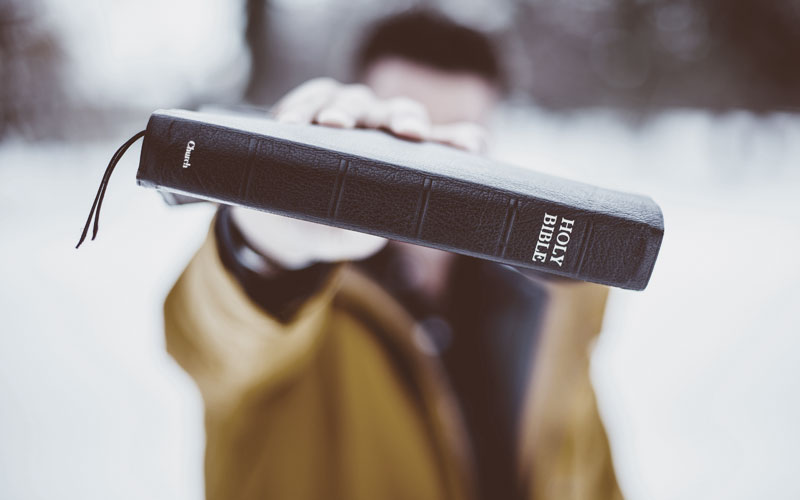
When one scans the religious landscape, particularly the segment of religious people who claim to be Christians, it does not take long to see a broad range of doctrines, beliefs, and practices. How is it that people that claim to follow Christ can believe and teach things that are not only different from each other, but completely contradictory to one another? The answer lies in how we use God’s divine standard.
The standard that God has given us is His word. It contains the truth (Psalm 119:160; John 17:17). His word is the standard that will judge us in the last day (John 12:48). Therefore, if we want to please the Lord, we must follow His word (John 14:15; Psalm 119:11).
“To the law and to the testimony!” (Isaiah 8:20). These words must be our attitude. Do the things we believe, teach, and practice harmonize with the word of God? When a question arises, our first response must be to consult God’s word.
- What type of music should be used in the assembly? “To the law and to the testimony!” We are told to be “speaking to one another in psalms and hymns and spiritual songs, singing and making melody with your heart to the Lord” (Ephesians 5:19).
- When should we partake of the Lord’s Supper? “To the law and to the testimony!” “On the first day of the week” was when the disciples “gathered together to break bread” (Acts 20:7).
- What organization are Christians to work through to evangelize the lost and edify the saved? “To the law and to the testimony!” The local church is “the pillar and support of the church” (1 Timothy 3:15).
These are just a few examples. Many more could be added to the list.
In Isaiah’s day, as in ours, not everyone had this attitude of respect for God’s word. Notice the context surrounding the phase quoted above: “When they say to you, ‘Consult the mediums and the spiritists who whisper and mutter,’ should not a people consult their God? Should they consult the dead on behalf of the living? To the law and to the testimony! If they do not speak according to this word, it is because they have no dawn” (Isaiah 8:19-20).
God, through the prophet, spoke of those who looked to sources other than God’s word for instruction and guidance. He then asked, “Should not a people consult their God?” Why would we go anywhere else than the word God has given us? We do not need to consult the mediums or spiritists – or in our day, the creeds, opinions, and wisdom of men.
The Bible plainly teaches us certain things. We must believe, teach, and practice those things. We are to speak “as one who is speaking the utterances of God” (1 Peter 4:11). The things that we do “in word or deed” must be done “in the name of the Lord Jesus” (Colossians 3:17). Are the things we do backed by God’s authority? The only way we can know is to go “to the law and to the testimony.” We can only know what pleases God based on what He has revealed to us (1 Corinthians 2:10-13), not what others have told us (Galatians 1:8) or what seems good to us (Proverbs 14:12).
The reason why there is so much diversity among professed Christians is because of the lack of importance placed upon doing all things based on the authority of Christ. People assume certain things are good works, rather than going to the Bible to prove them as such. They look to the churches around them, rather than the church discussed in the New Testament. They profess Jesus as Lord, but do not wholly submit to His authority (Matthew 28:18).
Why do many neglect the search for Bible authority, or fail to appeal to the authority of Christ as revealed in the word? Why do many not make the plea: “To the law and to the testimony”? The Lord answers this question: “If they do not speak according to this word, it is because they have no dawn [there is no light in them, KJV]” (Isaiah 8:20). They do not “walk in the Light as He Himself is in the Light” (1 John 1:7).
Really, this is how we distinguish a truth teacher from a false teacher – whether or not a direct appeal is made to Scripture for everything we say and do. John wrote, “We are from God; he who knows God listens to us; he who is not from God does not listen to us. By this we know the spirit of truth and the spirit of error” (1 John 4:6). Those who teach and practice the things revealed in God’s word by His inspired men are of the truth. Those who teach and practice things contrary to what has been revealed are in error.
As we examine ourselves, and as we teach others, we must make this plea that was articulated under the Old Law, and reiterated in the New. “To the law and to the testimony!” “What does the Scripture say” (Romans 4:3; Galatians 4:30)? Do not appeal to the creeds and traditions of men. We need to have book, chapter, and verse!
This article is one of the fifty articles included in the book Plain Bible Teaching: The First Ten Years. Click on the link to read more about the book.