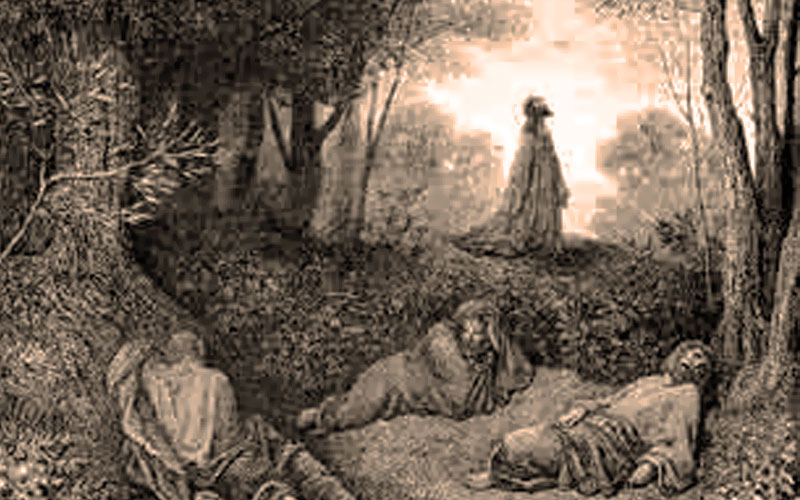
Shortly before His arrest, trials, beatings, and crucifixion, Jesus spent time in the Garden of Gethsemane praying to the Father. Some interpret this prayer in such a way as to try and show that Jesus was praying that He might escape death. They say that this was a moment of weakness for Jesus and describe Him as being in dread of the cross. They depict Jesus (perhaps unwittingly) as if He were some miserable coward. Can such an interpretation be correct?
Notice Matthew’s account of the Lord’s prayer:
“Then Jesus came with them to a place called Gethsemane, and said to His disciples, ‘Sit here while I go over there to pray.’ And He took with Him Peter and the two sons of Zebedee, and began to be grieved and distressed. Then He said to them, ‘My soul is deeply grieved, to the point of death; remain here and keep watch with Me.’ And He went a little beyond them, and fell on His face and prayed, saying, ‘My Father, if it is possible, let this cup pass from Me; yet not as I will, but as You will.’ […] He went away again a second time and prayed, saying, ‘My Father, if this cannot pass away unless I drink it, Your will be done” (Matthew 26:36-39, 42).
After reading of His prayer, let us seek to answer this question: Did Jesus wish to avoid the cross?
His Purpose
Jesus’ purpose in coming to earth was to die on the cross. This was God’s plan from before the beginning of time (1 Peter 1:18-20; Acts 2:22-23). It was prophesied about in the Old Testament (Genesis 3:15; Psalm 22:14-18; Isaiah 53:4-6). All of the Old Testament pointed to this event.
Jesus foretold of His death Himself. “From that time Jesus began to show His disciples that He must go to Jerusalem, and suffer many things from the elders and chief priests and scribes, and be killed, and raised up on the third day” (Matthew 16:21; cf. 17:12). He even spoke of His suffering and death right before this prayer. “I have earnestly desired to eat this Passover with you before I suffer; for I say to you, I shall never again eat it until it is fulfilled in the kingdom of God” (Luke 22:15-16). When instituting the Lord’s Supper, He said, “This is My body which is given for you,” and, “This cup which is poured out for you is the new covenant in My blood” (Luke 22:19-20). He said, “The Son of Man is going as it has been determined” (Luke 22:22). What had been determined was that Jesus would be “nailed to a cross by the hands of godless men and put…to death” (Acts 2:23).
Jesus knew His mission. He knew the whole purpose for coming to the earth. Nothing He faced was unexpected. It was already predetermined. This was what had to be done.
Jesus’ Will vs. the Father’s Will
Jesus, in His prayer, seemed to make a distinction between His will and His Father’s will: “My Father, if it is possible, let this cup pass from Me; yet not as I will, but as You will” (Matthew 26:39). Some try to use this to show that Jesus did not really want to die on the cross. They say it was not His will to do so, but He went through with it because that was what His Father wanted.
However, Jesus often spoke of the harmony between Himself and the Father – harmony we should expect since they were both part of the Godhead. “And He who sent Me is with Me; He has not left Me alone, for I always do the things that are pleasing to Him” (John 8:29). “I and the Father are one” (John 10:30). John’s account of another prayer of Jesus before His death includes this statement: “That they may all be one; even as You, Father, are in Me and I in You, that they also may be in Us, so that the world may believe that You sent Me” (John 17:21). These passages show Jesus as being perpetually in agreement and fellowship with the Father.
We could ask the question: When Jesus carried out the Father’s will, was it a willing obedience or a forced obedience? We know that God expects a willing obedience from us. We are to “serve Him with a whole heart and a willing mind” (1 Chronicles 28:9). For example, in our giving, “Each one must do just as he has purposed in his heart, not grudgingly or under compulsion, for God loves a cheerful giver” (2 Corinthians 9:7). God does not force us to do anything. He expects us to willingly obey Him.
Peter told us that Jesus is our perfect example (1 Peter 2:21) and emphasized His example in His death to make his point (1 Peter 2:24). In His death, Jesus showed us a perfect example, not an imperfect one. God demands willing obedience – obedience that is “from the heart” (Romans 6:17). Yet there are those who say that Jesus, in His death, did not display a willing obedience, but a compelled (forced) obedience. David wrote, “Willingly I will sacrifice to You” (Psalm 54:6). Is David a better example for us than Jesus? Who is willing to say this?
Jesus Himself testified to the suffering and death He would endure (Matthew 16:21; John 12:32-33). This was determined before the foundation of the world (Acts 2:23; Revelation 13:8). Jesus knew why He was coming to earth and what He would have to endure. He suffered and died willingly (John 10:17-18). So why does He make a distinction between His will and the Father’s will? We will answer that in the next point.
What Was the Cup?
Jesus prayed, “My Father, if it is possible, let this cup pass from Me; yet not as I will, but as You will” (Matthew 26:39). What was the cup that Jesus wanted to have passed from Him? Some believe the cup refers to the cross. Therefore, they suppose that Jesus wanted to escape the cross.
The answer is in the context. Notice Mark’s account: “And He went a little beyond them, and fell to the ground and began to pray that if it were possible, the hour might pass Him by. And He was saying, ‘Abba! Father! All things are possible for You; remove this cup from Me” (Mark 14:35). What did Jesus ask the Father to remove? Not the cross, but that hour. He was not asking to abort His mission, but for help to complete His mission.
Jesus was not praying to be delivered from the cross. He was praying to be delivered through the cross. He earlier said, “Now My soul has become troubled; and what shall I say, ‘Father, save Me from this hour? But for this purpose I came to this hour” (John 12:27). Jesus said He would not, could not, ask the Father to keep Him from dying on the cross. Did He change His mind (cf. Hebrews 13:8)? Do His words mean nothing?
Jesus was not going to work some miracle to help Himself. He was relying completely on the Father (cf. Philippians 2:5-8). So He prayed three times that the cup might be removed (Matthew 26:44). The Hebrew writer said that Jesus “was heard because of His piety” (Hebrews 5:7). When he said Jesus was heard, he meant more than just that the Father acknowledged His prayer. He meant His prayer was answered. When Jesus called on the Father to raise Lazarus from the dead, He knew Lazarus would be raised. How did He know that? He “knew that You [the Father] always hear Me [Jesus]” (John 11:42). Just as the Father heard Christ and Lazarus was raised from the dead, so also did the Father hear Christ and let the cup pass.
The context surrounding the Lord’s prayer also indicates that Jesus’ prayer was answered. What would have happened if Jesus was praying to avoid the cross? He would not have gone to the cross! That was Jesus’ point to Peter when he tried to defend the Lord from being arrested: “Or do you think that I cannot appeal to My Father, and He will at once put at My disposal more than twelve legions of angels?” (Matthew 26:53). If Jesus prayed for the cross to be removed, this would have been the result. But it was not. Instead, “an angel from heaven appeared to Him, strengthening Him” (Luke 22:43). Jesus was praying for the physical strength needed to complete His task.
We know Jesus was physically exhausted and fatigued (Matthew 26:41; 27:32). He was able to help Himself miraculously, but would not. Instead, He put His trust in the Father and relied on His help (Hebrews 2:13-14), which He received (Luke 22:43). Jesus was praying for the Father’s help that He might have the physical strength to complete His mission.
Who Is the Lord that We Serve?
Those who believe Jesus was desiring to escape the cross essentially make Him out to be:
- A hypocrite – Earlier, Jesus told His disciples “that He must go to Jerusalem, and suffer many things from the elders and chief priests and scribes, and be killed, and be raised up on the third day” (Matthew 16:21). Jesus knew this was coming and that it was something He must do. Peter rebuked the Lord, saying it would not happen. Jesus in turn said, “Get behind Me, Satan! You are a stumbling block to Me; for you are not setting your mind on God’s interests, but man’s” (Matthew 16:22-23). When the mob came to arrest Jesus and Peter tried to defend Him, Jesus told him, “Put the sword into the sheath; the cup which the Father has given Me, shall I not drink it?” (John 18:11). If Jesus wanted to escape the cross, then He hypocritically rebuked Peter for wanting Jesus to escape the cross.
- One with no conviction – Jesus rebuked Peter (Matthew 16:22-23), then allegedly took the same attitude that Peter had. This would indicate a lack of conviction. We could then call Jesus “double-minded…unstable in all His ways” (James 1:8), rather than “the same yesterday and today and forever” (Hebrews 13:8).
- One who desired to rebel against the will of God – It was the Father’s will for Jesus to die on the cross. Jesus was “delivered over by the predetermined plan and foreknowledge of God” (Acts 2:23). Yet there are many who believe that Jesus, at the end, wanted to rebel against the will of God and not do the very thing He was sent to do.
- One who cared more for His physical life than our spiritual lives – We are redeemed by “precious blood, as of a lamb unblemished and spotless, the blood of Christ” (1 Peter 1:19). If Jesus did not shed His blood in His death, there would be no redemption, no forgiveness (Ephesians 1:7), and no salvation (Romans 5:8-9). The depiction that many give implies that in the garden, Jesus would have rather avoided death and allowed us to be eternally damned than for Him to go to the cross.
- The Creator who feared His own creation – Jesus is credited as being instrumental in creation (John 1:3; Colossians 1:16). And yet the all-powerful Creator turns into a miserable coward at the thought of being delivered into the hands of the ones He created.
That is not the Lord that I serve! Jesus came to earth and willingly died on the cross to save us from our sins. Our responsibility to Him now is willing obedience (Hebrews 5:9).
This article is one of the fifty articles included in the book Plain Bible Teaching: The First Ten Years. Click on the link to read more about the book.











Amen! This is a very important subject. As you pointed out, misunderstanding the prayer in the garden can warp our understanding of Christ’s very character. Great job!
Thanks, Devin!