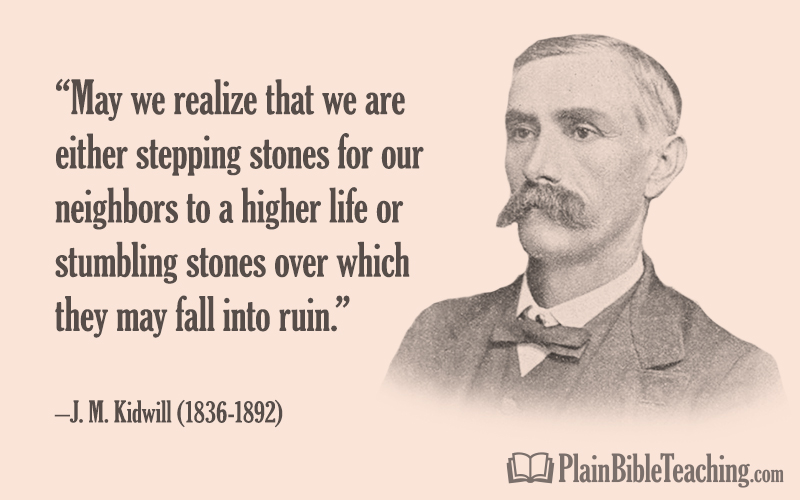
 J. M. Kidwill (1836-1892) spent twenty-five years preaching the gospel in Middle Tennessee. During his travels through the area, he came to Dixon Springs in Smith County. When he arrived, there was no church there, but he “saw a door opened to the truth at Dixon Springs, and he went in” (Twenty-Five Years of Trust, p. 76). Through Kidwill’s efforts, a congregation was established there, and the church maintained a close relationship with the preacher.
In a letter to one of the sisters in Dixon Springs (Sister Rose), Kidwill spoke of the opportunity for the members of that congregation to spread the gospel in that area, while also warning about what could hinder their efforts.
“I hope that you will have at no distant day a goodly number of devoted Christians at Dixon Springs, who will not only contend for the Bible in opposition to all humanisms, but who will practice what they preach. I want Bro. Rose’s ear while I say that much, very much, depends on the few members that we have in your vicinity. The Savior compares the influence of example in his disciples to leaven in meal until all is leavened. May we realize that we are either stepping stones for our neighbors to a higher life or stumbling stones over which they may fall into ruin.” (Twenty-Five Years of Trust, p. 79)
As Kidwill pointed out, the success of a congregation’s efforts to spread the gospel will depend on their contending for the Bible. Jude admonished Christians to “contend earnestly for the faith which was once for all handed down to the saints” (Jude 3). The church in Thessalonica was commended because “the word of the Lord has sounded forth from [them]” to the surrounding areas and beyond (1 Thessalonians 1:8). If we are to help turn people to Christ, we must proclaim the gospel and hold forth the word of truth.
However, Kidwill recognized that any efforts to do so could be undermined by the behavior of the Christians in that place. Not only did they need to courageously spread the gospel, but they also needed to “practice what they preach.”
In his letter to the saints in Rome, Paul described what happens when God’s people fail to live up to His standard:
“You, therefore, who teach another, do you not teach yourself? You who preach that one shall not steal, do you steal? You who say that one should not commit adultery, do you commit adultery? You who abhor idols, do you rob temples? You who boast in the Law, through your breaking the Law, do you dishonor God? For ‘the name of God is blasphemed among the Gentiles because of you,’ just as it is written” (Romans 2:21-24).
To blaspheme God is to speak evil of Him. Paul explained that some unbelievers might speak evil of God, not because He did anything wrong – after all, He is perfect (Matthew 5:48) – but because they saw the wicked behavior of God’s people and blamed Him for that. Would they be right to blaspheme God? Obviously not! However, the sinful actions of God’s people were seen by these unbelievers as justification to reject God.
This is why Kidwill said that we are “either stepping stones for our neighbors…or stumbling stones over which they may fall into ruin.” We can either lead people to God or push them away from Him, and this can be done while also trying to teach the gospel.
It is essential that we live our lives in such a way that helps draw people closer to God rather than driving them away. Yes, some will be driven away by the teachings of Christ, no matter how we act (cf. John 6:60, 66); but we need to give people the opportunity to reject the gospel themselves, not behave in a way that leads them to refuse to consider the gospel because of how we acted around them. Instead, we need to live in such a way that could help draw people to the Lord.
“Let your light shine before men in such a way that they may see your good works, and glorify your Father who is in heaven” (Matthew 5:16).
“Keep your behavior excellent among the Gentiles, so that in the thing in which they slander you as evildoers, they may because of your good deeds, as they observe them, glorify God in the day of visitation” (1 Peter 2:12).
We have an opportunity to lead people to the truth by the way we live our lives. As they see us living in harmony with the will of God, we will find more open doors to teach them the gospel.
While we go through our daily lives, we can either be “stepping stones,” helping to lead people to Christ through our example of faith, or “stumbling stones” that hinder those around us from finding the way that leads to eternal life. Will we be an influence for good?










