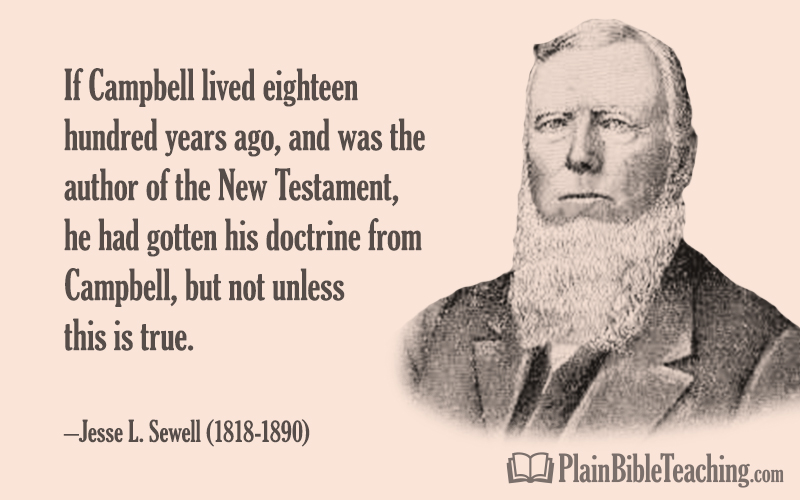
 Jesse L. Sewell (1818-1890) was a Tennessee preacher who sincerely wanted to please God and to proclaim what he found to be taught in the Bible. Eventually, he became connected with the Restoration Movement. It was common for these preachers to begin their work within the denominations before breaking away to follow the New Testament as their only rule of faith and practice. Sewell followed this course, having his start among the Baptists.
However, his Baptist brethren took exception to his preaching, and he was tried for heresy in December 1842. The charge against him was that he had “run fully into Campbellism” (The Life and Sermons of Jesse L. Sewell, p. 54), a label pejoratively given to those who allegedly followed the teachings of Alexander Campbell (1788-1866), a prominent figure in the Restoration Movement. Peter Ragan, a visiting preacher, offered this definition of “Campbellism”: “It denied faith, repentance and the influence of the Spirit, and made a God of the water” (ibid., p. 54). Sewell dismissed the allegation against him.
“If Campbell lived eighteen hundred years ago, and was the author of the New Testament, he had gotten his doctrine from Campbell, but not unless this is true” (ibid., p. 54).
The biographer added that Sewell indicated that he “did not remember ever to have read a page of Campbell’s writings in his life. He got his doctrine exclusively from the New Testament” (ibid., p. 54). Sewell may have agreed with Campbell, but that did not mean he was following Campbell’s teachings. Those are two very different things.
Today, we occasionally hear religious people charge us with being “Campbellites,” which carries with it the same negative connotation as “Campbellism.” However, whether we agree or disagree with Alexander Campbell is irrelevant. What matters is what the New Testament teaches. This is why Sewell said the only way it could be said that he got his doctrine from Campbell was if Alexander Campbell had written the New Testament!
The reason why “Campbellism” was denounced for making “a God of the water” was Campbell’s teaching on baptism. Because Sewell taught the same thing, he was charged with teaching “Campbellism.” When we teach what the New Testament says about baptism – that Jesus made it a condition of salvation (Mark 16:16), that it is necessary for forgiveness (Acts 2:38; 22:16), that it puts us into Christ (Romans 6:3; Galatians 3:27), that it saves us (1 Peter 3:21), and so on – some may charge us as being “Campbellites,” but in reality, we are simply teaching what the New Testament teaches.
After a delay, the trial concluded two months later, and the Baptists excluded Sewell from their fellowship. John Garrett, the moderator of their meeting, made the announcement and was asked what should be recorded as the reason why Sewell was put out.
Then the clerk asked how to make the record? To which John Garrett responded, make it “for teaching heresy.” To which Jesse replied, “That would be recording a falsehood, and that they could not make a true record in any other way, than by stating that he was excluded for preaching ‘faith, repentance and baptism, for the remission of sins.’” After some discussion it was agreed the record should be so made, which was done. (ibid. p. 55).
This was important. Condemning someone for “teaching heresy” marks them, but does not explain what they were teaching. After all, many doctrines could potentially be labeled as “heresy.” So Sewell pressed them to write down what he actually taught – “faith, repentance, and baptism, for the remission of sins.” This was the same message that Jesus commissioned His apostles to preach (Matthew 28:19; Mark 16:16; Luke 24:47), and the same message that began to be preached on the day of Pentecost (Acts 2:36-38).
This teaches us a lesson about how to address accusations of teaching error. Rather than letting someone label us with a generic term like “heretic” or misrepresent us with a prejudicial name like “Campbellite,” we should, when possible, have them explain specifically what we teach that they disagree with. This will make future opportunities to study the Scriptures with them (or with someone else) more likely and potentially more productive if such studies happen. Instead of allowing them to frame the disagreement in a way that forces us to deny that we have “made a God of the water,” we want an open discussion in which we can positively affirm “faith, repentance, and baptism, for the remission of sins.”
While we may not face a formal trial for preaching “heresy,” we will face opposition for our teaching. Let us make sure we are getting our doctrine from the New Testament, not from any man. And let us call for clarity in any discussions on spiritual matters so that those who are honest will be able to do what the Bereans did and search the Scriptures to determine whether what they have heard is the truth (Acts 17:11).