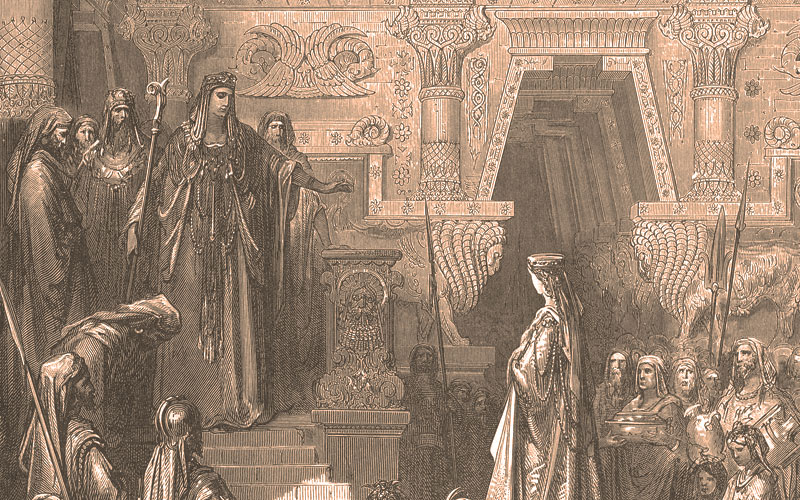
The Fall of King Solomon

Solomon and the Queen of Sheba

When the Queen of Sheba visited Solomon, she wanted to find out for herself if the reports of his greatness and wisdom were true. As she discovered, they certainly were.

Then she said to the king, ‘It was a true report which I heard in my own land about your words and your wisdom. Nevertheless I did not believe the reports, until I came and my eyes had seen it. And behold, the half was not told me. You exceed in wisdom and prosperity the report which I heard. How blessed are your men, how blessed are these your servants who stand before you continually and hear your wisdom. Blessed be the Lord your God who delighted in you to set you on the throne of Israel; because the Lord loved Israel forever, therefore He made you king, to do justice and righteousness” (1 Kings 10:6-9).

It is interesting that she recognizes a fundamental principle that applies to all civil governments. They are in place to “do justice and righteousness.” Solomon recognized this as well.Continue Reading


Making Sin a Trivial Thing (6/26)

Thought from today’s Bible reading from 1 Kings 15:25-16:34; 2 Chronicles 17.

Now Ahab the son of Omri became king over Israel in the thirty-eighth year of Asa king of Judah, and Ahab the son of Omri reigned over Israel in Samaria twenty-two years. Ahab son of Omri did evil in the sight of the Lord more than all who were before him.

It came about, as though it had been a trivial thing for him to walk in the sins of Jeroboam the son of Nebat, that he married Jezebel the daughter of Ethbaal king of the Sidonians, and went to serve Baal and worshiped him. So he erected an altar for Baal in the house of Baal which he built in Samaria. Ahab also made the Asherah. Thus Ahab did more to provoke the Lord God of Israel than all the kings of Israel who were before him” (1 Kings 16:29-33).

Ahab is one of the more infamous kings in the Bible. The text says he provoked the Lord more than the kings who came before him (quite a feat in itself) and that sin had become trivial.
Continue Reading

Defeating a Million Man Army (6/25)

Thought from today’s Bible reading from 1 Kings 15:1-24; 2 Chronicles 13-16.

After Asa became king of Judah, he faced a formidable foe: Zerah the Ethiopian with his million man army.

Now Asa had an army of 300,000 from Judah, bearing large shields and spears, and 280,000 from Benjamin, bearing shields and wielding bows; all of them were valiant warriors. Now Zerah the Ethiopian came out against them with an army of a million men and 300 chariots, and he came to Mareshah. So Asa went out to meet him, and they drew up in battle formation in the valley of Zephathah at Mareshah. Then Asa called to the Lord his God and said, ‘Lord, there is no one besides You to help in the battle between the powerful and those who have no strength; so help us, O Lord our God, for we trust in You, and in Your name have come against this multitude. O Lord, You are our God; let not man prevail against You.’ So the Lord routed the Ethiopians before Asa and before Judah, and the Ethiopians fled” (2 Chronicles 14:8-12).

Asa’s army was not insignificant, but it was greatly outnumbered against the Ethiopians. He placed his trust in the Lord and the Lord delivered him.
Continue Reading

The Difference Between Serving God and the Kingdoms of Men (6/24)

Thought from today’s Bible reading from 2 Chronicles 10-12.

When Rehoboam and the people “forsook the law of the Lord” (2 Chronicles 12:1), Shishak king of Egypt came to fight against him. Shemaiah the prophet revealed God’s judgment to Rehoboam: “You have forsaken Me, so I also have forsaken you to Shishak” (2 Chronicles 12:5). At this revelation, the king and his princes humbled themselves and repented, but there would still be consequences to suffer.

When the Lord saw that they humbled themselves, the word of the Lord came to Shemaiah, saying, ‘They have humbled themselves so I will not destroy them, but I will grant them some measure of deliverance, and My wrath shall not be poured our on Jerusalem by means of Shishak. But they will become his slaves so that they may learn the difference between My service and the service of the kingdoms of the countries’” (2 Chronicles 12:7-8).

As king, it would be easy for Rehoboam to be unable to relate to the plight of his people under an oppressive ruler. Rehoboam’s oppression of the people was the reason why the kingdom was divided and many left from serving him (2 Chronicles 10). But now, under the oppression of Shishak, he would learn what it is like to live under an oppressive king.
Continue Reading

The Lying Prophet (6/23)

Thought from today’s Bible reading from 1 Kings 12-14.

A young prophet who revealed a divine message to King Jeroboam refused to stay with the king and receive a reward from him. He explained why:

If you were to give me half your house I would not go with you, nor would I eat bread or drink water in this place. For so it was commanded me by the word of the Lord, saying, ‘You shall eat no bread, nor drink water, nor return by the way which you came’” (1 Kings 13:8-9).

This man knew what God instructed and was intent upon obeying Him. His determination was commendable. But unfortunately for this man, there was more to this story.
Continue Reading

"It Is Not for Kings to Drink Wine" (6/22)

Thought from today’s Bible reading from Proverbs 30-31.

It is not for kings, O Lemuel, it is not for kings to drink wine, or for rulers to desire strong drink, for they will drink and forget what is decreed, and pervert the rights of all the afflicted.

Give strong drink to him who is perishing, and wine to him whose life is bitter. Let him drink and forget his poverty and remember his trouble no more” (Proverbs 31:4-7).

There are at least four points to be made from the instructions given to Lemuel.
Continue Reading

Rising Number of Stay-At-Home Dads: What Does the Bible Say About This?

Stay-at-home dad

A recent study has shown that the number of “stay-at-home dads” has doubled in the last decade.

While we might expect the poor economy and layoffs among men to be a factor, many of these men who are staying at home to be the primary care-giver for the children are doing so as the result of a mutual decision made by both parents. The article cited above states: “But according to the results of a new study by Boston College, the rise may be due more to choices and evolving gender roles of parents” (emphasis mine).

In this arrangement, the wife is the one who leaves the home for the workplace and the husband either quits his job or chooses not to look for a job so he can stay home with the kids. As this becomes more common, it is important for Christians to be reminded about what the Bible has to say that relates to this issue.
Continue Reading








