
Hedges to Help Protect Us from Sin

Hedges

When Satan came before the Lord, God praised Job for his righteousness: “Have you considered My servant Job? For there is no one like him on the earth, a blameless and upright man, fearing God and turning away from evil” (Job 1:8). Satan, however, protested. In his mind, he believed that God was unfairly protecting Job from temptation: “Does Job fear God for nothing? Have You not made a hedge about him and his house and all that he has, on every side?” (Job 1:10). This “hedge” of divine blessing made Job less susceptible to temptation.

Of course, when God granted permission for this “hedge” to be removed, Job remained faithful (Job 1:22; 2:10). But the fact that Job had to work harder to resist the temptation to forsake God cannot be denied. Temptation was more severe when the “hedge” protecting Job was taken away.

As we make application to our lives, we should understand that we can have certain hedges to help protect us from sin. God has promised a way of escape so that every temptation can be defeated (1 Corinthians 10:13). The more hedges we have in place, the better we will be able to overcome temptation.

The only infallible safeguard against temptation is the word of God. The wise man wrote, “Every word of God is tested; He is a shield to those who take refuge in Him” (Proverbs 30:5). However, there are other hedges that we can put in place to help guard against temptation. We will consider a few of these in this article. We should understand that none of these safeguards are infallible, but they can greatly help if we use them properly.
Continue Reading

Making Sin a Trivial Thing (6/26)

Thought from today’s Bible reading from 1 Kings 15:25-16:34; 2 Chronicles 17.

Now Ahab the son of Omri became king over Israel in the thirty-eighth year of Asa king of Judah, and Ahab the son of Omri reigned over Israel in Samaria twenty-two years. Ahab son of Omri did evil in the sight of the Lord more than all who were before him.

It came about, as though it had been a trivial thing for him to walk in the sins of Jeroboam the son of Nebat, that he married Jezebel the daughter of Ethbaal king of the Sidonians, and went to serve Baal and worshiped him. So he erected an altar for Baal in the house of Baal which he built in Samaria. Ahab also made the Asherah. Thus Ahab did more to provoke the Lord God of Israel than all the kings of Israel who were before him” (1 Kings 16:29-33).

Ahab is one of the more infamous kings in the Bible. The text says he provoked the Lord more than the kings who came before him (quite a feat in itself) and that sin had become trivial.
Continue Reading

Making Sacrifices

Burnt Offering

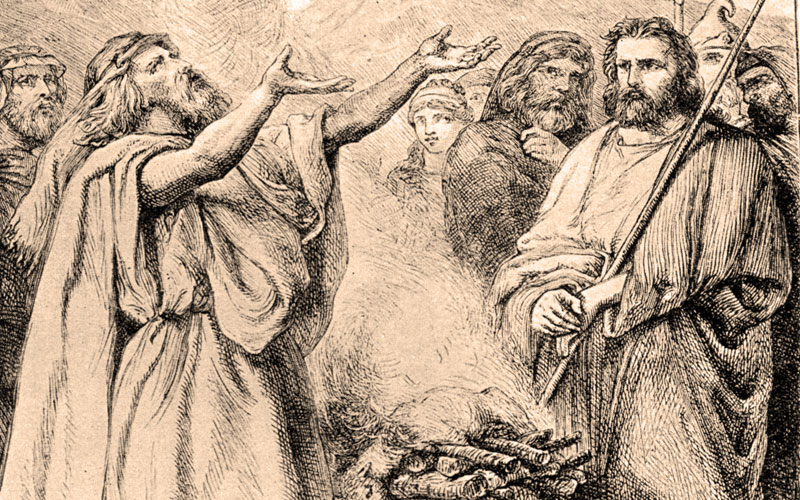
The Bible has much to say about sacrifices. Animal sacrifices were practiced throughout the Old Testament. The sacrifice of Jesus is part of the foundation of the gospel (1 Corinthians 15:3-4). We are told to sacrifice our lives for Him: “Therefore I urge you, brethren, by the mercies of God, to present your bodies a living and holy sacrifice, acceptable to God, which is your spiritual service” (Romans 12:1). Let us consider what the Bible has to say about the sacrifices we are to make.
Continue Reading

Training Our Senses

Bible study

In Hebrews 5, the writer began a discussion in which he compared Jesus Christ with the high priest Melchizedek. He broke from this discussion in verse 11 before picking it up again in chapter 7. The reason for this interlude was because there was “much to say, and it is hard to explain, since you have become dull of hearing.” So the writer had to pause to reinforce some more basic truths before finishing this discussion. By this point, these Christians should have been mature and able to consider such a discussion about Melchizedek; yet they were not. The mature are those who have trained their senses (Hebrews 5:14).

What is meant by the term senses? This is the part of us that can perceive or judge right and wrong. We might call this our conscience. The writer said that our senses – or our conscience – should be trained in such a way that it can “discern good and evil” (Hebrews 5:14). We are striving to develop an inherent – almost subconscious – sense of right and wrong. This passage shows how we can train our senses in this way.
Continue Reading