What Is Your Congregation Known For?

Silhouette of a Preacher

Local churches are made up of Christians working together for the cause of Christ. However, not every congregation will be judged favorably by the Lord. When the Lord addressed the seven churches of Asia, two of them were commended for their faithfulness – Smyrna (Revelation 2:8-11) and Philadelphia (Revelation 3:7-13). The rest were in danger of having their “lampstand” removed (Revelation 2:5), which was a symbol of the Lord’s approval. He knew that they did not measure up to His standard. Though they may have had “a name that [they were] alive,” He knew if they were “dead” (Revelation 3:1).

A congregation develops a reputation based upon what they do. However, this reputation does not always match the Lord’s judgment of His people in that place.

On different occasions, I have heard brethren comment that the church should be known more for what it is for than what it is against. Generally, those who make comments like this have introduced doctrines or practices into the local church (or would like to do so) and do not want to respond to challenges from other brethren about whether such teachings are in harmony with the Scriptures or their proposed practices are authorized by God’s word. So they attempt to turn the tables against those who raise questions about doctrinal correctness and Scriptural authority, exempting themselves from having to defend what they say and do.Continue Reading


Cassius’ Weapons of Choice

Cassius' Weapons of Choice

Samuel Robert Cassius (1853-1931) was born into slavery in Virginia and lived in Washington, D.C., during the Civil War. As an adult, he moved to Indiana, where he heard the “Restoration plea” and obeyed the gospel. He spent most of his life living, working, and preaching in Oklahoma.

In the book To Save My Race from Abuse, Cassius’ biographer described his preparation for a debate with a Primitive Baptist in which Cassius was to affirm “that the Church of Christ, of which I am member, is apostolic in faith, doctrine and practice” (To Save My Race from Abuse, p. 41). Unfortunately, his opponent backed out, and the debate never happened. In the following quote, Cassius adapted the imagery of the armor of God (cf. Ephesians 6:10-17) to describe his readiness to defend the truth in debate.

“I carried two large solid rocks—one in each hand. In my right hand I had the four Gospels, in my left the Acts of the Apostles, and belted about my waist I had all of the pistols of Paul, James and Peter, and between my teeth I carried the sword of the Spirit.” (ibid. p. 41)

Continue Reading

The Church of the Chaldeans

Tigris and Euphrates Rivers

When we study “church” history, we are limited to what has been recorded in the past and preserved until the present. Because of this, there are religious groups from various times and places that we know little or nothing about. I recently learned about one of these groups while browsing Barton W. Stone’s journal, The Christian Messenger. An excerpt titled, A Christian Church among the Arabs, Turks & Persians, described a “Christian Church” in the Middle East.

“On the shores of the River Tigris, there exists a Christian Church, the members of which call themselves Chaldeans, and trace their origin to the time of the Apostles. It is supposed that they number 500,000 souls. But little is known of these people. The Papists attempted to make an impression on them some years ago, but failed, and that because of the Bible, of which they had many manuscript copies. Since it has been discovered that these Bible Christians have no printing establishments among them, and no books, the British & Foreign Bible Society, are making arrangements to provide them with printed copies of the Bible.” (Excerpt from The Christian Messenger, Volume 2)

The quote above was published in 1827. This “Christian Church” in the area of the Tigris River called themselves Chaldeans, numbered half a million people, and claimed to trace their origin to the apostles in the first century.Continue Reading

The Time When They Will No Longer Endure Sound Doctrine

Megachurch

As Paul began to close his second letter to Timothy, he “solemnly” charged him (2 Timothy 4:1) to carry out his work as a preacher. He told the young evangelist, “Preach the word; be ready in season and out of season; reprove, rebuke, exhort, with great patience and instruction” (2 Timothy 4:2).

Timothy was not at liberty to teach any message that he or others might prefer. He was to proclaim the word of God, just as Paul and the other apostles taught (2 Timothy 1:13). He was not to deviate from this message in any way – just as we must not alter the message (cf. Galatians 1:8-9; Revelation 22:18-19). The charge for him to “be ready in season and out of season” to preach this pure, unadulterated message of the gospel required a willingness to proclaim it even if it was unpopular, inconvenient, and difficult for people to accept.

However, since the message of the gospel is sometimes unpopular, inconvenient, and difficult for people to accept, many turn away from it. Sadly, this even happens among Christians and in local churches. Paul warned Timothy that he would encounter this:

For the time will come when they will not endure sound doctrine; but wanting to have their ears tickled, they will accumulate for themselves teachers in accordance to their own desires, and will turn away their ears from the truth and will turn aside to myths” (2 Timothy 4:3-4).

Continue Reading

Dangers on the Safe Side (Part 1): Avoiding Controversy

Dangers on the Safe Side

For many Christians, controversy is undesirable. Debates, which were common in the nineteenth and early twentieth centuries, are rare today. In some ways, this is understandable. As our society has become more polarized and heated debates can erupt over issues that seem to be largely insignificant, it is tempting to want to stay “on the safe side” and avoid anything controversial (we do not want to “rock the boat”) so we can continue to get along with our brethren. However, there are dangers that come with avoiding controversy on spiritual issues.

Consider the example of the apostle Peter (also called Cephas):Continue Reading

Why People Do Not Receive Jesus

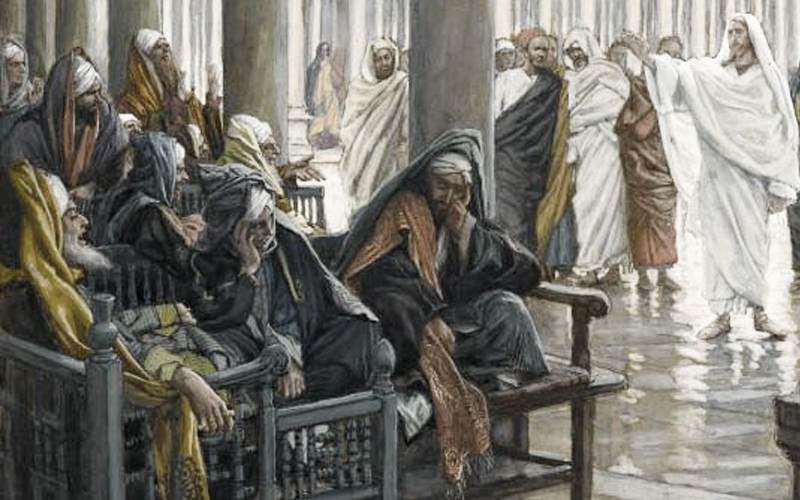
Scribes and Pharisees

He came to His own, and those who were His own did not receive Him. But as many as received Him, to them He gave the right to become children of God, even to those who believe in His name” (John 1:11-12).

When Jesus came and preached to the Jews, many “did not receive Him.” What does this mean?

Some today might explain this as receiving Jesus as their Savior and inviting Him into their heart. Certainly, we must see Jesus as our Savior; however, this is about more than that. This is about receiving Jesus as the Son of God and obeying Him as Lord. John said, “He who believes in the Son has eternal life; but he who does not obey the Son will not see life, but the wrath of God abides on him” (John 3:36). To believe in the Son is to accept that Jesus is the Son of God. To obey the Son is to recognize Him as Lord – the one with the right to rule over us and expect us to do His will.

In his gospel account, John recorded certain events in Jesus’ life. The purpose of this record was to produce faith in us (John 20:30-31). Yet today, many are like “His own” who “did not receive Him.” Why? People today will often reject Jesus for the same reasons that people did during His time on earth. We will not be considering an exhaustive list of the reasons why people refuse to accept Jesus, but will notice some of the reasons recorded for us in the gospel of John.Continue Reading

How to Silence False Teachers

Man with duct tape over mouth

When Paul wrote to Titus about the qualifications for elders, one of the requirements for these men was that they have an ability to deal with false teachers.

Holding fast the faithful word which is in accordance with the teaching, so that he will be able both to exhort in sound doctrine and to refute those who contradict. For there are many rebellious men, empty talkers and deceivers, especially those of the circumcision, who must be silenced because they are upsetting whole families, teaching things they should not teach for the sake of sordid gain” (Titus 1:9-11).

Paul said these false teachers “must be silenced.” But how would this be done? No one expects the elders of a local church to kidnap a false teacher, put duct tape over his mouth, tie him up, and then lock him in a closet to prevent him from spreading his error. Since they cannot use physical force to silence false teachers, how are they to do it?Continue Reading