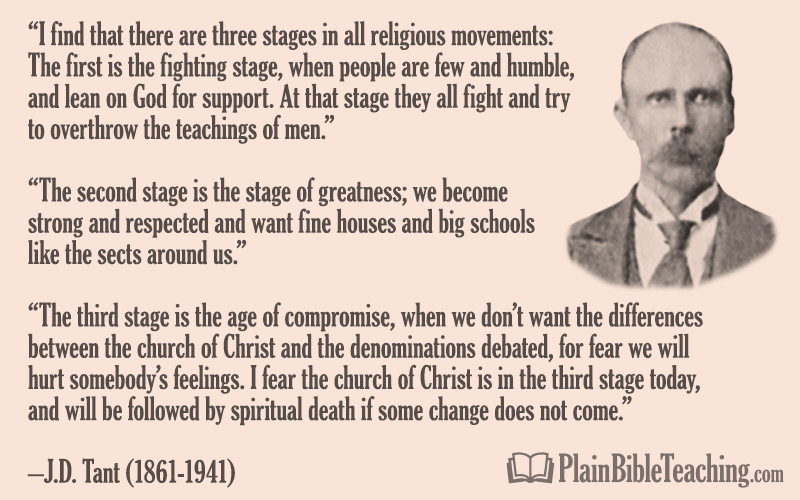
J.D. Tant (1861-1941) worked tirelessly to preach the gospel throughout his life and was never one to back down or compromise his convictions. However, he eventually began to realize that his brethren were not nearly as willing to stand as firmly as he was. Almost a century ago, he wrote the following observations in the Gospel Advocate, January 5, 1928:
“I find that there are three stages in all religious movements: The first is the fighting stage, when people are few and humble, and lean on God for support. At that stage they all fight and try to overthrow the teachings of men, as the Jews did as recorded in Deut. 7.
“The second stage is the stage of greatness; we become strong and respected and want fine houses and big schools like the sects around us. The Jews reached that stage when they rejected God and wanted a king, to be like other people.
“The third stage is the age of compromise, when we don’t want the differences between the church of Christ and the denominations debated, for fear we will hurt somebody’s feelings. I fear the church of Christ is in the third stage today, and will be followed by spiritual death if some change does not come.” (J.D. Tant: Texas Preacher, p. 413)
When we study the history of the Restoration Movement, we can see what Tant described in these paragraphs. As people started to leave the churches of men in order to simply follow the New Testament, they were very zealous in their efforts to preach the gospel and defend the truth.
Eventually as their numbers (and resources) grew, they began to build bigger and fancier buildings for their churches and put more emphasis and investments into their institutions (missionary societies, schools, etc.). Whenever this happens, aside from questions about whether such things are Scriptural or not, there is a temptation to do almost anything to maintain and grow these institutions. This naturally requires people to be involved and money to be invested. Because brethren value the institutions they have created, they tend to do whatever they need to do to keep the most people happy in order to secure the personnel and finances needed to continue. This inevitably leads to compromise.Continue Reading
 “Brother W. M. McIntyre has done more preaching and baptizing than any other preacher in the county, and is hated by all the denominations, and is never called upon to help in their union meetings. This causes me to think he is a man of God, sound in the faith” (Published in Gospel Advocate, April 29, 1897; Quoted from J. D. Tant – Texas Preacher, p. 177-178).