The Troubler of Israel (6/27)

Thought from today’s Bible reading from 1 Kings 17-19.

Prior to his showdown with the prophets of Baal on Mount Carmel, Elijah met with King Ahab. Ahab was quick to blame Elijah for the troubles that plagued the nation.

When Ahab saw Elijah, Ahab said to him, ‘Is this you, you troubler of Israel?’ He said, ‘I have not troubled Israel, but you and your father’s house have, because you have forsaken the commandments of the Lord and you have followed the Baals’” (1 Kings 18:17-18).

Ahab wanted to place the blame for Israel’s problems on the one who prophesied the truth. Elijah correctly turned the charge around on Ahab, declaring that the king had troubled the nation by rejecting the Lord and embracing a false god.
Continue Reading

The Fall of King Solomon

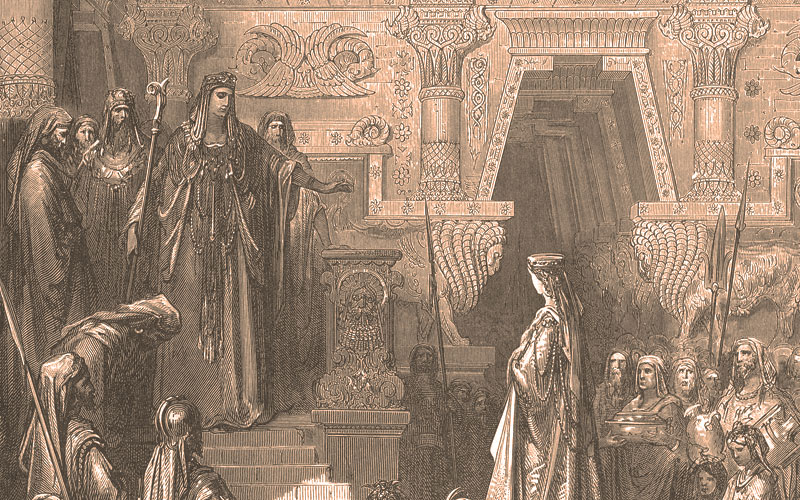
Solomon and the Queen of Sheba

When the Queen of Sheba visited Solomon, she wanted to find out for herself if the reports of his greatness and wisdom were true. As she discovered, they certainly were.

Then she said to the king, ‘It was a true report which I heard in my own land about your words and your wisdom. Nevertheless I did not believe the reports, until I came and my eyes had seen it. And behold, the half was not told me. You exceed in wisdom and prosperity the report which I heard. How blessed are your men, how blessed are these your servants who stand before you continually and hear your wisdom. Blessed be the Lord your God who delighted in you to set you on the throne of Israel; because the Lord loved Israel forever, therefore He made you king, to do justice and righteousness” (1 Kings 10:6-9).

It is interesting that she recognizes a fundamental principle that applies to all civil governments. They are in place to “do justice and righteousness.” Solomon recognized this as well.Continue Reading

Making Sin a Trivial Thing (6/26)

Thought from today’s Bible reading from 1 Kings 15:25-16:34; 2 Chronicles 17.

Now Ahab the son of Omri became king over Israel in the thirty-eighth year of Asa king of Judah, and Ahab the son of Omri reigned over Israel in Samaria twenty-two years. Ahab son of Omri did evil in the sight of the Lord more than all who were before him.

It came about, as though it had been a trivial thing for him to walk in the sins of Jeroboam the son of Nebat, that he married Jezebel the daughter of Ethbaal king of the Sidonians, and went to serve Baal and worshiped him. So he erected an altar for Baal in the house of Baal which he built in Samaria. Ahab also made the Asherah. Thus Ahab did more to provoke the Lord God of Israel than all the kings of Israel who were before him” (1 Kings 16:29-33).

Ahab is one of the more infamous kings in the Bible. The text says he provoked the Lord more than the kings who came before him (quite a feat in itself) and that sin had become trivial.
Continue Reading

"It Is Not for Kings to Drink Wine" (6/22)

Thought from today’s Bible reading from Proverbs 30-31.

It is not for kings, O Lemuel, it is not for kings to drink wine, or for rulers to desire strong drink, for they will drink and forget what is decreed, and pervert the rights of all the afflicted.

Give strong drink to him who is perishing, and wine to him whose life is bitter. Let him drink and forget his poverty and remember his trouble no more” (Proverbs 31:4-7).

There are at least four points to be made from the instructions given to Lemuel.
Continue Reading

Consider Your Steps (6/7)

Thought from today’s Bible reading from Proverbs 13-15.

The naive believes everything, but the sensible man considers his steps.

A wise man is cautious and turns away from evil, but a fool is arrogant and careless” (Proverbs 14:15-16).

The wise and sensible man is compared to two different types of people: the naive and the fool. Both of these people end up in sin. The fool acts arrogantly, rejects the truth, and follows after that which is evil. The naive is simply ignorant of the truth and, as a result, ends up believing a false way that on the surface seems to be right. Where the naive and the fool are the same is that neither one is careful to be sure that what he does is right.
Continue Reading

Different Responses to Correction (6/5)

Thought from today’s Bible reading from Proverbs 7-9.

There will be times in which we need to correct someone who has fallen into sin. There will also be times in which we must be corrected for some sin we have committed. But unfortunately, not all correction is received as it ought to be. Consider the words of the wise man:

He who corrects a scoffer gets dishonor for himself, and he who reproves a wicked men gets insults for himself. Do not reprove a scoffer, or he will hate you, reprove a wise man and he will love you. Give instruction to a wise man and he will be still wiser, teach a righteous man and he will increase his learning” (Proverbs 9:7-9).

Solomon mentions two ways in which correction might be received:
Continue Reading

One Who Commits Adultery Lacks Sense (6/4)

Thought from today’s Bible reading from Proverbs 4-6.

Can a man take fire in his bosom and his clothes not be burned? Or can a man walk on hot coals and his feet not be scorched? So is the one who goes in to his neighbor’s wife; whoever touches her will not go unpunished” (Proverbs 6:27-29).

This is one of several passages in the book of Proverbs that warns against adultery. The number of times it is addressed should make us realize how dangerous this sin is. Besides that, we all know of cases of a person, often one we would not expect, who has gotten caught up in this sin.

The world will tell us it is alright to look and lust as long as we do not commit adultery. The Scriptures teach us not even to look and lust because this leads to adultery (cf. Matthew 5:28; James 1:14-16).
Continue Reading