He Broke in Pieces the Bronze Serpent (7/19)

Thought from today’s Bible reading from 2 Kings 18:1-8; 2 Chronicles 29-31; Psalm 48.

Hezekiah was one of the righteous kings of Judah. He did something interesting as he attempted to purge the land of sin.

He did right in the sight of the Lord, according to all that his father David had done. He removed the high places and broke down the sacred pillars and cut down the Asherah. He also broke in pieces the bronze serpent that Moses had made, for until those days the sons of Israel burned incense to it; and it was called Nehushtan.

He trusted in the Lord, the God of Israel; so that after him there was none like him among all the kings of Judah, nor among those who were before him. For he clung to the Lord; he did not depart from following Him, but kept His commandments, which the Lord had commanded Moses” (2 Kings 18:3-6).

Continue Reading

“These Who Have Turned the World Upside Down”

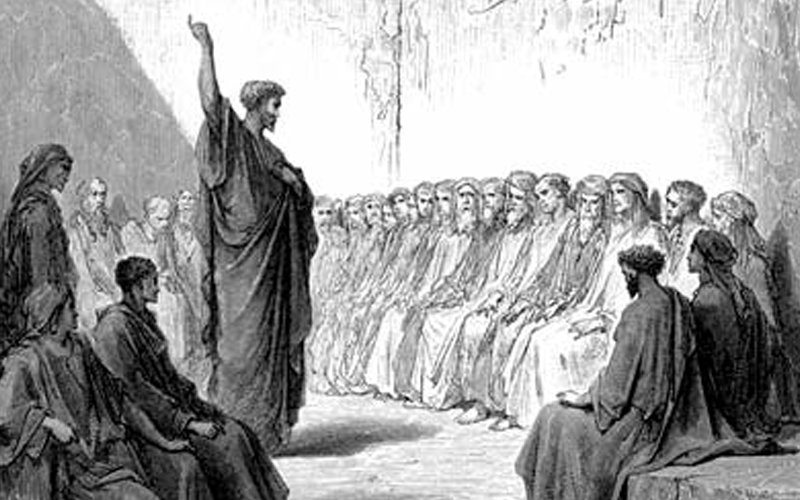
Paul preaching in Thessalonica

After just a few weeks of Paul preaching in Thessalonica, the gospel had been received by some of the Jews and “a large number of the God-fearing Greeks and a number of the leading women” (Acts 17:1-4). In an effort to try to silence this message, the Jews intended to capture Paul and Silas. When they could not find them, they took Jason and some of the brethren and brought them before the authorities in order to accuse them.

When they did not find them, they began dragging Jason and some brethren before the city authorities, shouting, ‘These men who have upset the world have come here also; and Jason has welcomed them, and they all act contrary to the decrees of Caesar, saying that there is another king, Jesus’” (Acts 17:6-7).

Continue Reading

Why Did Israel Fall? (7/15)

Thought from today’s Bible reading from 2 Chronicles 28; 2 Kings 16-17.

In the ninth year of Hoshea, the king of Assyria captured Samaria and carried Israel away into exile to Assyria, and settled them in Halah and Habor, on the river of Gozan, and in the cities of the Medes” (2 Kings 17:6).

After a long period of trouble and instability in Israel, the people were finally taken away from their homeland, the land that God had promised their fathers, and relocated by force to Assyria. Why would God bring this upon them? The text goes on to list the reasons why they were punished in this way.
Continue Reading

"Woe to Those Who Are at Ease in Zion" (7/12)

Thought from today’s Bible reading from Amos 6-9.

Woe to those who are at ease in Zion and to those who feel secure in the mountain of Samaria, the distinguished men of the foremost of nations, to whom the house of Israel comes” (Amos 6:1).

God was sending a message through the prophet Amos of the coming judgment against Israel. Yet these people were oblivious to the danger. They had other matters to focus on besides divine punishment for sin.
Continue Reading

Appalling and Horrible and the People Love It So!

At the time when Jeremiah prophesied, God was preparing to send Judah into Babylonian captivity in order to punish them for their sins (Jeremiah 1:14-16). But it was not just the common people that had devolved into a state of spiritual corruption. The prophets and priests were involved as well.

An appalling and horrible thing has happened in the land: The prophets prophesy falsely, and the priests rule on their own authority; and My people love it so!” (Jeremiah 5:30-31).

The inhabitants of Judah had learned to tolerate and celebrate sin. “Where they ashamed because of the abomination they have done? They were not even ashamed at all; they did not even know how to blush” (Jeremiah 6:15). The prophets spoke lies and the priests followed their own rule. “For from the least of them even to the greatest of them, everyone is greedy for gain, and from the prophet even to the priest everyone deals falsely. They have healed the brokenness of My people superficially, saying ‘Peace, peace,’ but there is no peace” (Jeremiah 6:13-14). Yet even as judgment was planned because of these things, God invited His people to repent and turn back to Him.
Continue Reading

Let Us Reason Together (7/9)

Thought from today’s Bible reading from Isaiah 1-4.

At the time when Isaiah prophesied, the people of Judah had become so sinful and corrupt that God would not even accept their sacrifices or hear their prayers (Isaiah 1:2-4, 10-15). Yet God was willing to offer them a chance at reconciliation. So He extended an invitation to them.

‘Come now, and let us reason together,’ says the Lord, ‘though your sins are as scarlet, they will be as white as snow; though they are red like crimson, they will be like wool. If you consent and obey, you will eat the best of the land; but if you refuse and rebel, you will be devoured by the sword.’ Truly, the mouth of the Lord has spoken” (Isaiah 1:18-20).

The invitation began with God calling the people to “reason together” with Him. He wanted them to understand their current state, His offer, and the conditions attached to that offer.
Continue Reading

"Each Shall Be Put to Death for His Own Sin" (7/6)

Thought from today’s Bible reading from 2 Kings 14; 2 Chronicles 25.

Amaziah became king of Judah after his father, Joash, was killed. When an appropriate time came, he punished those who were guilty of killing his father.

Now it came about, as soon as the kingdom was firmly in his hand, that he killed his servants who had slain the king his father. But the sons of the slayers he did not put to death, according to what is written in the book of the Law of Moses, as the Lord commanded, saying, ‘The fathers shall not be put to death for the sons, nor the sons be put to death for the fathers; but each shall be put to death for his own sin” (2 Kings 14:5-6).

Amaziah could have reacted emotionally, rather than according to the Law. It would have been easy to do so since it was his father that had been killed. But rather than overreact and kill the children of the guilty men, he killed only those who were guilty. This was in keeping with the law (Deuteronomy 24:16).
Continue Reading