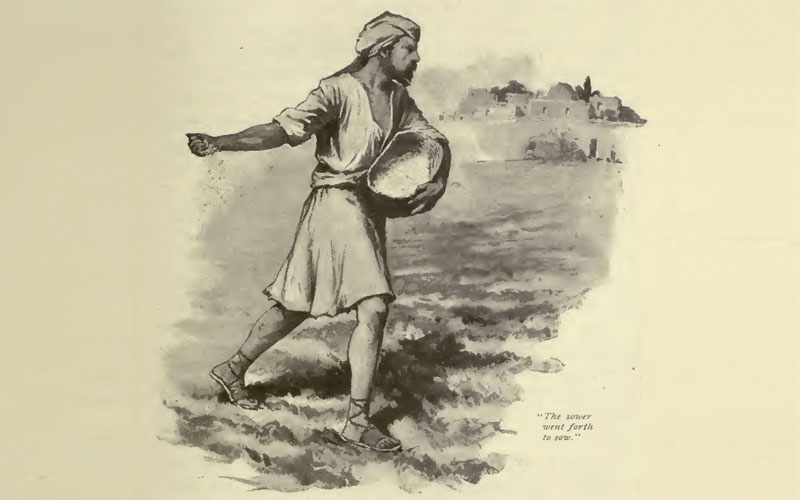
The parable of the sower is one of the more familiar parables spoken by Jesus. In it, He taught an important lesson about the type of message that is required in order to produce fruit.
“‘The sower went out to sow his seed; and as he sowed, some fell beside the road, and it was trampled under foot and the birds of the air ate it up. Other seed fell on rocky soil, and as soon as it grew up, it withered away, because it had no moisture. Other seed fell among the thorns; and the thorns grew up with it and choked it out. Other seed fell into the good soil, and grew up, and produced a crop a hundred times as great.’ As He said these things, He would call out, ‘He who has ears to hear, let him hear’” (Luke 8:5-8).
Jesus spoke of four different outcomes from the sowing. Each type of soil produced a different result. But there was one constant – the seed. The same seed was sown by the roadside, on the rocky soil, among the thorns, and in the good soil.
As Jesus went on to explain, “The seed is the word of God” (Luke 8:11). The four soils represented four different types of hearts that might come in contact with the gospel message (Luke 8:12-15) – those who are uninterested (the roadside), those who have only a shallow faith (the rocky soil), those who are worldly minded (the thorny ground), and those with good and honest hearts (the good soil) (Luke 8:12-15). The sowing produced different results in each case, but the seed – the message of the word of God – remained constant.
Notice that Jesus never implied that the message should be altered or supplemented in an attempt to attract those who are uninterested. Nowhere did He teach that the gospel should be changed to make it more palatable to those who want only enough religion to soothe their consciences. And He certainly did not suggest revising His teaching in order to appeal to those who have their mind set on worldly things. Rather, His conclusion is simply this: “He who has ears to hear, let him hear” (Luke 8:8).
The Scriptures warn of the sad reality that not all will be interested in the truth (2 Timothy 4:3-4; 2 Thessalonians 2:10). Yet our responsibility to “preach the word” (2 Timothy 4:2) and to do so accurately (1 Peter 4:11), in its entirety (Acts 20:27), and with all authority (Titus 2:15) remains unchanged.
Sure, we could “convert” more people if we preached the more popular, watered-down gospel message that is so common today. But if we change the seed, how can we hope to produce the same fruit? Paul told the Corinthians, “For Christ did not send me to baptize, but to preach the gospel” (1 Corinthians 1:17). Paul’s point was certainly not that baptism has no connection with the gospel (Mark 16:15-16) or that baptism is unnecessary for salvation (1 Peter 3:21). Rather, he said that his mission was primarily to preach, not to produce results. He later wrote, “I planted, Apollos watered, but God was causing the growth” (1 Corinthians 3:6).
Let us avoid the temptation to change the pure and simple message of the gospel in an attempt to reach and then retain more people. If we sow the seed, it will produce fruit in those who have good and honest hearts (Luke 8:14). We must be content with the seed that God has provided and the fruit it produces.











Andy, you are doing a great job with this site, in teaching the gospel. I thank you for your love for our Lord, and my prayer is that he will bless your efforts to the fullest.
Carlos Raymer
Thanks, I appreciate the support.
Thank you so much for the teaching of the sower, i teach a wednesday night class and this will be so helpful!thank you and may God continue to bless you!