Trampled at the Gate (7/3)

Thought from today’s Bible reading from 2 Kings 5-8.

Now it came about after this, that Ben-hadad king of Aram gathered all his army and went up and besieged Samaria. There was a great famine in Samaria; and behold, they besieged it, until a donkey’s head was sold for eighty shekels of silver, and a fourth of a kab of dove’s dung for five shekels of silver” (2 Kings 6:24-25)

Times were desperate in Samaria. With the city under siege, food was scarce, prices were high, and people had even started resorting to cannibalism in order to survive (2 Kings 6:26-29). Elisha prophesied that conditions would soon change.
Continue Reading

The Fall of King Solomon

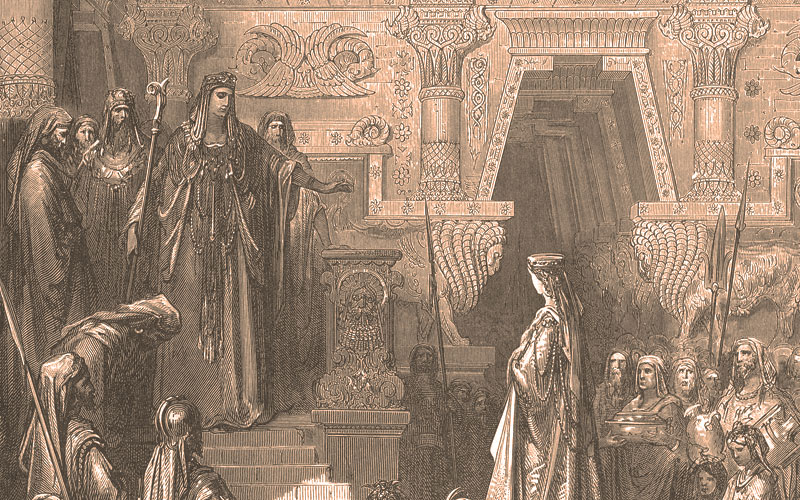
Solomon and the Queen of Sheba

When the Queen of Sheba visited Solomon, she wanted to find out for herself if the reports of his greatness and wisdom were true. As she discovered, they certainly were.

Then she said to the king, ‘It was a true report which I heard in my own land about your words and your wisdom. Nevertheless I did not believe the reports, until I came and my eyes had seen it. And behold, the half was not told me. You exceed in wisdom and prosperity the report which I heard. How blessed are your men, how blessed are these your servants who stand before you continually and hear your wisdom. Blessed be the Lord your God who delighted in you to set you on the throne of Israel; because the Lord loved Israel forever, therefore He made you king, to do justice and righteousness” (1 Kings 10:6-9).

It is interesting that she recognizes a fundamental principle that applies to all civil governments. They are in place to “do justice and righteousness.” Solomon recognized this as well.Continue Reading

Defeating a Million Man Army (6/25)

Thought from today’s Bible reading from 1 Kings 15:1-24; 2 Chronicles 13-16.

After Asa became king of Judah, he faced a formidable foe: Zerah the Ethiopian with his million man army.

Now Asa had an army of 300,000 from Judah, bearing large shields and spears, and 280,000 from Benjamin, bearing shields and wielding bows; all of them were valiant warriors. Now Zerah the Ethiopian came out against them with an army of a million men and 300 chariots, and he came to Mareshah. So Asa went out to meet him, and they drew up in battle formation in the valley of Zephathah at Mareshah. Then Asa called to the Lord his God and said, ‘Lord, there is no one besides You to help in the battle between the powerful and those who have no strength; so help us, O Lord our God, for we trust in You, and in Your name have come against this multitude. O Lord, You are our God; let not man prevail against You.’ So the Lord routed the Ethiopians before Asa and before Judah, and the Ethiopians fled” (2 Chronicles 14:8-12).

Asa’s army was not insignificant, but it was greatly outnumbered against the Ethiopians. He placed his trust in the Lord and the Lord delivered him.
Continue Reading

"They Forsook Their Cities" (4/29)

Thought from today’s Bible reading from 1 Chronicles 7-10.

There is an interesting piece of information that the Scriptures record regarding the events that transpired after the death of Saul.

Thus Saul died with his three sons, and all those of his house died together. When all the men of Israel who were in the valley saw that they had fled, and that Saul and his sons were dead, they forsook their cities and fled; and the Philistines came and lived in them” (1 Chronicles 10:6-7).

Why is it significant that these Israelites “forsook their cities” following the death of Saul? Remember a few points:
Continue Reading

"Dark Sayings of Old" (4/26)

Thought from today’s Bible reading from Psalm 73, 77-78.

Listen, O my people, to my instruction; incline your ears to the words of my mouth. I will open my mouth in a parable; I will utter dark sayings of old, which we have heard and known, and our fathers have told us. We will not conceal them from their children, but tell to the generation to come the praises of the Lord, and His strength and His wondrous works that He has done.

For He established a testimony in Jacob and appointed a law in Israel, which He commanded our fathers that they should teach them to their children, that the generation to come might know, even the children yet to be born, that they may arise and tell them to their children, that they should put their confidence in God and not for get the works of God, but keep His commandments, and not be like their fathers, a stubborn and rebellious generation, a generation that did not prepare its heart and whose spirit was not faithful to God” (Psalm 78:1-8).

The words of God are to be passed down from one generation to another today, just as they were under the Law of Moses when this was written. Below is a list of some of the lessons that need to be taught.
Continue Reading

Why Satan Is More Successful than the Atheists

It seems that atheists have become more militant of late in trying to persuade others to join them in their non-belief of God. While some might be convinced to convert to the atheists’ faith (atheism is most certainly a faith because it is rooted in the belief, not the provable fact, that there is no God), most will reject their teaching. If the goal is to get people to forfeit their chance at salvation, Satan is far more successful than the atheists are.

Why is Satan more successful? He has a more appealing offer than the atheists have. Case in point: I recently read an article about the Atheist Agenda group at a college in Texas. The group set up a table on campus and promised to give free pornography for anyone willing to give up a Bible in exchange. The article noted that this event which started in 2008, attracting lots of attention early on, has barely been noticed this year. The reason is simple: Very few people will surrender their Bibles and embrace atheism (or at least consider it), in exchange for free pornography.

The atheists offer an either/or proposition. You can either have the Bible or you can have pornography You can either believe in God or reject God. Satan is more successful because he does not offer an either/or proposition; he offers a both/and proposition.
Continue Reading

Jesus’ Resurrection: Just an Optical Illusion?

The resurrection of Christ is fundamental to our faith. Paul lists it with the death and burial of Christ as being “of first importance” in the gospel (1 Corinthians 15:3-4). We are “born again to a living hope through the resurrection of Jesus Christ from the dead” (1 Peter 1:3). If the resurrection of Christ did not happen, Paul tells the brethren in Corinth, “Your faith is worthless; you are still in your sins” (1 Corinthians 15:17).

Since the time of Jesus’ resurrection, His opponents have denied that this event happened (Matthew 28:11-13). Opponents of Christ and His truth continue to deny the resurrection today. A new theory about the resurrection has been proposed by Thomas de Wesselow, an art historian. His theory revolves around the Shroud of Turin – the alleged burial cloth that was used to wrap the body of Jesus after His death. He argues that the image on the Shroud “fooled the Apostles” by producing an “optical illusion” that made them believe they were seeing their risen Lord.
Continue Reading