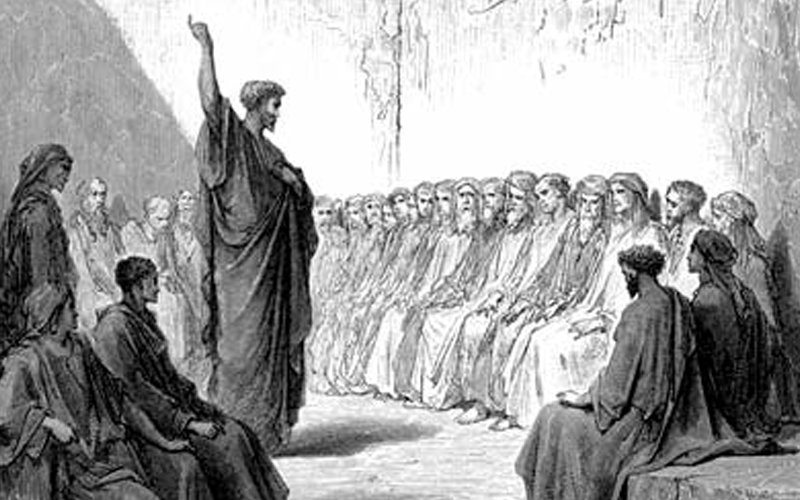
The Application of Wisdom: Work

Notes on Proverbs

When we consider the subject of work, Solomon’s words in Ecclesiastes provide a fitting starting point: “Whatever your hand finds to do, do it with all your might; for there is no activity or planning or knowledge or wisdom in Sheol where you are going” (Ecclesiastes 9:10). Our time here on earth is limited. Therefore, we must work hard in the time that we have. Once our lives here are over, there will be no opportunity to do what we ought to have done during our time under the sun. So the wise man spends a good deal of time in the book of Proverbs discussing the important topic of work.
Continue Reading
J.S. Sweeney: Sprinkling & Pickling

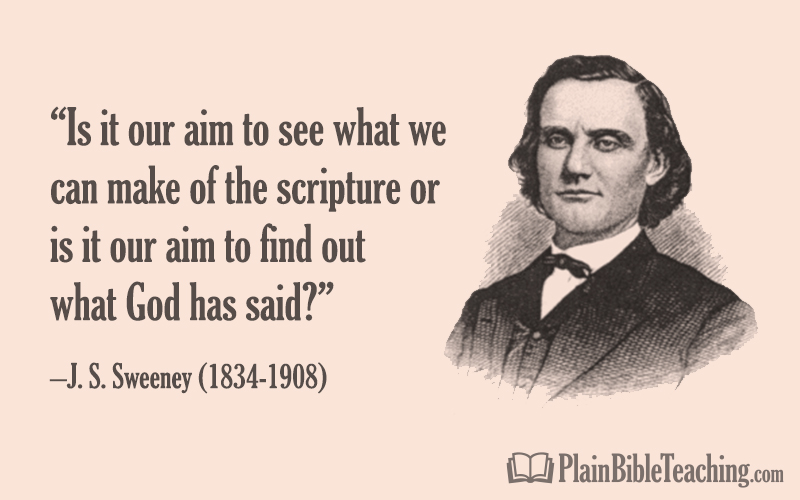
J. S. Sweeney: Our Aim

There is a lot of opposition in the religious world to the Bible’s teaching on baptism. The Greek word baptizo is where we get the English word baptize. It means to immerse. Yet if you look up the definition of baptize in an English dictionary, it will likely include the act of sprinkling along with immersion. Why? It is because sprinkling is commonly accepted in the religious world, and has been for some time.

J.S. Sweeney (1834-1908), a gospel preacher, was debating the Scriptural mode of baptism with a man named Jacob Ditzler. Ditzler tried to make the argument that sprinkling was authorized and used a dictionary to make his point. Sweeney’s humorous yet brilliant response is recounted below:
Continue Reading

Does God Want Us to Be Happy?

Ohio Senator Rob PortmanOhio Senator Rob Portman wrote an editorial that was published on March 15, 2013 in which he announced his change of position on same-sex marriage. Previously, he had been against such “marriages.” Now he believes “the government shouldn’t deny [same-sex couples] the opportunity to get married.”

In the editorial, he explained the reason for his change of heart. Two years ago, one of his sons informed him that he was a homosexual. After learning this, Senator Portman began re-evaluating his stance on same-sex marriage and eventually changed his mind on the issue. He said he is “a dad who wants all three of his kids to lead happy, meaningful lives with the people they love.” Couple that with his statement about “the Bible’s overarching themes of love and compassion and my belief that we are all children of God,” and we see one who has tried to find a way to harmonize – in his own mind – faith in God and man’s desire to be happy.

His statement about wanting all of his children to be happy seems reasonable to a lot of people, even among those who are religious. Many people believe that God would want them to be happy. Therefore, if something like homosexuality makes one happy, they conclude that God must accept it and that we should accept it, too.

So we should ask the question: Does God want us to be happy? In answering this question, we must be sure that our conclusion comes from the Bible and not our emotions.
Continue Reading

The Application of Wisdom: Speech (Part 3)

Notes on Proverbs

As we noticed in the previous section, we should never underestimate the power of words – both good and evil. Understanding how important our speech is, we must be sure that our words reflect wisdom at all times.
Continue Reading

The Application of Wisdom: Speech (Part 2)

Notes on Proverbs

We sometimes hear the saying, “The pen is mightier than the sword.” This concept of words being more powerful than physical force is similar to the idea expressed by Solomon: “Death and life are in the power of the tongue” (18:21). Words are powerful. The wise man shows us the power of both good and evil words.
Continue Reading

“These Were More Noble-Minded”

Paul preaching in Thessalonica

Paul was in Thessalonica for just three weeks when he had to quickly leave the city under the cover of darkness because of the uproar that was caused by his preaching (Acts 17:1-10). When he left, he went to Berea. Undeterred by his experience in Thessalonica, he preached in this new city as well. Luke noted the significant reaction of the Bereans:

Now these were more noble-minded than those in Thessalonica, for they received the word with great eagerness, examining the Scriptures daily to see whether these things were so” (Acts 17:11).

Luke compared the Thessalonians and the Bereans in their reaction to the gospel. The Bereans were “more noble-minded” in that they “received the word with great eagerness.” This does not mean that everyone in Thessalonica rejected the gospel – some were persuaded (Acts 17:4). This also does not mean that everyone in Berea accepted the gospel – the Jews of Thessalonica were able to come to Berea and turn “the crowds” against Paul (Acts 17:13). But there is an important difference between the first recipients of the gospel in each city – those in the synagogues (Acts 17:2, 10). Notice what Luke recorded about Paul’s custom in preaching.
Continue Reading

The Application of Wisdom: Speech (Part 1)

Notes on Proverbs

The next area of application has to do with our speech. Exercising wisdom is not just about what we do, but includes those things which we speak.

Excellent speech is not fitting for a fool, much less are lying lips to a prince” (17:7).

Continue Reading